HUB 01 · Adventure & Dual-Sport Helmets
Klim Krios Pro Review
The lightest way to hold genuine US DOT + ECE 22.06 in an adventure helmet — a full-carbon convertible that we rate on published spec and homologation, not a lab test we didn't run.
We earn a commission when you buy through our Amazon links, at no extra cost to you. It never changes a ranking, and we tell you when the cheaper helmet is the better buy. How this works.
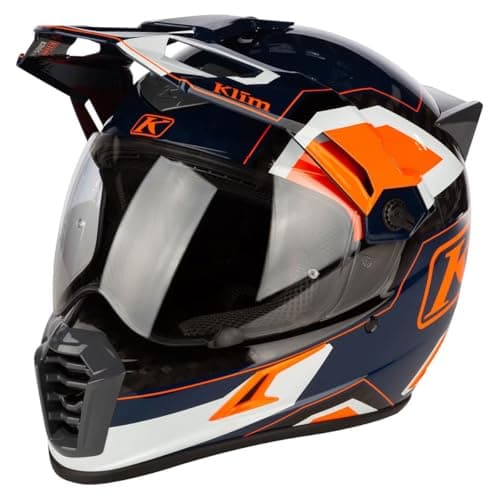
Weight-obsessed ADV riders who want ECE 22.06
The lightest way to hold genuine US DOT + ECE 22.06 — a full-carbon convertible that goes from ADV to street to dirt.
Price as of October 21, 2026. Prices change — Amazon's at checkout is the one that counts.
#ad · we may earn a commission from this link to Klim Krios Pro
Most of the adventure-helmet conversation is about peaks and goggles. The Krios Pro earns its place at the top of our ranking on a quieter point: it is one of the few ADV helmets whose US-market version carries genuine DOT + ECE 22.06, and it does so in a full-carbon shell that weighs about 1,450 g in a size large. Klim publishes the homologation, which is why we can state it plainly rather than hedge.
We have not crash-tested this helmet — nobody honest reviewing helmets at this scale has — so what follows is compiled from Klim's published specification, the ECE 22.06 standard it's homologated to, and aggregated owner reports. Where a number is Klim's claim, we say so.
Why the certification matters here
ECE 22.06 is the current global gold standard: independently type-tested, with a rotational (oblique) impact test that older standards lack, plus testing of the peak and visor as fitted. On an adventure helmet — where the peak is a real object in a crash — that fitted-accessory testing is more than a footnote. The Krios Pro carrying 22.06 on the US build puts it ahead of the Arai XD-5 and Shoei Hornet X2, both of which are sold in the US as DOT + Snell rather than ECE 22.06. That is not a knock on Snell, which is a demanding standard in its own right; it's a statement about which failure modes each helmet was tested against. Read our DOT vs ECE vs Snell explainer for the full picture.
Weight you feel at hour six
The carbon shell is the other headline. At ~1,450 g the Krios Pro is dramatically lighter than a polycarbonate ADV lid like the Scorpion EXO-AT960 (~1,860 g). Four hundred grams doesn't sound like much until it's hanging off your neck at highway speed on hour six of a ride day, catching every crosswind through the peak. Owners consistently report the low weight as the single thing they notice most.
Three helmets in one
The Krios Pro converts between full ADV (peak plus visor), a street configuration (visor, no peak) and a goggles-and-peak dirt setup. That versatility is the practical argument for an ADV helmet over a dedicated road or dirt lid, and the Krios Pro does it without the peak buffeting that plagues cheaper designs. The trade-off is quiet: it's calmer with the visor than in full ADV trim, and a dedicated touring modular will always be hushier.
Who should skip it
If you tour long sealed-road days and want the deepest sun-visor shade and plushest quiet, a road-first modular like the Shoei Neotec 3 serves you better. And it's a flagship price — the budget ADV picksget you genuine ECE 22.06 for a third of the money if carbon and weight aren't your priority.
Krios Pro, head to head
If you have shortlisted the Krios Pro against one specific rival, we have those comparisons written out: Krios Pro vs Arai XD-5 (22.06 carbon against the round-oval Snell build), Krios Pro vs Shoei Hornet X2 (carbon ECE against road-biased Snell), Krios Pro vs Scorpion EXO-AT960 (the same certification, 400 g and a lot of money apart) and Bell MX-9 Adventure vs Krios Pro (what flagship money adds over the budget 22.06 pick).
The scorecard
How it scores, and who should skip it
- Certification
- 9.5
- Weight
- 9.5
- Versatility
- 9
- Quiet
- 7.5
- Value
- 7.5
Pros
- Genuine US DOT + ECE 22.06 — the rotational-impact standard, on the US build
- ~1,450 g in a full-carbon shell is class-leading light for a convertible ADV lid
- Peak, visor and goggle configuration all in one helmet
Cons
- Carbon and Koroyd cost money — this is a flagship price
- Quieter with the visor than in full peak-and-goggles ADV mode
Don't buy this if…
…you want the deepest sun-visor sunshade and plushest touring quiet — a road-first modular does that better.
Price as of October 21, 2026. Prices change — Amazon's at checkout is the one that counts.
#ad · we may earn a commission from this link to Klim Krios Pro
How we picked
We do not crash-test helmets
We compiled published specifications, cited each helmet's certification (DOT, ECE 22.06, Snell, SHARP) from the standards body or manufacturer homologation, and aggregated owner reports, then scored against a published method. The scores are judgments from documented research — not measurements we took. We do not run a crash lab. Certifications reflect the US-market build; where it differs from the European version, we say so and cite it.
Questions
Frequently asked
Is the US Klim Krios Pro really ECE 22.06?
How heavy is the Krios Pro?
Can I use goggles with the Krios Pro?
Keep reading
Related
- All adventure helmetsThe full ranked roundup, by certification.
- ECE 22.06 explainedWhat the standard the Krios Pro holds actually tests.
- Best budget ADV helmetsGenuine ECE 22.06 for a third of the price.
- Krios Pro vs AGV AX9The two light carbon ADV flagships, head to head.
- Klim Krios Pro safety ratingGenuine US ECE 22.06 in carbon, explained.
- Bell MX-9 Adventure vs Krios ProWhat the extra $500 over the budget ECE 22.06 pick actually buys.
- Black Friday helmet & gear dealsBuy the Krios Pro now or wait? What has historically been discounted.
Receipts
Sources
We do not run a crash lab, and we do not pretend to. Certifications are cited to the standards body or the manufacturer's stated homologation; where a US model's certification differs from its European namesake, we say so. Where we could not verify something, we say so on the page rather than quietly leaving it out. Read our full method.