HUB 01 · Adventure & Dual-Sport Helmets
Arai XD-5 (Tour-X5) Review
The reference ADV lid for round-oval heads and long days — but read the certification carefully, because the US XD-5 is not the ECE 22.06 Tour-X5 you may have read about.
We earn a commission when you buy through our Amazon links, at no extra cost to you. It never changes a ranking, and we tell you when the cheaper helmet is the better buy. How this works.
Long-haul ADV touring
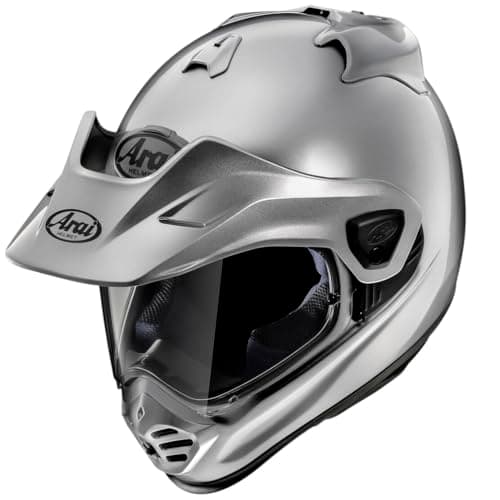
The reference ADV lid for round-oval heads and long days — a Snell build in the US, with a peak that actually behaves at speed.
Price as of October 21, 2026. Prices change — Amazon's at checkout is the one that counts.
#ad · we may earn a commission from this link to Arai XD-5 (Tour-X5)
The Arai XD-5 is one of the best adventure helmets you can buy, and it's also the clearest example of why this site exists. Ride forums are full of praise for the "Arai Tour-X5" and its ECE 22.06 rating — but the helmet Arai sells in the US is the XD-5, and that build is DOT + Snell M2025D, not ECE 22.06. Same helmet family, different name, different homologation. If you buy in the US expecting 22.06, know what's actually on the shell.
None of this makes the XD-5 a lesser helmet. Snell M2025D is an independently-tested standard that favors a stiffer shell built for high-energy, repeat same-site impacts — a different and demanding philosophy from ECE's rotational focus. It's a genuine step above the DOT legal floor. It just answers a different safety question, and you should buy knowing which question that is.
The fit is the reason to buy
Arai's defining trait is its rounder internal shape. If you have a round-oval head — the shape that most Shoei, AGV and HJC helmets pinch at the temples — the XD-5 can be the first helmet that's comfortable for a full day. That fit, plus Arai's famously smooth, continuous shell (designed to glance off rather than catch), is what keeps riders loyal despite the price.
The peak behaves
Older peaked helmets turn into sails at highway speed. The XD-5's peak is engineered to shed wind rather than lift your head, and it's a measurable improvement over the previous XD-4. It still moves more air than a bare full-face, as any peak does, but it no longer fights you on the slab.
Who should skip it
If ECE 22.06 is your deciding factor, the US XD-5 doesn't carry it — buy the Klim Krios Pro(genuine US DOT + ECE 22.06) or import the European Tour-X5 direct. If you have a long-oval head, Arai's round shape will be too tight; and if you want carbon-fiber lightness, the XD-5's composite shell is heavier than a Krios Pro.
XD-5, head to head
Deciding between the XD-5 and one specific alternative? Read Krios Pro vs XD-5 if genuine US ECE 22.06 is on your mind, or AGV AX9 vs Arai XD-5 for the sporty 22.06 carbon alternative against this round-oval Snell build. If head shape is what brought you here, our head-shape guide explains why Arai is the brand to try first.
The scorecard
How it scores, and who should skip it
- Certification
- 8.5
- Fit range
- 9
- Wind/peak
- 8.5
- Weight
- 7.5
- Value
- 7.5
Pros
- Snell M2025D in the US market — a stricter add-on to DOT, not just the legal floor
- Arai's rounder internal shape fits round-oval heads most rivals pinch
- Peak is engineered to shed wind rather than lift your head at highway speed
Cons
- Premium price, and the US version is not the ECE 22.06 you may have read about abroad
- Heavier than a carbon ADV lid like the Krios Pro
Don't buy this if…
…you specifically want ECE 22.06 rotational-test homologation in the US — the US XD-5 is a Snell build; buy the European Tour-X5 direct for 22.06.
Price as of October 21, 2026. Prices change — Amazon's at checkout is the one that counts.
#ad · we may earn a commission from this link to Arai XD-5 (Tour-X5)
How we picked
We do not crash-test helmets
We compiled published specifications, cited each helmet's certification (DOT, ECE 22.06, Snell, SHARP) from the standards body or manufacturer homologation, and aggregated owner reports, then scored against a published method. The scores are judgments from documented research — not measurements we took. We do not run a crash lab. Certifications reflect the US-market build; where it differs from the European version, we say so and cite it.
Questions
Frequently asked
Is the Arai XD-5 the same as the Tour-X5?
Does the Arai XD-5 have ECE 22.06?
Is the XD-5 good for round heads?
Keep reading
Related
- All adventure helmetsThe full ranked roundup, by certification.
- Klim Krios Pro reviewThe genuine US ECE 22.06 alternative.
- DOT vs ECE vs SnellWhat Snell M2025D tests, and how it differs from ECE.
- Arai XD-5 vs Hornet X2The two Snell ADV touring lids, head to head.
- AGV AX9 vs Arai XD-5Sporty ECE 22.06 against the round-oval Snell build.
- Arai XD-5 safety ratingThe US Snell build vs the EU Tour-X5's ECE 22.06 and SHARP.
Receipts
Sources
We do not run a crash lab, and we do not pretend to. Certifications are cited to the standards body or the manufacturer's stated homologation; where a US model's certification differs from its European namesake, we say so. Where we could not verify something, we say so on the page rather than quietly leaving it out. Read our full method.