HUB 04 · Bluetooth & Comms Helmets
Cardo Packtalk Edge Review
The bolt-on Mesh intercom we rank first — and the one whose spec sheet quietly changed this year. Cardo's free Mesh Boost update more than doubled the group size, which is either the headline feature or a footnote depending on who you ride with.
We earn a commission when you buy through our Amazon links, at no extra cost to you. It never changes a ranking, and we tell you when the cheaper helmet is the better buy. How this works.
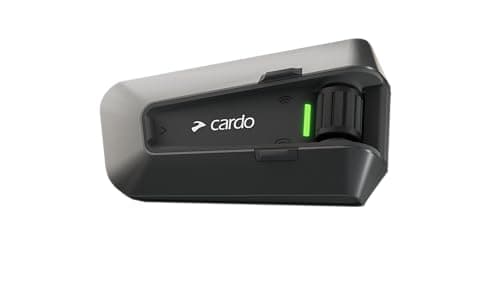
Best bolt-on comms overall
The bolt-on to beat: true dynamic Mesh, JBL 40 mm speakers, IP67 weatherproofing, and it fits the helmet you already own.
$439.9510% off
Price as of October 24, 2026. Prices change — Amazon's at checkout is the one that counts.
#ad · we may earn a commission from this link to Cardo Packtalk Edge
The Packtalk Edge is the bolt-on intercom we rank ahead of everything else, and the reason is not really the audio or the mount. It is that Cardo's Dynamic Mesh Communication behaves like a network rather than a phone call: riders drop out of range and the group re-routes around them, they come back and it stitches them in again, and nobody has to re-pair anything. This year that network got materially bigger, for free, on a unit people already own.
One framing note before the specs, because it is the theme of this site: a comms unit carries no helmet safety rating. The shell you bolt it to does. Nothing on this page changes which helmet you should buy — start with the certification explainerfor that, then pick the comms. We have not lab-tested this unit; everything below is Cardo's published specification or a retailer spec sheet, sourced at the foot of the page.
Mesh Boost: the free update that doubled the group
This is the part most listings have not caught up with. In August 2026 Cardo shipped Mesh Boost, a free over-the-air upgrade that raises the ceiling to "up to 31 riders in a single true DMC group" — more than double the 15 the Edge shipped with. It runs on the supported second-generation DMC units, which Cardo lists as the Packtalk Pro, Edge and Neo, and it arrives through the Cardo Connect app rather than a cable.
Two features came with it that are more useful than the headline number. Public Meshis, in Cardo's words, "a shared always-on DMC conversation space that riders can join instantly without the need to create a specific DMC group" — you can talk to Cardo riders you have never paired with. Remote Grouping lets you build the group in the app before anyone leaves, generate a link or QR code, and invite people to it, which removes the ritual of standing in a parking lot pairing headsets in the cold.
Now the caveat, which is the honest reason we still put a 15 next to a 31. Cardo states that riders on older units "can still participate in mixed groups, although those groups are limited to 15 riders and some advanced Mesh Boost capabilities are not available until everyone upgrades." So the 31-rider figure describes a group where everybody has updated. One un-updated headset in the pack and the ceiling drops back to where it was. If you ride with a big, mixed-vintage group, plan on 15 and treat 31 as the upside.
Range and audio: the numbers that hold up
Cardo publishes up to 1 mile (1.6 km) unit-to-unit and up to 5 miles (8 km) across a full group — the group figure is larger because Mesh relays through the riders in between, which is exactly the behavior a chain of bikes spread down a canyon road needs. It runs Bluetooth 5.2 alongside the Mesh stack for your phone.
Audio is 40 mm "Sound by JBL" speakers, and this is a genuine step up rather than a badge — clearer mids, enough headroom to stay intelligible at highway speed, and Cardo ships speaker booster pads in the box so you can seat them properly against your ear in a deep helmet pocket. There is also FM radio with RDS and six station presets, which is a small thing until you are somewhere with no signal for streaming.
IP67 is the spec that actually separates it
If you compare the Edge against its obvious rival, this is the line that does the most work. The Edge is rated IP67— sealed against dust and temporary immersion, which is a real weatherproofing claim rather than the vague "water resistant" most units settle for — and it is the benchmark to hold up against an undocumented IP67 claim on a cheap unit, as we do in the LEXIN B4FM review. Sena does not publish an IP rating for the 50S at all, so a rider who genuinely commutes through winter is choosing between a stated seal and an unstated one. We take that comparison apart properly in Packtalk Edge vs Sena 50S. Sena's newer bolt-on narrows this point: the Sena 60Sis rated IPX7 — immersion-rated, though not rated for dust the way the Edge's IP67 is.
Living with it
Natural Voice Operationmeans "Hey Cardo" and then a plain instruction — no button hunt with a gloved hand, which is the entire point of voice control on a motorcycle and the thing jog-dial units make you work for. The Air Mount is a patented magnetic mount: the unit snaps on and off the cradle in one motion, so taking it inside to charge is trivial.
Battery is up to 13 hours talk time with about 10 days of standby, over a USB-C port, and the fast-charge figure is the useful one: "2 hours of talk time after 20 minutes of charge" — a coffee stop buys you the rest of the afternoon. Software arrives over the air, with "no cables needed, ever," which is how Mesh Boost reached units that shipped years earlier. Cardo covers it with a three-year warranty.
Where it sits against the Packtalk Pro
Cardo sells a step above this, and pretending otherwise would be dishonest. The Packtalk Pro runs the same second-generation DMC and got the same Mesh Boost update, so on the core communication job the two are level. What the Pro adds is larger 45 mm JBL speakers, crash detection, and auto on/off, at a higher price. If crash detection is something you want, buy the Pro — it is the only one of the two that has it, and it is not a feature we would talk anyone out of. If it is not, the Edge gets you the identical Mesh network and the same IP67 seal for less.
Who should skip it
Three riders, honestly. Solo riders and fixed pairs: Mesh is the expensive part of this unit and plain Bluetooth does a two-up conversation perfectly well, so you are paying for a network you will not build. The Cardo Spirit HD is the two-rider unit we would buy instead. Anyone whose group runs Sena: Mesh does not interoperate across brands — cross-brand you fall back to plain Bluetooth and lose the self-healing behavior that is the whole reason to buy this. And riders who want comms without a box on the side of the helmet: an integrated smart helmet like the Sena Stryker is the cleaner install, as long as you accept that it also picks your helmet for you.
For everyone else — group riders on Cardo, or riders building a group from scratch who get to choose the brand — this is the bolt-on to beat, and the Mesh Boost update made it a better buy without anyone spending anything. Pick the safest helmet first using the certification pillar, then bolt this to it. Its JBL 40 mm drivers also top our intercoms for music picks, and the brand decision is in Sena vs Cardo.
The scorecard
How it scores, and who should skip it
- Audio
- 9
- Range/Mesh
- 9.5
- Ease of use
- 8.5
- Weatherproofing
- 9.5
- Value
- 8
Pros
- Dynamic Mesh (DMC) self-heals as riders drop in and out — and Cardo's free Mesh Boost update raised the group ceiling from 15 riders to 31
- JBL 40 mm speakers are a real step up in clarity
- IP67 rated — genuinely weatherproof, not just water-resistant
Cons
- Premium price for a comms unit
- The magnetic Air Mount is great but a proprietary part to keep track of
- The 31-rider ceiling assumes every unit in the group has the Mesh Boost update — mixed groups drop back to 15
Don't buy this if…
…you only ever ride solo or in a fixed pair — you're paying for Mesh you won't use; the Bluetooth-only Outrush R is cheaper.
$439.9510% off
Price as of October 24, 2026. Prices change — Amazon's at checkout is the one that counts.
#ad · we may earn a commission from this link to Cardo Packtalk Edge
How we picked
We do not crash-test helmets
We compiled published specifications, cited each helmet's certification (DOT, ECE 22.06, Snell, SHARP) from the standards body or manufacturer homologation, and aggregated owner reports, then scored against a published method. The scores are judgments from documented research — not measurements we took. We do not run a crash lab. Certifications reflect the US-market build; where it differs from the European version, we say so and cite it.
Questions
Frequently asked
How many riders can the Cardo Packtalk Edge connect?
Is Mesh Boost a free update, and does the Packtalk Edge get it?
Is the Cardo Packtalk Edge waterproof?
What is the Packtalk Edge's range?
Packtalk Edge or Packtalk Pro?
Will a Cardo unit talk to a Sena unit?
Keep reading
Related
- Packtalk Edge vs Sena 50SThe bolt-on Mesh decision, settled by which brand your group runs.
- All Bluetooth & commsThe full ranked comms roundup, bolt-on and integrated.
- Sena Stryker reviewThe integrated alternative if you would rather not bolt a box on.
- Sena 50S reviewThe Sena bolt-on, if your group is already on Sena Mesh.
- Sena 60S reviewThe Sena bolt-on we rank — the closest a Sena has come to the Edge.
- DOT vs ECE vs Snell vs SHARPThe comms carries no safety rating — the shell does.
- The best gifts for motorcycle ridersWhy the Packtalk Edge tops our gift list - and what to check before gifting one.
Receipts
Sources
- Cardo — Packtalk Edge (Bluetooth 5.2, 40 mm JBL, IP67, Air Mount, fast charge, OTA updates, 3-year warranty)
- Cardo — Mesh Boost (up to 31 riders; free OTA for Packtalk Pro, Edge and Neo; mixed groups limited to 15)
- Cardo — Packtalk Edge vs Packtalk Pro (45 mm speakers and crash detection on the Pro)
- RevZilla — Cardo Packtalk Edge (13 h talk time, 1 mi / 5 mi range, FM radio with RDS)
- Sena — 50S (Group Mesh 24 riders; no IP rating published)
We do not run a crash lab, and we do not pretend to. Certifications are cited to the standards body or the manufacturer's stated homologation; where a US model's certification differs from its European namesake, we say so. Where we could not verify something, we say so on the page rather than quietly leaving it out. Read our full method.