The single most expensive mistake a new rider can make is believing a good first helmet has to be a costly one. It does not. A first helmet needs to do two things well: carry a real certification, and fit your head correctly. If you have settled on a road helmet rather than an ADV lid, our best budget full-face helmets roundup ranks the same way at the same money. Neither of those is what you pay flagship money for - carbon weight savings, wind-tunnel quiet and premium finish are the expensive part, and none of it makes you meaningfully safer than a properly certified helmet that fits. All three picks here carry genuine US DOT + ECE certification, they are affordable, and we tell you the one place the certification story has a caveat rather than papering over it.
Rule one: buy certified, and know what the sticker means
Certification is the floor you never go below, even on a budget. In the US, DOT (FMVSS 218) is the legal minimum, but it is self-certified - the manufacturer declares compliance - and counterfeit "novelty" DOT stickers on non-helmets are a documented problem, so DOT alone is a floor and not a gold star. ECE 22.06 is the one to look for on top of it: it is independently lab-tested, and unlike older standards it adds a rotational (oblique) impact test plus testing of the visor and fitted accessories. All three helmets below hold DOT plus an ECE mark. The honest caveat, spelled out below, is that two of them are the current ECE 22.06 while one is the older ECE 22.05 - a real distinction we walk through in the DOT vs ECE vs Snell explainer and ECE 22.06 explained.
Rule two: fit beats brand, every time
A beginner does not need a famous badge - they need a helmet that fits. A certified budget lid that grips your head correctly protects you better than a flagship a size too big, because the certification tests assume a helmet that stays in place. That is why we would tell any new rider to spend their energy on measuring and trying on rather than chasing a brand name. Take your head circumference and check your head shape first - our guide on how to measure your head is the companion to this page - then pick whichever of these fits your shape best. And if you have not settled on a style yet, the types of motorcycle helmets covers full-face versus modular before you shop.
What a first helmet does not need
It is worth naming the features you can safely ignore on a first helmet, because they are exactly where the price climbs and none of them is safety. You do not need carbon fiber: it shaves weight and a little neck fatigue on very long days, not risk, and a polycarbonate shell can hold the identical certification. You do not need a wind-tunnel-quiet touring shell for your first season, though a cheap set of earplugs is worth having from day one. You do not need Bluetooth built into the helmet - a plain helmet you add a comms unit to later keeps your options open and your first purchase cheaper. Put the money those features would cost into trying on more helmets and nailing the fit instead. That is the upgrade that actually protects you.
Bell MX-9 Adventure MIPS - the safety-data value pick
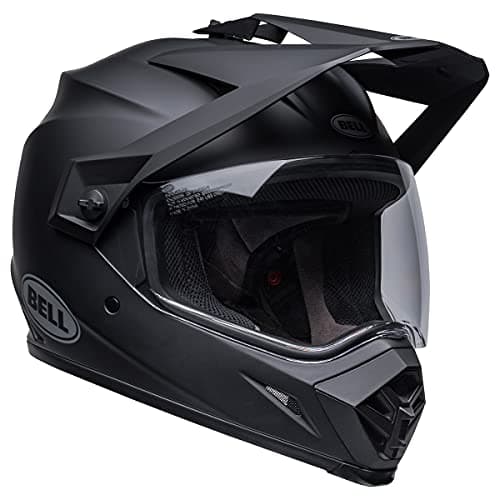
If you want the most documented safety for the least money, this is it. The Bell MX-9 Adventure is a rare sub-flagship helmet that carries genuine DOT + ECE 22.06 and MIPS and an independent SHARP 4/5 score - a combination several helmets costing three times as much cannot show. MIPS adds a rotational-management layer on top of the shell, and the SHARP star rating is real third-party impact data rather than a marketing claim. It is polycarbonate and not luxurious, and it is technically an adventure lid with a peak you can remove, but on certified-safety-per-dollar nothing here beats it. For a first helmet, that is a very strong place to start. The peak lifts off in a couple of minutes for pure street use, so do not let the adventure styling put you off - underneath it is a straightforward, exceptionally well-documented road helmet.
Scorpion EXO-AT960 - the do-it-all modular that grows with you
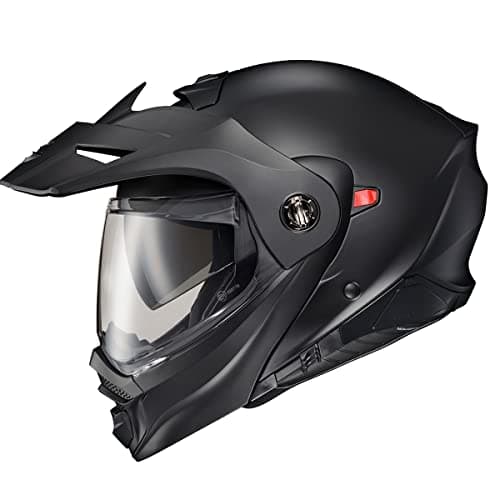
The AT960 is the pick for a beginner who wants one helmet to cover commuting, first tours and the odd bit of exploring. It holds genuine DOT + ECE 22.06 and adds practical features a new rider actually uses: it is a modular you can flip open at the gas station, it has a drop-down internal sun visor, and it converts between street and peak configurations. It is polycarbonate and on the heavier side, so it is not the lightest, but the flip-up convenience and the built-in sun visor make daily life easier - and the certification is the current 22.06, same as the Bell. For a rider who is not yet sure which kind of riding will stick, that flexibility is worth the extra weight: it is the pick least likely to be outgrown within a year.
Scorpion EXO-GT930 Transformer - the budget convertible, with one honest caveat
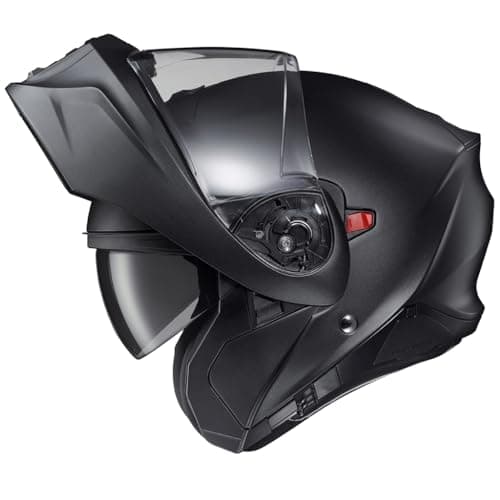
The GT930 is genuinely clever: a three-in-one that converts from a full-face to an actual open-face, with P/J homologation so riding it open is approved, plus a drop-down sun visor at a friendly price. Here is the caveat we promised, and it matters. This helmet is certified DOT + ECE 22.05, not the newer ECE 22.06 - so it does not carry the rotational (oblique) impact test that 22.05 lacks. That does not make it uncertified or unsafe; ECE 22.05 is a legitimate independently-tested standard and the P/J open-face trick is genuinely useful. It simply means that if you specifically want the current 22.06 rotational test, you would step up to the AT960 or the Bell. We would rather tell you that plainly than let a spec sheet imply otherwise. A handful of marketplace listings claim 22.06 for this model; treat that as unverified and buy it as the 22.05 helmet it is. For a purely urban first helmet where you value flipping the entire front up at a light over having the newest test protocol, it is a defensible, honest choice at the price.
So which one?
If safety data is your deciding factor, the Bell MX-9 Adventure - MIPS plus a SHARP 4/5 on top of 22.06 is the strongest evidence on the page. If you want one versatile helmet for commuting and touring with flip-up convenience, the Scorpion EXO-AT960. And if the convert-to-open-face trick and the lowest price win the day, the EXO-GT930 - as long as you have read the 22.05 note and it does not bother you. Whichever you choose, measure your head and fit it properly before you fall for a paint scheme - a certified helmet that grips your head is the one whose safety rating you actually get to wear.
If the choice is down to one helmet and you want more detail than a shortlist can carry, read in-depth helmet reviews of that single model before you buy - a roundup like this one ranks a field, while a single-model review takes one lid apart spec by spec.
One last piece of first-helmet advice: buy new, or buy used only from someone you trust completely. A used helmet can look flawless and still have absorbed an impact whose damage is hidden inside the liner, and you cannot read its history from the outside. For a first helmet especially, the peace of mind of a known, undamaged lid is worth far more than the saving.
How we would choose a first helmet
We do not run a crash lab, and we do not pretend to - our picks are judgments built from each maker's published homologation, the ECE and DOT standards themselves, third-party SHARP data where it exists, and aggregated owner reports, exactly as our methodology lays out. For a beginner, we weight the decision simply: certification first, fit second, features third, and brand prestige last. Insist on a real DOT mark plus an ECE mark, and prefer the current ECE 22.06 with its rotational test where your budget and needs allow. Then let fit decide between the certified options - a helmet that grips your head is the one whose safety rating you actually get to keep. Price should be a constraint you shop within, never a proxy for how protected you are. If two certified helmets both genuinely fit, then and only then let weight, features and price break the tie.