HUB 04 · Bluetooth & Comms Helmets
Sena 60S Review
Sena's flagship bolt-on since November 2024, and the first Sena intercom with a water rating on the record. What the spec pages say changed from the 50S, what the new cellular Wave mode actually needs to work, and whether the step up is worth it — or whether a 50S owner should stay put.
We earn a commission when you buy through our Amazon links, at no extra cost to you. It never changes a ranking, and we tell you when the cheaper helmet is the better buy. How this works.
Sena-ecosystem flagship bolt-on
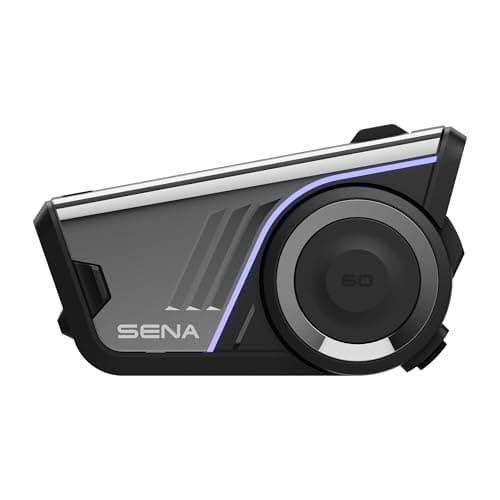
Sena's current flagship bolt-on: Mesh 3.0, cellular Wave Intercom, 2nd-generation Harman Kardon audio and, at last, a published IPX7 rating.
$439.0011% off
Price as of Sep 18, 2026. Prices change — Amazon's at checkout is the one that counts.
#ad · we may earn a commission from this link to Sena 60S
The Sena 60S is the unit Sena now puts at the top of its bolt-on range. Sena announced it on November 4, 2024 with the line that it "improves across every metric over the 50S, which was released in 2020," and nearly two years on it is the intercom a Sena-group rider should be cross-shopping — not the 50S most reviews still call the flagship. This review is for two readers: the rider joining or starting a Sena group who wants the current unit, and the 50S owner wondering whether the spec sheet justifies the change.
The usual framing note first, because it is the theme of this site: a comms unit carries no helmet safety rating. The shell it bolts to does. Choose the helmet on its certificationfirst, then the comms. We have not lab-tested this unit; every figure below comes from Sena's own 60S and 50S product pages, its launch announcement and its Wave Intercom page, plus the live Amazon listing — all sourced at the foot of the page. Where Sena's own documents disagree with each other, we say so rather than pick the flattering number.
What actually changed from the 50S
Put the two spec pages side by side and the upgrade is real, but it is not where the marketing points. Bluetooth moves from 5.0 to 5.3. Talk time goes from 16 hours on Bluetooth intercom and 13 on Mesh to 24 and 17. Charging drops from 2.5 hours to 1.5, over USB-C. The speakers are still 40 mm Harman Kardon drivers, but Sena calls the 60S set 2nd-generationand lists them at 8.6 mm thick against the 50S's 7.2 mm. The module is smaller — 94 × 52 × 27 mm against 102 × 56 × 27 — and it carries a 3-year warranty, the same as the 50S. And it has the spec that this site criticized the 50S for lacking: a published IPX7 water rating, covered in its own section below.
Two things did notchange the way you might expect. First, weight: Sena's launch announcement said the 60S is "40g (1.4oz) lighter than 50S," but Sena's own spec pages list the 60S main module at 68 g and the 50S main module at 64 g. We do not know what the announcement was measuring, so we do not repeat the "lighter" claim; on the published module figures the 60S is marginally heavier. Second, the network itself: the 60S runs Mesh 3.0 and 2.0with Open Mesh on 6 channels for a "virtually unlimited" number of riders and Group Mesh for up to 24, at a stated 2 km (1.2 mi) in open terrain — but the 50S got Mesh 3.0 by firmware in March 2025 and publishes the same 24-rider Group Mesh and 2 km range, and Sena's 50S page now lists Wave Intercom support too. So a 50S owner is not locked out of the network features; the upgrade case is the seal, the battery, the charge time and the audio generation.
Wave Intercom: what it is, and what it needs
Wave is the headline feature and the one to understand before you pay for it. It is not a radio. Sena describes it as a "cellular network-based protocol": the intercom talks to your phone, your phone talks to Sena's server over mobile data through the free Wave Intercom app, and the audio goes anywhere the network does — which is why Sena can say "virtually unlimited number of participants" and no range figure at all. It has two modes. Geo Wave connects you to any Sena user in a Wave Zone of a 1-mile radius in North America (1.6 km in Europe); Friends Wavekeeps a private group of riders you have added, with no distance limit. Sena also publishes a live map of your friends' positions in the app, and states an estimated data use of about 9 MB per hour, with the caveat that "actual usage rates may vary."
The conditions matter as much as the feature. Wave needs cellular coverage for every rider in the conversation; it needs the Wave app "running in the background"to be controllable from the unit's buttons; it uses your phone's data plan and your phone's battery, and Sena publishes Bluetooth and Mesh talk times but no Wave talk time. What Sena does do well is the fallback: when the cellular network is unavailable, "the Wave server seamlessly switches all participants to the same Mesh Intercom channel," so a group that rides out of coverage drops to Mesh rather than to silence. For a touring group spread across a highway with good coverage, Wave is a genuine step past what any radio-based Mesh can do. For a canyon or backcountry group, plan on Mesh — the 60S's stated 2 km is the number that applies where there is no signal.
Mesh 3.0 — and the backward-compatibility catch
The 60S ships with Mesh 3.0 and Mesh 2.0 both on board, and Sena says the 2.0 side is there for backward compatibility with legacy Sena Mesh products. The practical rule is the same one we lay out in the 50S review: a group that mixes updated and older Sena units runs on Mesh 2.0, and somebody has to agree the version before the ride. If your friends all run current firmware, you get Mesh 3.0; if one of them has an older 30K, everybody is on 2.0. And Mesh, in either version, is Sena-only — Sena Mesh and Cardo DMC do not bridge, so a 60S in a Cardo group is a plain Bluetooth intercom. That single fact should decide the purchase before any of the specs above.
IPX7: finally a published seal, and what the X means
The 50S review's main criticism was that Sena published no water rating at all. The 60S fixes that: Sena rates it IPX7and says it was "fully submerged in a fishbowl and continued to operate flawlessly for over 20 hours." Read the rating carefully, though. The 7is the water figure — protection against temporary immersion, a stronger claim than the "water resistant" most units settle for. The X means Sena did not rate it for dust. The Cardo Packtalk Edge's IP67 rates both — the 6 is dust-tight — which is a small but real difference for a rider who does dirt roads. For rain, both are now stated seals rather than promises, and that closes the gap this site used to hold against Sena in the Packtalk Edge vs Sena 50S comparison.
Audio, controls and living with it
The 2nd-generation Harman Kardon speakers are 40 mm drivers, and Sena pairs them with what it calls AI-based noise cancellation on the microphone side, a wired-boom mic for open-face and modular helmets and a wired mic for full-face helmets, both in the box. Control is a jog dial and a simple button set, with a magnetic mount rather than a release latch, a USB-C port, built-in FM radio, and a voice command engine Sena describes as next-generation with an expanded range of commands over the 50S — it does not publish the language list on the product page, so we do not quote one. There is some personalization that is new to the range: four interchangeable faceplates and swappable jog dial covers, an LED ring Sena calls RideGlow that you set in the app, and an integrated LED flashlight. Configuration and over-the-air firmware updates run through the Sena Motorcycles app; Wave lives in its own separate Wave Intercom app. The single pack ships with the unit, two helmet clamps, a mounting plate, adhesive and Velcro pads, speaker pads, both microphones, a 3.5 mm audio adapter and the USB-C cable. Our Sena pairing guide covers the phone, intercom and Mesh setup steps once it is on the helmet.
The honest cons
Price. The 60S sits a clear step above the 50S, and because the 50S received Mesh 3.0 and Wave by firmware, the extra money buys the seal, the battery, the faster charge, the newer speakers and Bluetooth 5.3 — not a different network. That is a fair list, but it is a smaller list than the launch language implies. Wave's dependencies. Coverage, an app in the background, data and phone battery, with no published Wave talk time. Weight.Not lighter on Sena's own module figures, whatever the announcement said. Brand lock-in. Mesh does not bridge to Cardo. And the range keeps moving.Sena has since added a 60S Evo, with Bose audio, and a 60X with joystick controls, both now listed on Amazon alongside this unit; we have not reviewed either, and the 60S remains the one we link because it is the established, full-spec unit at the lower price of the three. If Bose audio or the 60X's controls matter to you, that is a buy-direct decision we have not done the work on yet.
Against the Cardo Packtalk Edge
The Edge stays our top comms pick, and the 60S does not change that so much as narrow it. The Edge holds the dust-and-water IP67 rating, the Air Mount and JBL audio, and it has its own 2026 upgrade in Cardo's free Mesh Boost update (31 riders in a fully updated DMC group). The 60S answers with Bluetooth 5.3, longer talk times, a faster charge, 24-rider Group Mesh plus an unlimited Open Mesh, and Wave — a cellular mode Cardo does not offer. On paper it is the closest a Sena bolt-on has come. But the deciding factor is still the one it always was: the brand your riding group runs. Read the Packtalk Edge review for the Cardo side.
Who should skip it
Anyone whose group runs Cardo — a 60S there is a Bluetooth unit that cost you Mesh money. 50S owners with a working unit whose only complaint is the missing water rating: you already have Mesh 3.0 and Wave by firmware, so unless the 16-hour battery or 2.5-hour charge is actually limiting your riding, the upgrade is a want, not a need. Solo riders and fixed pairs, who are paying for Mesh and Wave they will not use — plain Bluetooth does a two-up conversation perfectly well. And riders who want comms with no box on the helmet, for whom an integrated helmet like the Sena Impulse is the cleaner install, as long as they accept it also picks the helmet.
For a rider joining or starting a Sena group who wants the current unit, a stated seal, the longest battery in the range and the option of cellular Wave on long highway days, this is the Sena to buy. Pick the safest helmet first using the certification pillar, then bolt this to it.
The scorecard
How it scores, and who should skip it
- Audio
- 9
- Range/Mesh
- 9.5
- Ease of use
- 8.5
- Weatherproofing
- 9
- Value
- 7.5
Pros
- A published IPX7 water rating — the one spec the 50S never had on the record
- 24 h Bluetooth / 17 h Mesh talk time and a 1.5-hour USB-C charge, both well ahead of the 50S
- Mesh 3.0 with Mesh 2.0 kept for older units, plus cellular Wave Intercom that falls back to Mesh when coverage drops
Cons
- A clear price step over the 50S, which got Mesh 3.0 and Wave by firmware and still does most of the same job
- Wave needs cellular coverage, the app running in the background and your phone's data and battery
- Sena Mesh still does not bridge to Cardo DMC — cross-brand you drop to plain Bluetooth
Don't buy this if…
…your group runs Cardo, or you already own a 50S that does what you need — the upgrade case is the seal and the battery, not the network.
$439.0011% off
Price as of Sep 18, 2026. Prices change — Amazon's at checkout is the one that counts.
#ad · we may earn a commission from this link to Sena 60S
How we picked
We do not crash-test helmets
We compiled published specifications, cited each helmet's certification (DOT, ECE 22.06, Snell, SHARP) from the standards body or manufacturer homologation, and aggregated owner reports, then scored against a published method. The scores are judgments from documented research — not measurements we took. We do not run a crash lab. Certifications reflect the US-market build; where it differs from the European version, we say so and cite it.
Questions
Frequently asked
Is the Sena 60S waterproof?
Sena 60S vs 50S: what's the difference?
What is Sena Wave Intercom and does it need a subscription?
Will the Sena 60S work with a Cardo Packtalk?
Is the Sena 60S worth it over the 50S?
Keep reading
Related
- Sena 50S reviewThe previous flagship, still on sale — and still what most Sena groups run.
- Cardo Packtalk Edge reviewOur top comms pick, and the IP67 unit the 60S is measured against.
- Packtalk Edge vs Sena 50SThe bolt-on Mesh decision, settled by which brand your group runs.
- How to pair a Sena comms unitPhone, intercom and Mesh pairing, step by step.
- Best Bluetooth modular helmetsIf you'd rather have the comms built into the helmet.
- All Bluetooth & commsThe full ranked comms roundup, bolt-on and integrated.
Receipts
Sources
- Sena — 60S product page (Mesh 3.0 & 2.0, Open Mesh 6 channels, Group Mesh 24, 2 km; Wave Intercom; Bluetooth 5.3; 24 h / 17 h talk time; 1.5 h USB-C charge; 68 g; 94 × 52 × 27 mm; 2nd-gen Harman Kardon 40 mm / 8.6 mm; AI noise cancellation; IPX7 fishbowl statement; FM; RideGlow; 3-year warranty; box contents)
- Sena — 60S launch announcement, November 4, 2024 ('improves across every metric over the 50S, which was released in 2020'; '40g (1.4oz) lighter than 50S')
- Sena — 50S product page (64 g main module; 102 × 56 × 27 mm; Bluetooth 5.0; 16 h / 13 h talk time; 2.5 h charge; 40 mm / 7.2 mm speakers; Group Mesh 24; Wave Intercom supported; 3-year warranty; no IP rating)
- Sena — Wave Intercom (cellular network-based protocol; free app; Wave Zone 1-mile radius NA / 1.6 km EU; Friends Wave; Mesh fallback; ~9 MB per hour estimate; app must run in the background)
- Sena — Firmware notice: 50S v1.5 adds Mesh 3.0 (March 27, 2025)
- Cardo — Packtalk Edge (IP67, for the weatherproofing comparison)
- Motorcycle News — Sena's EICMA 2025 releases (60X with joystick controls)
- Motorcycle News — Sena 60S Evo (Bose audio) on sale, 2026
We do not run a crash lab, and we do not pretend to. Certifications are cited to the standards body or the manufacturer's stated homologation; where a US model's certification differs from its European namesake, we say so. Where we could not verify something, we say so on the page rather than quietly leaving it out. Read our full method.