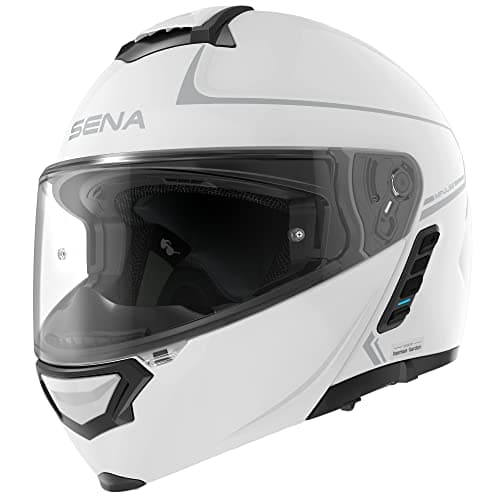
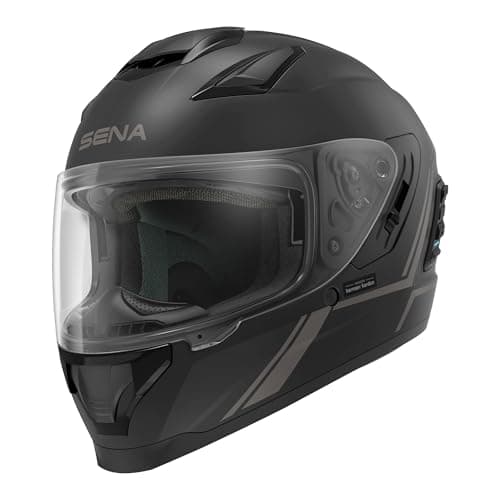
These are Sena's two flagship integrated smart helmets, and they share a lot: both run Mesh and Bluetooth, both have Harman Kardon audio, both are DOT-certified. The real decision is format — the Impulse is a flip-up modular with a sun visor and an integrated taillight; the Stryker is a one-piece full-face. Do you want the flip-up and the extra features, or the lighter, simpler shell?
Comms and audio: effectively a tie
Both run Sena's self-healing Mesh network plus Bluetooth, and both use Harman Kardonspeakers and mics, so on the two things that matter most for a smart helmet — group networking and audio quality — they're closely matched. Whichever you choose, you get Sena's best comms and premium integrated audio. This isn't where the decision is made.
Format and features: the Impulse's edge
The Impulse is the more feature-loaded helmet. As a modular, its chin bar flips up at stops; it has a drop-down sun visor; and it adds an integrated rear taillight for visibility. The Stryker is a full-face, so it does none of those — no flip-up, and it relies on its own shield for sun. For a rider who wants maximum convenience and features, the Impulse simply does more.
Weight and simplicity: the Stryker's edge
A one-piece full-face has fewer joints and less hardware, so the Stryker is the lighter, simpler helmet, and some riders prefer the solidity of a fixed chin bar. If you don't need the flip-up or the sun visor, the Stryker gives you the same Mesh and Harman Kardon audio in a lighter package. Neither publishes an IP waterproof rating, so treat both as water-resistant.
The verdict
Want the flip-up chin bar, a sun visor and an integrated taillight in one box? The Sena Impulse. Prefer a lighter, simpler one-piece full-face with the same Mesh and Harman Kardon audio? The Sena Stryker. It's a clean format decision between two flagship integrated smart helmets — read the Impulse review and Stryker review.
How we picked
We compiled published specifications, cited each helmet's certification (DOT, ECE 22.06, Snell, SHARP) from the standards body or manufacturer homologation, and aggregated owner reports, then scored against a published method. The scores are judgments from documented research — not measurements we took. We do not run a crash lab. Certifications reflect the US-market build; where it differs from the European version, we say so and cite it.