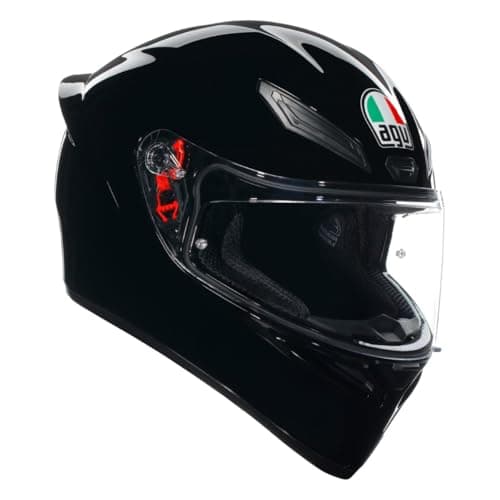
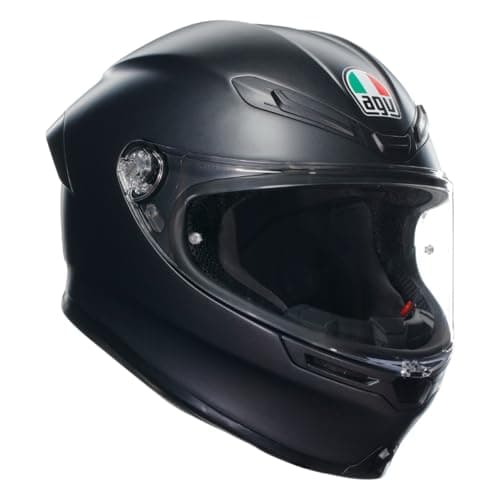
Here's the AGV decision with the certification held equal. Both the K1 S and the K6 S carry genuine US DOT + ECE 22.06 — the same current standard — but the K6 S costs roughly three times as much. So this page answers a blunt question: with the mark on the shell identical, what does the flagship money buy?
Certification: a genuine tie, with one edge to the K6 S
Both hold genuine DOT + ECE 22.06. The tiebreak is independent data: the K6 S has been SHARP-tested at a perfect 5/5, real third-party impact data, while the budget K1 S is not SHARP-rated. That doesn't make the K1 S less certified — the homologation is the same — but the K6 S has an extra, independent safety data point on its side.
Weight: the K6 S wins, decisively
This is where the money goes. The K6 S is around 1,255 gof carbon-aramid — one of the lightest full-face helmets made — versus the thermoplastic K1 S's ~1,600 g. That's a ~345 g difference you feel as neck fatigue on a long day and as agility through corners. If low weight matters to you, the K6 S is in a different class.
Finish and fit
The K6 S feels like the premium helmet it is — plusher interior, more refined finish — while the K1 S is comfortable but plainer. Both share AGV's sporty, wide-view character and a fit that suits intermediate-oval-to-sporty heads and runs snug for round ones. Neither has a sun visor. So the K6 S is the better helmet to live with; the K1 S gives you AGV's look and the current certification for far less.
The verdict
Want the lightest AGV full-face with independent SHARP data and a premium feel? The K6 S— the safety-data leader of its class. Want genuine ECE 22.06 and AGV's character at a budget price, and you can live with the weight? The K1 Sis the value choice, and you're not compromising on the current standard to get it. Read the K1 S review and K6 S review for the detail.
How we picked
We compiled published specifications, cited each helmet's certification (DOT, ECE 22.06, Snell, SHARP) from the standards body or manufacturer homologation, and aggregated owner reports, then scored against a published method. The scores are judgments from documented research — not measurements we took. We do not run a crash lab. Certifications reflect the US-market build; where it differs from the European version, we say so and cite it.