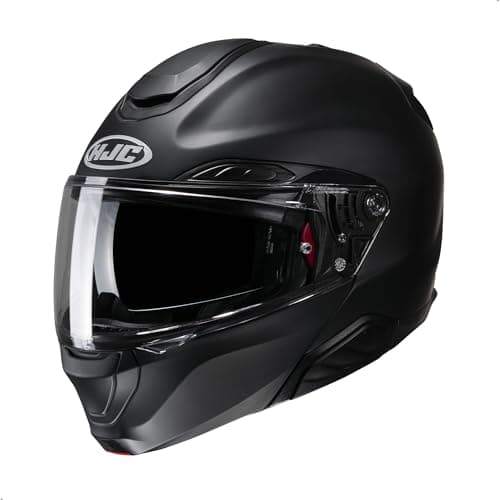
The worry behind this question is always the same picture: a chin bar that springs open at the worst possible moment. It is a reasonable worry, and the honest answer is not a flat reassurance. A modular helmet is safe - genuinely, independently-tested safe - when it carries two specific things. One of them is printed on the label in a code most riders have never had explained. The other is a percentage that SHARP, the UK government's independent helmet-testing scheme, publishes for flip-ups and for nothing else. Almost no review mentions it. It is the single most useful number in this entire category.
We have not crash-tested any of these helmets and we have no lab. Everything below comes from the standards bodies, from SHARP's published results and its own description of its method, and from each maker's stated homologation - all linked at the foot of the page. Where a figure does not exist for a helmet, we say so rather than filling the gap.
Condition one: the P/J mark, and what it actually approves
Under the ECE standard a flip-up can be homologated three ways, and they are not interchangeable. P stands for protective: the helmet is approved only as a full-face, which means the chin guard must stay closed while the bike is moving and may be opened only at a stop. J stands for jet: approved only as an open-face, where the chin bar is not protective at all. P/J means it passed both, so the helmet is simultaneously approved as a full-face and as a jet, and the rider can legitimately ride with the bar up or down.
This is the mark to look for, and it is the reason a P/J helmet can be treated as a genuine full-face rather than a compromise. It is also why we put certification in the first column of every table on this site: a modular sold without the P/J mark is not approved to be ridden open, whatever the marketing photograph shows. If you want the standard itself explained, start with ECE 22.06 explained and the certification comparison.
Condition two: the latch score, and the sentence that should change how you shop
Here is the gap. Certification tests the chin guard - it gets impacted like any other part of the shell, and for a P/J helmet the tests are run in both configurations. What certification does not do is measure how reliably the latch keeps holding. SHARP puts it plainly: the standards impact the chin guard, but "no tests are conducted in relation to the mechanism that keeps it locked in place."
So SHARP measures it separately. It runs each helmet through 30 linear impacts at different speeds and records how many of them leave the lower face cover fully locked. That figure is published as a percentage alongside the star rating. SHARP's own reading of the numbers is blunt: 100% "provides a high level of confidence that the helmet chin guard will stay locked after an impact"; anywhere from 70% to 99% means "the helmet has the potential to open in a collision"; around 50% is "like a coin toss"; under 20% is "definitely cause for concern."
And now the part that should genuinely change how you shop. SHARP states that it "is not currently able to apply an objective measure to the safety effect of a failure of the chin bar locking mechanism and the percentage score is not therefore factored into the safety rating." The latch percentage is not part of the stars. A five-star modular can carry a middling latch score and still be a five-star modular. If you have been using the star rating as your whole answer on a flip-up, you have been reading half the data.
HJC RPHA 91 — the strongest modular safety case you can actually buy here
The RPHA 91 is our top pick because it is the only modular we cover whose US-market helmet carries the full set: genuine ECE 22.06 with P/J dual homologation, an independent 4/5 SHARP star rating, and a published latch figure of 80%. Nothing else on this page gives you all three on the box sold in the States, and it does it at roughly half the price of the flagship below it.
The honest con is the one this page exists to teach you to read. 80% sits inside SHARP's 70-99% band- the band SHARP describes as having "the potential to open in a collision." That is not a disqualification, and it is better documented than the helmets with no figure at all, but it is not the 100% you would want and we are not going to round it up. It is also not as quiet as a Neotec 3 and the interior is a notch less plush than the premium Japanese brands. Detail in the RPHA 91 review and its safety rating page.
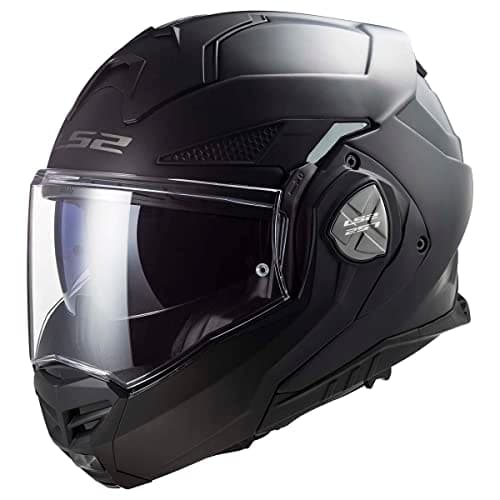
LS2 Advant X — genuine 22.06 P/J, and no independent data at all
On paper the Advant X matches the RPHA 91 where it counts: homologated DOT + ECE 22.06 with P/J, so it is approved to be ridden open, and it is by some way the lightest helmet here - which matters more than it sounds, because a flip-up carries hinge and latch hardware a one-piece full-face simply does not. Drop-down sun visor and a Cardo-based comms channel round it out.
The honest con is a blank space rather than a bad number: it has not been SHARP tested, so there is no star rating and no latch percentage for it. We are not going to infer one from the certification, because the whole point of the section above is that the certification does not measure the latch. Buy it for the 22.06 P/J mark and the weight, and understand that on chin-bar retention you are trusting LS2 rather than an independent result. It is also louder at highway speed than a one-piece shell, and it uses a micrometric ratchet strap rather than Double-D rings. See the Advant X review.
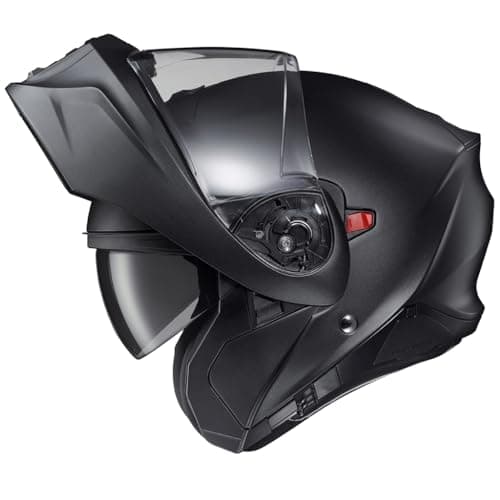
Scorpion EXO-GT930 Transformer — approved to ride open, on the older revision
The GT930 earns its place because P/J is exactly what it is for: the chin bar does not just lift, it comes off entirely, turning the helmet into a true open-face. It holds DOT + ECE P/J homologation, so riding it open is an approved configuration rather than something you get away with, and it is the cheapest way onto this page with a drop-down sun visor included.
The honest con is the revision. It is ECE 22.05, not 22.06 - the older version of the standard, without the rotational-impact test the newer revision added. A few marketplace listings claim 22.06 for it; treat those as unverified. It has also never been SHARP tested, so again there is no latch figure, and the polycarbonate shell is heavy. If the current standard matters to you, the two helmets above carry it. Detail in the EXO-GT930 review.
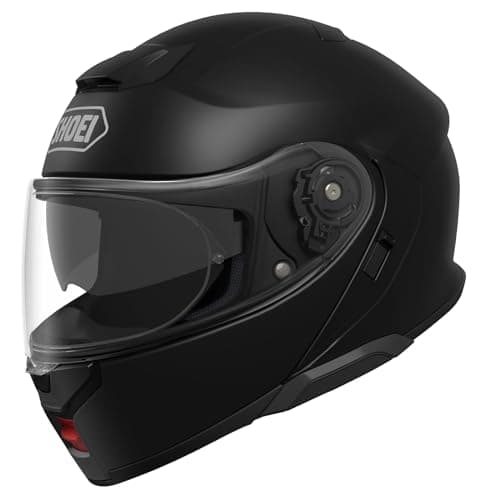
Shoei Neotec 3 — the best latch score in the class, on a helmet you cannot buy here
This one is the cleanest illustration of the trap this site exists to flag. The European Neotec 3 is the best-documented modular in the world: ECE 22.06 P/J, a perfect 5/5 SHARP star rating, and a latch score of 93% - the highest figure of any helmet on this page, and comfortably the most reassuring number in this whole article.
The honest con is that the US Neotec 3 is a DOT build. The helmet SHARP impact-tested and scored is the European unit, not the box on the American shelf, and DOT is a self-certified floor rather than an independent result. So you are buying, genuinely, the quietest and best-finished flip-up most riders will ever wear - superb seal, deep neck roll, a purpose-built Sena SRL3 comms channel - but you are not buying the certification the reviews are quoting at you. It is also the heaviest and by far the most expensive helmet here. Full picture in the Neotec 3 review and its safety rating page.
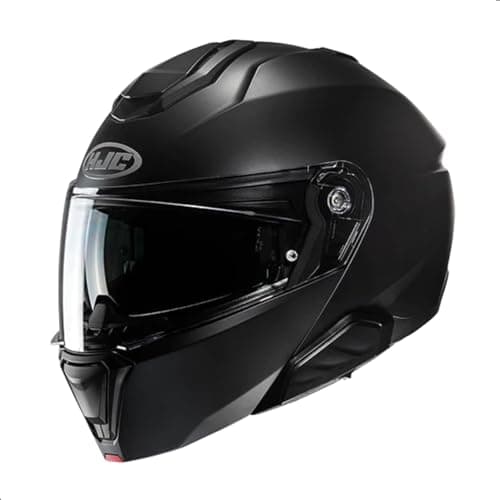
HJC i91 — the honest budget answer, and what the budget actually costs you
The i91 is here to show the floor rather than to win. It is a comfortable, genuinely complete budget flip-up - drop-down sun visor, Pinlock-ready shield, comms-ready, the widest size range we cover - and it is marketed DOT-approved, which is a real certification and the legal standard for riding in the United States.
The honest cons are exactly the two conditions at the top of this page, and it clears neither on paper. We do not assert ECE 22.06 or a P/J markon the US unit - HJC's European i91 has existed in both 22.05 and 22.06 builds depending on production date, so confirm the label on the helmet you actually receive rather than assuming. And it has not been SHARP tested, so there is no latch percentage. If you ride with the chin bar up in traffic, that combination is the one to think hardest about; step up to the RPHA 91, which carries P/J explicitly. See the i91 review.
So which one?
Want the strongest documented safety case on a helmet actually sold here? The HJC RPHA 91 - 22.06 P/J, 4/5 SHARP, 80% latch, and read that 80% for what SHARP says it is. Want the current standard and the lightest flip-up, and can live without independent data? The LS2 Advant X. Want to ride genuinely open on the cheapest ticket? The Scorpion EXO-GT930, on the older revision. Want the quietest touring modular and DOT satisfies you? The Shoei Neotec 3, knowing the 5-star, 93%-latch helmet is the European one. Buying on the tightest budget? The HJC i91, with both caveats understood. And whichever you pick, size it properly - a loose helmet undoes everything the label promises.
If you are still deciding on the format
This page answers whether a flip-up is safe. The companion question - whether it is the right format for you at all - is in modular vs full-face helmets, which sets the same P/J and latch evidence against the weight, noise and simplicity case for a one-piece, with four helmets compared.
Is a modular as safe as a full-face?
Structurally, a flip-up asks more of its engineering. It has a hinge, a latch and a moving chin bar where a one-piece full-face has continuous shell, and all of that hardware adds weight - the modulars on this page are among the heaviest helmets we rank. So the theoretical answer is that a full-face has an easier job.
The measured answer is more interesting, and more encouraging. The Shoei Neotec 3 took a full 5/5 SHARP rating in Europe, the same top score SHARP awards its best full-faces, so a well-made flip-up can absolutely reach the highest independent protection band. The category is not compromised by being modular. It is compromised by being bought without checking the two things that are specific to it - the P/J mark and the latch score - and by the fact that neither appears in a typical product listing.
How SHARP actually produces these numbers
Worth knowing, because it is why we lean on them. SHARP buys helmets off the shelf rather than accepting samples from manufacturers, then subjects each model to 32 impact tests - 30 linear and 2 oblique - across a minimum of seven individual helmets. The star rating comes from how well the shell manages impact energy, and it is weighted using real motorcycle accident data. For flip-ups, SHARP additionally records what the chin guard did during the 30 linear impacts, and publishes that as the latch percentage.
The limitation is SHARP's own and it is stated openly: it cannot yet put an objective safety value on a latch failure, so the percentage is reported but kept out of the star rating. Treat the two numbers as answering different questions - the stars tell you how much impact energy the helmet manages, the percentage tells you how confident you can be the front stays shut while it does.
Riding with the chin bar up
Two separate things get confused here. The first is approval: only a P/J helmet is homologated to be ridden with the bar raised. On a P-only modular the chin guard is meant to come up at a stop and go back down before you move. The second is protection, and it is simple physics - an open chin bar is not protecting your chin and face regardless of what the label permits. P/J means the open configuration was tested and approved as a jet helmet, not that it performs like a closed full-face.
The practical habit that follows: close it, and make sure it actually clicks home. A chin bar resting on the first detent rather than fully latched is both noisier and, on the evidence above, the condition the latch score is measuring. If you mostly ride with the front open, consider whether you want a modular at all - the helmet types explainer covers what each format is really for.
How we chose these five
We do not run a crash lab and we do not claim to. These are judgments built from published homologation data, SHARP's published star and latch results, SHARP's own description of its test method, and aggregated owner reports - exactly as our methodology sets out. For this page we weighted the decision in one order: the certification the US box carries, then whether it holds P/J, then whether an independent SHARP result exists and what its latch percentage is, then the practical stuff - weight, noise, features. Where a helmet has no SHARP data we have said so plainly rather than treating silence as a pass. Every pick here is a helmet we would let a friend buy, provided they read the caveat attached to it.