HUB 01 · Adventure & Dual-Sport Helmets
Scorpion EXO-AT960 Review
The value ADV pick that clears the bar that matters: genuine DOT + ECE 22.06, in a three-configuration modular you can flip open, with a drop-down sun visor.
We earn a commission when you buy through our Amazon links, at no extra cost to you. It never changes a ranking, and we tell you when the cheaper helmet is the better buy. How this works.
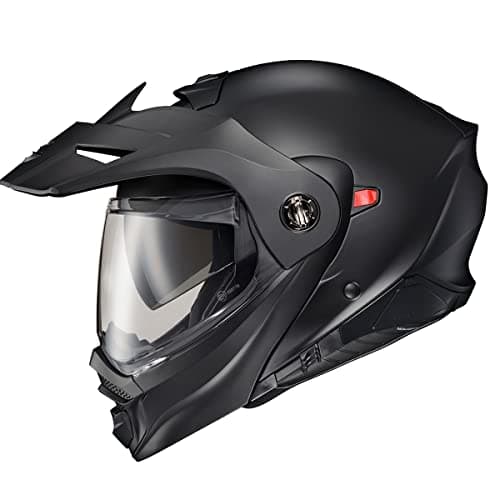
Best budget ADV with ECE 22.06
The value ADV pick that still clears the bar that matters: genuine DOT + ECE 22.06, in a modular you can flip open.
Price as of Sep 18, 2026. Prices change — Amazon's at checkout is the one that counts.
#ad · we may earn a commission from this link to Scorpion EXO-AT960
The Scorpion EXO-AT960 is the helmet that proves you don't need to spend flagship money to get the certification flagships are praised for. It carries genuine US DOT + ECE 22.06, it's a modularyou can flip open at a gas station, and it has a drop-down internal sun visor — all for roughly a third of a carbon ADV lid's price. The trade is weight, and we'll be straight about it.
We haven't crash-tested this helmet. The certification comes from the standards body, the specs from Scorpion, and the ride impressions are aggregated from owners.
Genuine DOT + ECE 22.06 at a value price
This is the headline and it's a real one: the AT960 holds genuine ECE 22.06— the current rotational-test standard — on top of DOT, at a price where most helmets are still on the older standard or DOT-only. On a site that ranks by the mark on the shell, that's the whole argument. You get the certification that matters without the carbon-flagship outlay.
Three configurations and a sun visor
The AT960 is genuinely versatile. It runs as a peaked ADV helmet, a street helmet with the visor and no peak, or with goggles — and because it's a modular, the chin bar flips up for gas stops and conversations. The drop-down internal sun visor is a feature most ADV helmets omit entirely, and it's the one commuters and tourers miss most. For a rider who wants one helmet to do adventure, commuting and touring, the flexibility is the pitch.
The honest con: weight
Polycarbonate and modular means heavy— around 1,860 g, the heaviest kind of ADV helmet here. On a long highway day you feel it, and the peak adds drag at speed. That's the price of the certification-and-features-per-dollar: the money went into the homologation and the feature set, not into a carbon shell that would shave the weight. If long slab days and neck fatigue are your reality, spending up for carbon (the Klim Krios Pro or AGV AX9) is the fix.
Configurations, sun visor and everyday use
The AT960 is the Swiss-army knife of this list. As a modular, the chin bar flips up for gas stops, conversations and cooling off in traffic; as an adventure helmet it takes the peak; as a street helmet you drop the peak for a cleaner, quieter shape; and it accepts goggles for dirt. On top of that it has the drop-down internal sun visor that most peaked ADV helmets omit entirely, which is the single feature commuters and tourers miss most. For a rider who wants one helmet to genuinely do everything — commute, tour, explore — very little else at any price is this flexible, and nothing at this price is.
On value, the AT960 lands right around the entry point for a genuine ECE 22.06 modular, which is the whole argument for it: you get the current certification, the flip-up mechanism, three configurations and a sun visor for roughly a third of what a carbon flagship costs. The catch, again, is the polycarbonate weight and the wind noise a peaked modular generates at speed — this is a helmet you buy for versatility and certification-per-dollar, not for a hushed, featherweight ride. Run earplugs on the highway (as you should in any helmet — see our quiet-helmet guide) and the AT960's value case is hard to argue with.
Who should skip it
Riders who do long highway days and feel every gram — the weight and wind will wear on you, and carbon is worth the money for you. Everyone else who wants genuine ECE 22.06, modular convenience and a sun visor without spending flagship money should have the AT960 near the top of their list — it's our best value ADV pick and features in best budget adventure helmets.
Where the AT960 sits in the range
The AT960 is the value-and-versatility anchor of the adventure lineup. Its closest peer on price and certification is the Bell MX-9 Adventure MIPS — both carry genuine ECE 22.06 for budget money — and the two split the value field neatly: the Bell adds MIPS and an independent SHARP 4/5 score, while the AT960 counters with modular convenience, a sun visor and three configurations. If documented safety data leads, the Bell; if versatility and features lead, the AT960. Step up from either to a carbon flagship like the AGV AX9or Klim Krios Pro and you're paying for weight and quiet, not a better certification — which is the point the AT960 makes so well.
The bottom line: the AT960 is the smart-money adventure helmet for a rider who wants the current certification, a flip-up chin bar, a sun visor and genuine do-everything flexibility without spending flagship money — and who's willing to accept the polycarbonate weight and highway noise that come with the price. For a great many riders, that's exactly the right set of trade-offs, which is why it's our standing value pick in the category.
The scorecard
How it scores, and who should skip it
- Certification
- 9
- Value
- 9.5
- Versatility
- 8.5
- Weight
- 6.5
- Quiet
- 7
Pros
- Genuine DOT + ECE 22.06 at roughly a third of a carbon flagship's price
- Three-configuration modular: peak-and-visor, street, or goggles
- Drop-down internal sun visor most ADV helmets omit
Cons
- Polycarbonate shell makes it the heaviest here
- Not the quietest, and the peak adds drag at highway speed
Don't buy this if…
…you ride long highway days and weight or wind noise wear you down — spend up for carbon.
Price as of Sep 18, 2026. Prices change — Amazon's at checkout is the one that counts.
#ad · we may earn a commission from this link to Scorpion EXO-AT960
How we picked
We do not crash-test helmets
We compiled published specifications, cited each helmet's certification (DOT, ECE 22.06, Snell, SHARP) from the standards body or manufacturer homologation, and aggregated owner reports, then scored against a published method. The scores are judgments from documented research — not measurements we took. We do not run a crash lab. Certifications reflect the US-market build; where it differs from the European version, we say so and cite it.
Questions
Frequently asked
Does the Scorpion EXO-AT960 really have ECE 22.06?
Is the EXO-AT960 heavy?
Is the AT960 a good all-rounder?
Keep reading
Related
- All adventure helmetsThe full ranked ADV roundup, by certification.
- Best budget ADV helmetsWhere the AT960 ranks among the sub-$300 picks.
- Bell MX-9 Adventure reviewThe other budget DOT + ECE 22.06 ADV pick, with a SHARP score.
- AT960 vs EXO-GT930The two Scorpion modulars, adventure vs street, head to head.
- Krios Pro vs EXO-AT960Carbon flagship against the value pick, both genuine ECE 22.06.
- Hornet X2 vs EXO-AT960Snell touring ADV against the ECE 22.06 modular value pick.
Receipts
Sources
We do not run a crash lab, and we do not pretend to. Certifications are cited to the standards body or the manufacturer's stated homologation; where a US model's certification differs from its European namesake, we say so. Where we could not verify something, we say so on the page rather than quietly leaving it out. Read our full method.