Ask a hundred riders what they would change about their helmet and most of them say the same thing: make it quieter. Wind noise is the reason a two-hour ride feels like four, the reason you cannot hear your intercom over 60 mph, and - the part nobody puts on a box - the reason a lot of long-distance riders end up with tinnitus. So a page about the quietest motorcycle helmets ought to start by being honest about what can and cannot be known here. We do not own a wind tunnel or a sound lab. What we can do is tell you what independent measurement exists, whose it is, what it does and does not prove, and which helmets the evidence and the design details actually support.
The short version, before the detail: the one helmet on this page with a third-party decibel measurement behind it is not the most expensive one. And the single biggest improvement you can make to helmet noise costs about twenty dollars and is not a helmet at all.
Why we will not print a decibel spec for every helmet
There is no standardized, published noise rating for motorcycle helmets. Nothing like SHARP exists for sound - no government body buys helmets off the shelf and measures them the same way twice. What you find instead are three kinds of number, and they are not interchangeable. Manufacturers occasionally publish a figure from their own wind tunnel (Schuberth quotes roughly 85 dB at 100 km/h on a naked bike for the C5). Magazines occasionally run a batch test. And a handful of retailers and reviewers ride with a decibel meter taped inside the shell.
Those numbers are useful only when you compare like with like, because the research on this is blunt about how much the rest of the setup matters. The Institute of Sound and Vibration Research at Southampton found that above roughly 40 mph the dominant noise a rider hears is not the engine at all - it is aerodynamic noise, generated largely by turbulence coming off the edge of the windscreen and hitting the helmet. Their conclusion is the sentence every quiet-helmet article should be required to print: a helmet which is relatively quiet on one motorcycle can be relatively noisy on another. A dB figure measured on somebody else's bike, behind somebody else's screen, at somebody else's height, is evidence - it is not a spec.
So here is the rule we used. Where a third party has measured helmets against each other with the same rider, bike and meter, we treat that as the strongest evidence available and we name the source. Where no measurement exists, we say so and rank on the design features that demonstrably drive noise, exactly as our methodology describes. Units we have crash-tested or sound-metered ourselves: zero. We would rather tell you that than invent a number.
The five things that actually make a helmet quiet
Noise gets into a helmet through gaps and through turbulence, and every quiet helmet is quiet for the same unglamorous reasons. These are the five that matter, in the order they matter.
1. The neck roll. Most of the air that ends up as noise in your ears comes up from underneath, not in through the front. A deep, dense neck roll that seals against your collar is the single most effective feature on a quiet helmet, which is why touring lids have fat neck rolls and race lids do not. The Southampton work found that improving neck sealing on a bike with a low screen cut noise by 5-8 dB on its own - a bigger swing than most riders will ever get by changing helmets.
2. The chin curtain and, on a modular, the chin bar seal. A chin curtain closes the last gap under the chin bar. On a flip-up helmet the chin bar has to clamp back down against a gasket, and the quality of that seal is the difference between a quiet modular and a whistling one - it is the specific thing Shoei redesigned between the Neotec 2 and the Neotec 3, and the specific thing HJC engineered a two-way pivot around on the RPHA 91.
3. The visor and eyeport seal. A visor that pulls tight into a beaded seal all the way round keeps the high-frequency hiss out. On a bike with a tall screen, where turbulence hits you around eye level rather than at the neck, the Southampton research found visor sealing was worth the same 5-8 dB the neck roll was worth on a naked bike. Which of the two matters more for you depends entirely on your motorcycle.
4. Shell aerodynamics and vent design. A smooth shell with no shelf for air to trip over is quieter than a shell covered in spoilers and scoops, and open vents whistle - which is why some helmets are noticeably louder with the top vent open. This is real, but it is a smaller effect than the seals, and it is the one manufacturers talk about most because it photographs well.
5. Fit and shell size. A helmet a half-size too big leaks air at the neck and moves in the wind, and a helmet built on a shell two sizes too large for your head puts more surface into the airstream. This is the reason the same model can be quiet for one rider and loud for another, and the reason our head-measuring guide is the first thing we would send a noise-sensitive buyer to read.
Your windscreen matters as much as your helmet
If you take one piece of practical advice from this page, take this one: before you spend $900 trying to buy silence, look at your screen. The Southampton research is unambiguous that turbulence shed from the top edge of a windscreen is a primary noise source, and that screen height determines which part of your helmet sits in dirty air. A screen that puts the turbulent band exactly at helmet height is the worst case - it is why some riders find a taller screen makes things dramatically worse rather than better, and why lowering or removing a screen sometimes makes a bike quieter.
The cheap experiment: ride the same road at the same speed with the screen at its lowest setting, then at its highest, then (if it is removable and legal for your bike) without it. If one of those is obviously better, you have just improved your noise situation for free, and you now also know which helmet feature to prioritize - neck sealing if the air hits you low, visor sealing if it hits you high. This matters most on a cruiser, where you sit upright in unfaired air behind a screen that is usually the wrong height - we go through the sizing rule and the rest of the cruiser-specific priorities in best helmets for cruisers.
The uncomfortable part: no helmet on this list protects your hearing
This is the section that costs us money and we are printing it anyway. A quiet helmet is a comfort feature. It is not hearing protection, and the numbers are not close. The Dutch magazine Promotor tested ten full-face and modular helmets across price brackets at 50, 100 and 150 km/h; the best performing helmet in that test still let through 85 dB at 50 km/h and 100 dB at 100 km/h. For context on what those numbers mean, hearing damage becomes possible from around 80 dB, eight hours a day is the safe ceiling at 80 dB, and every 3 dB above that halves the safe exposure time. At 100 dB you are into minutes, not hours.
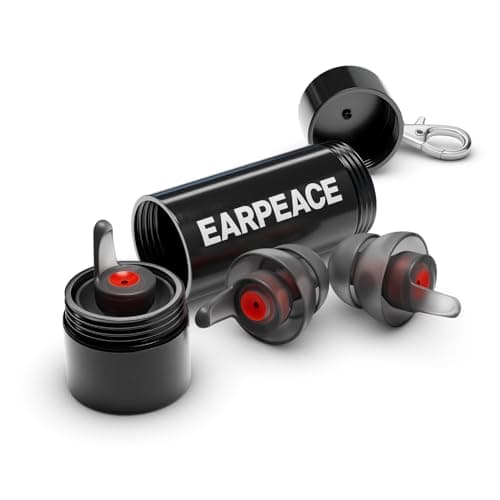
The Southampton researchers reached the same place from the other direction: riders' daily noise exposures routinely exceed 90 dB(A) without protection, and they recommend earplugs worn under the helmet. So do we, and it changes how you should read the rest of this page. The difference between the quietest helmet here and a merely good one is a few decibels. The difference between any of them and a set of filtered earplugs is 15-25 dB. Buy the helmet for fatigue, clarity on the intercom and being able to hear yourself think - and buy earplugs because that is the thing that actually protects your hearing.
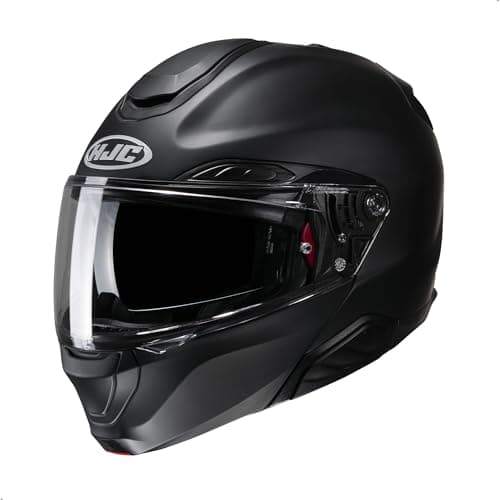
HJC RPHA 91 - the quietest one measured, and it is not the priciest
The RPHA 91 is our top pick because it is the only helmet here with a comparative measurement in its favor. Champion Helmets, a European retailer that road-tests helmets with a decibel meter inside the shell, recorded 95 dB at about 130 km/hin the RPHA 91 and called it the quietest helmet they had ever measured. In the same reviewer's test of the two helmets everyone assumes are the quiet benchmarks - the Shoei Neotec 3 and the Schuberth C5 - both came in at 98 dB, a dead tie, three decibels behind the HJC. Three decibels is not marketing noise: on the exposure scale above it is a halving of safe listening time.
That is one reviewer, one bike, one meter, and we are not going to pretend it is a laboratory. But it is a like-for-like comparison, which is more than any brochure gives you, and it lines up with how the helmet is built: a two-way pivot chin bar designed to clamp the seal shut, a deep neck roll, and a visor-and-ratchet profile HJC specifically shaped to cut turbulence. The certification story is just as good - the RPHA 91 carries ECE 22.06 with P/J dual homologation, so riding it with the chin bar up is an approved configuration, and it has an independent SHARP 4/5 score behind it.
The honest cons: at about 1,740 g in a medium it is not light, and a heavy helmet is its own kind of fatigue on a long day. The interior is a clear notch below Shoei plushness - the padding is good, not luxurious. And the noise evidence, while the best available, rests on a single tester rather than a standard. If you want the full argument against its obvious rival, we wrote it up as Neotec 3 vs RPHA 91.
Shoei Neotec 3 - the plushest seal, and the benchmark it ties with
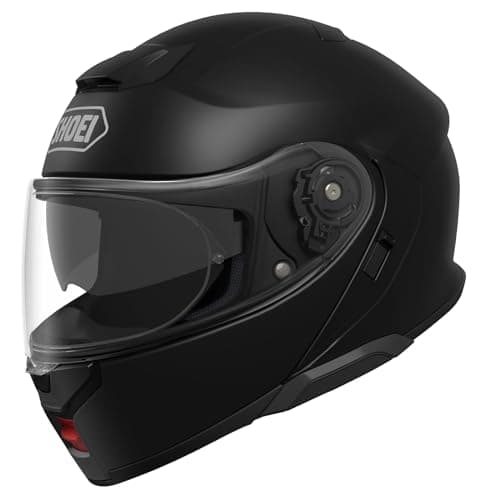
The Neotec 3 is the helmet most riders mean when they say quiet modular, and it earns the reputation. Shoei rebuilt the chin bar seal specifically to kill the whistle that dogged the Neotec 2, flattened the nose profile for cleaner airflow, and fitted one of the deepest neck rolls on any production helmet. In the Champion Helmets road test it measured 98 dB - level with the Schuberth C5, the helmet with the strongest quiet reputation in motorcycling, and three behind the HJC. Subjectively it is the most refined of these: the seal quality, the shield mechanism and the sun visor all feel a class above, and the purpose-built channel for the Sena SRL3 means your intercom sits flush instead of bolted to the side.
The cons are real and we say them on every page that features this helmet. The US-market Neotec 3 is a DOT build - the European Neotec 3 is the one that carries ECE 22.06 P/J and a perfect 5/5 SHARP score, and it is the European unit that was measured in the noise test above. It is also the heaviest helmet here at roughly 1,880 g, and it is priced like the flagship it is. If quiet is your only criterion, you are paying a large premium over the HJC for a helmet that measured slightly louder. If refinement, comms integration and finish matter alongside quiet, this is the one to buy - see the full Neotec 3 review.
Shoei GT-Air 3 - the quiet full-face that keeps a sun visor
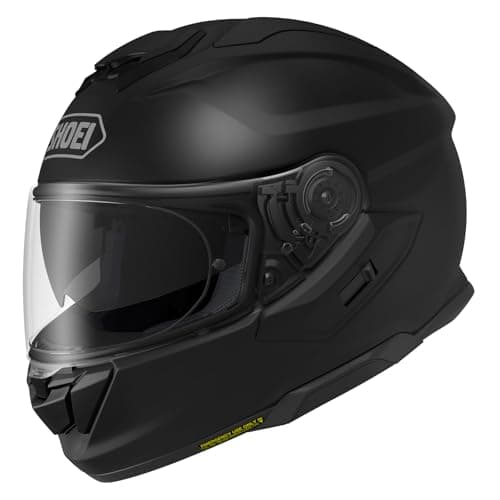
Every modular pays a noise tax for its hinge and its chin bar seam, no matter how well engineered. A full-face has fewer joints to leak, and the GT-Air 3 is Shoei's touring answer: the same aero and sealing thinking as the Neotec, in a one-piece shell, with the drop-down internal sun visor the RF-1400 does without. For a commuter who rides into low sun and wants a hushed helmet without carrying a spare shield, it is the most practical helmet on this page.
Honest cons, and one of them is a limitation of this page rather than the helmet: we have not found a like-for-like decibel measurement of the GT-Air 3 against the helmets above, so its placement here is a judgment from its design and from owner reports, not from a number. It is also a DOT build in the US (the European GT-Air 3 is ECE 22.06 and 5/5 SHARP), it is heavier than the RF-1400 at around 1,774 g, and the sun visor mechanism is an extra penetration in the shell that a purist would rather not have.
Shoei RF-1400 - the light, quiet sport-touring answer
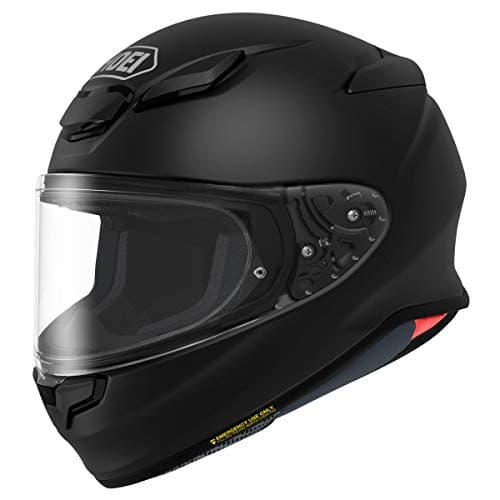
The RF-1400 is the helmet to buy if you want quiet without the weight. At roughly 1,385 g it is the lightest lid on this list by a wide margin, and it is the one helmet here where the maker put real numbers behind the aero work: Shoei credits wind tunnel development with a 4% reduction in drag and 6% reduction in lift versus the RF-1200, and pairs it with an airtight window beading system and removable ear pads aimed squarely at wind noise. It also has the fewest apertures and seams of anything here - no sun visor slot, no chin bar joint. It is DOT + Snell M2025 in the US, and its European twin, the NXR2, holds a perfect 5/5 SHARP score.
The cons matter more on this helmet than on the others, because its quiet is the most position-dependent. A sport-touring shell is optimized for a rider tucked slightly forward behind a screen; sit bolt upright on a naked bike and you put the helmet straight into undisturbed air, and it will not feel as hushed as a touring lid with a deeper neck roll. There is no sun visor, so you commit to a clear shield plus sunglasses or carry a tinted spare. And if ECE 22.06 specifically is your requirement, the US build is a Snell helmet - our RF-1400 review walks through what that trade actually means.
Shoei Hornet X2 - the quiet option if you need a peak
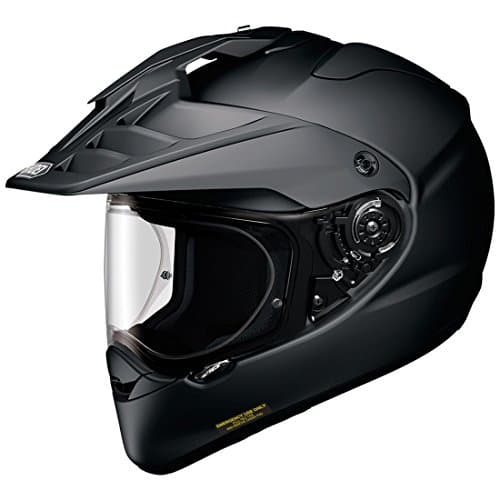
A peak is a noise-maker. It catches air, it adds a shelf for turbulence, and it is why almost no adventure helmet appears on a quiet-helmet list. The Hornet X2 is here because it is the exception worth knowing about: it is the most road-biased ADV lid we cover, with an aerodynamic peak and a shield seal good enough that riders who spend most of their miles on sealed roads consistently rate it as the calmest peaked helmet they have owned. If your riding is 80% pavement but you want the ADV look and the goggle option, this is the compromise that costs you the least noise.
The cons are not subtle. It is still louder than every road helmet above it - a peak is a peak, and at highway speed you will hear it. At roughly 1,778 g it is heavy, the US build is DOT + Snell rather than ECE 22.06, and if you genuinely ride off-road the peak is tuned more for the road than the trail. If quiet is your top priority and the peak is negotiable, buy one of the road helmets above instead; if it is not negotiable, start here and read the adventure hub for the rest of the field.
The quietest modular we cannot sell you
It would be dishonest to write this page without naming the Schuberth C5. It is the helmet with the strongest quiet reputation in motorcycling, Schuberth quotes roughly 85 dB at 100 km/h on a naked bike for it, and in the one like-for-like road test we found it tied the Neotec 3 at 98 dB. It is also, as of this writing, not sold through Amazon in the US - we checked our own product feed and there is no listing to link to. The same is true of the AGV Tourmodular. We are not going to manufacture a buy button for a helmet you cannot buy through us, and we are not going to leave it off the page either. If the C5 is what you want, buy it direct from Schuberth or a dealer; we earn nothing on that and you should do it anyway if it is the right helmet.
So which one?
If you want the quietest helmet the available evidence actually supports, and you want the current ECE 22.06 rotational standard with a SHARP score and a price that is not a flagship price, buy the HJC RPHA 91. If refinement, the best comms integration on the market and the plushest seal matter as much as the decibels, buy the Shoei Neotec 3 and go in knowing the US build is DOT. If you do not need a flip-up, the GT-Air 3 is the quiet touring full-face with a sun visor and the RF-1400 is the light one for riders behind a screen. And if you need a peak, the Hornet X2 is the least noisy way to have one.
Whichever you pick, do the two free things first: try your screen at different heights, and make sure the helmet is genuinely the right size rather than a comfortable half-size up. Then put earplugs in the pocket of every jacket you own. A quiet helmet makes riding nicer. Earplugs are what keep you able to hear the bike in twenty years.
Where quiet sits on a premium shortlist
Quiet is one of four things flagship money reliably buys, alongside low weight, finish and comms integration - our premium touring roundup is the shortlist if you are spending at that end, and are expensive helmets worth it? puts the decibel difference in perspective against a set of earplugs.