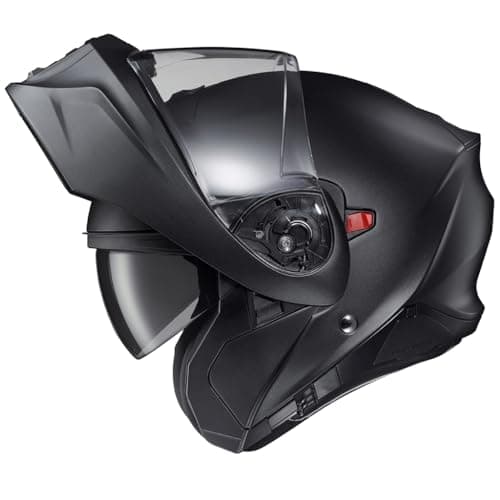
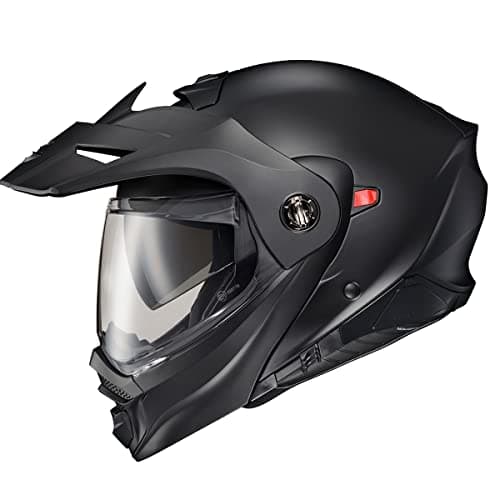
Buy the Scorpion EXO-AT960 if you want the current standard: it carries genuine DOT + ECE 22.06 and converts three ways - peak and visor, visor only, or peak and goggles - with a drop-down sun visor most adventure helmets omit. Buy the EXO-GT930 Transformer if what you want is a street helmet whose chin bar comes off entirely, turning it into a genuine open-face with P/J approval. Those are the two Scorpion helmets we rank, and the honest framing of this page is that we only rank what we can verify and link.
A word on that, because "which Scorpion should I buy" usually means "rank the whole EXO line for me." We will not: our catalog contains the models we have resolved to a live listing with a certification we could source, and inventing a ranking for helmets we have not checked would be exactly the behaviour this site exists to avoid. What we can tell you is what each of these two actually is, and which rider each one suits.
What both of them get right
Three things run through both helmets, and together they are the practical case for the brand at this price. First, convertibility: neither is a fixed one-piece helmet - the AT960 reconfigures for road or dirt and flips up, and the GT930 switches between full-face and open-face. Second, a drop-down internal sun visor on both, which is the feature that stops you carrying a second tinted shield; our sun-visor roundup has the AT960 in it for that reason. Third, eyeglass provision: RevZilla documents the AT960's KwikFit cheek pads as sculpted to accommodate most eyeglasses and lists the GT930 as compatible with most eye glasses, which is more than most makers put in writing - see our helmets for glasses guide for why we weight published claims so heavily there.
There is a fourth, less obvious one: size range. The AT960 runs XS-3XL and the GT930 XS-4XL, which makes Scorpion a genuinely useful brand if you are at the large end of the chart - most premium helmets stop at 2XL. Our big-heads guide covers that field.
Scorpion EXO-AT960 - the one with the current standard
The AT960 is the pick for most riders. It carries genuine DOT + ECE 22.06 - the current standard, including the rotational (oblique) impact test that 22.05 lacks - in an LG polycarbonate shell at about 1,860 g, and it is a genuine three-configuration helmet: run it with peak and visor as an adventure lid, visor only as a road helmet, or peak and goggles for dirt. It also flips up, and it has the sun visor.
Who it is for: adventure and dual-sport riders, and anyone who wants one helmet to cover a commute and a gravel weekend with the current certification on the shell. The honest cons: weight, which is the price of all that mechanism and of polycarbonate rather than composite, and noise - every peaked helmet catches air. Full detail in the EXO-AT960 review, and it is also in our budget ADV picks.
Scorpion EXO-GT930 Transformer - the one that becomes an open-face
The GT930 does something no other helmet we cover does: the chin bar comes off entirely, so it is a full-face on the highway and a true open-face in town, with the drop-down sun visor working in either mode. Crucially, its P/J homologation means the open configuration is a tested, approved one - P for the closed impact test, J for the open one - rather than an improvisation.
Who it is for: urban commuters and riders who want the open-face experience without owning two helmets. The honest cons, stated plainly: it is certified DOT + ECE 22.05, not the newer 22.06, so it lacks the rotational impact test - and a few marketplace listings claim 22.06 for this helmet, which we treat as unverified. At about 1,890 g it is heavy, and it is louder than a sealed one-piece. See the EXO-GT930 review and our open-face guide, where it is the convert-to-open pick.
Head to head
Certification: AT960 (22.06) over GT930 (22.05). If one factor decides it for you, make it this one. Versatility: both, differently - the AT960 spans road and dirt, the GT930 spans full-face and open-face. Weight: near-identical, and both are heavy. Glasses: both documented, the AT960 slightly more specifically. Sizes: GT930 reaches 4XL, AT960 stops at 3XL. We put them head to head in AT960 vs GT930 if you want the full comparison.
When a Scorpion is not the answer
If you want low weight, neither of these is close - both are around 1,860-1,890 g, where a carbon flip-up like the LS2 Advant X is about 1,550 g with 22.06 P/J, and a carbon full-face can be under 1,300 g. If you want quiet touring, a sealed premium modular beats a peaked or convertible helmet by design. And if you want independent impact data, note that neither of these has been SHARP-tested - the HJC RPHA 91 is the modular we point riders to when a published star rating is the deciding factor.
How to choose between them in one question
Ask yourself whether your riding ever leaves pavement. If it does - gravel roads, forest service tracks, anything where you might want goggles and a peak - buy the AT960, and you get the better certification as a bonus. If it genuinely never does, and what you actually want on a hot commute is air on your face, the GT930 is the more useful object, and you are accepting ECE 22.05 instead of 22.06 to get it.
Verify the ECE code on the helmet you receive
This matters more than usual here. A few marketplace listings advertise the GT930 as ECE 22.06; the sourcing we can find supports 22.05. The label sewn onto the chin strap settles it: a circled E, a country number, and an approval code beginning 06 for the current series or 05 for the previous one. On a flip-up, a P or J on that label tells you whether the chin bar was tested closed, open, or both.
Both of these helmets want a Pinlock
A convertible with a sun visor is a helmet whose outer shield stays clear, which makes fog the thing you have to manage. A Pinlock-style anti-fog insert is the fix, and it is the cheapest upgrade in motorcycling - our Pinlock guide covers fitment, and how to stop your visor fogging covers the rest.