The strongest argument against spending flagship money on a full-face is sitting right here: three of these four helmets publish genuine US DOT + ECE 22.06, the current revision with the oblique rotational-impact test, at budget prices. One of them is a ~1,474 g composite shell that undercuts helmets costing three times as much on weight as well as on price. Who this page is for: the rider who wants the certification the expensive helmets are praised for and does not want to pay for carbon, wind-tunnel hours or a famous badge to get it.
We have not crash-tested any of these helmets and we do not have a lab. Certifications come from the manufacturers' published homologations and the standards bodies, weights and specs from the manufacturers, and ride impressions are aggregated from owners. Every figure below is sourced at the foot of the page, and where something is not published - the Bell's ECE revision, most notably - we say so rather than guess.
How we ranked a budget full-face
Certification first. At this price the single biggest difference between helmets is whether the maker publishes a current ECE 22.06 approval or leaves you with DOT alone. DOT is the US legal minimum and it is self-certified; 22.06 is independently lab-tested and adds the rotational test. A budget helmet that publishes 22.06 is not a compromise on safety - it is a compromise on weight, finish and quiet, which is a completely different thing.
Then shell and weight, because the cheapest way for a manufacturer to hit a price is a heavy polycarbonate shell, and the grams show up in your neck on hour three. Then the shield and fog provision - a Pinlock-ready shield is the difference between a helmet you can ride in the cold and one you cannot. Then value: what you give up compared with the next helmet up. We did not rank on brand prestige, and we did not rank on looks except where the look is the entire point of the helmet, which on one of these four it is.
What a budget full-face does and does not cost you
It is worth being precise about the trade, because the internet is vague about it. What you give up under $300 is weight, quiet, finish and sometimes a sun visor. What you do not have to give up is the certification. Three helmets on this page carry the same ECE 22.06 mark as lids at four times the money, and the one that does not is a documentation gap rather than a known failure. The flagship premium buys carbon or composite weight savings, wind-tunnel aero, airtight window beading, plusher liners and better ventilation engineering. Those are real improvements to a long day in the saddle. None of them is the protection floor.
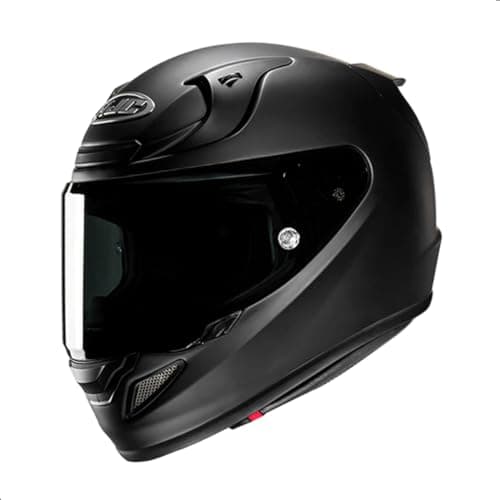
HJC RPHA 12 - the one most riders should buy
Our top pick, and it is not close on paper. The RPHA 12 is a genuine DOT + ECE 22.06helmet in HJC's PIM EVO composite - fiberglass, carbon and aramid - at a published ~1,474 g. That weight is the headline: it is lighter than most sport-touring helmets at any price, and dramatically lighter than the polycarbonate lids this bracket usually offers. It ships with a Pinlock-ready HJ-42 shield, and the shell and rear spoiler come out of wind-tunnel work aimed at lift, drag and noise. Who it is for: the rider who wants a flagship-spec sport-touring helmet and refuses to pay flagship money for it.
The honest cons: it has no SHARP result, so unlike an AGV K6 S there is no independent star score to point at - the 22.06 approval is the evidence, and that is a type approval rather than a comparative rating. There is also no drop-down sun visor, because it is a sport helmet, so you run a tinted shield or sunglasses. And the fit is sporty and snug rather than accommodating. Full detail is in the RPHA 12 review.
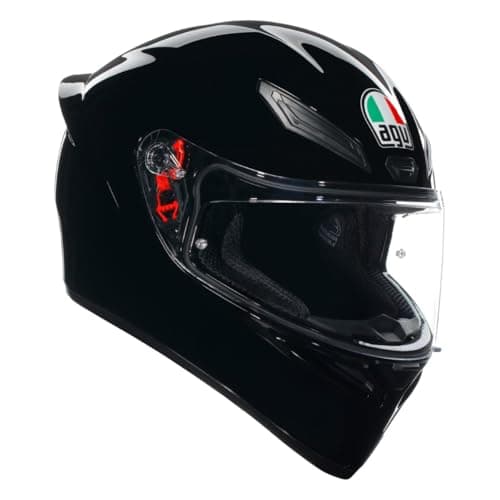
AGV K1 S - the cheapest genuine 22.06 full-face we rate
The K1 S is the one to buy if the RPHA 12 is out of budget or the wrong shape for your head. It publishes genuine US DOT + ECE 22.06in AGV's high-resistance thermoplastic shell, with a race-derived aero profile and a notably wide field of view - this is the entry point into AGV's sporting line rather than a separate budget design. Who it is for:the sport or commuting rider who wants the current standard and AGV's wide eyeport at the lowest price it comes at.
The honest cons: the thermoplastic shell is heavier at around 1,600 gand feels less premium than the RPHA 12's composite - you can tell which is the cheaper construction by picking both up. There is no sun visor, the sporty fit runs snug on round heads, and like the HJC it has no SHARP score. If you want a direct read on how it compares with the MIPS option below, we put them head to head in AGV K1 S vs Bell Qualifier DLX, and the model page is the K1 S review.
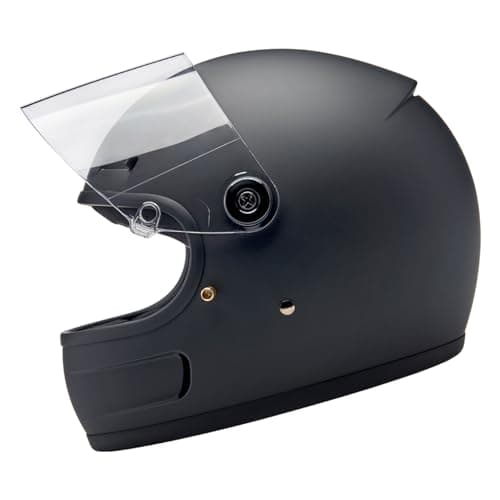
Biltwell Gringo SV - classic looks that kept the chin bar and the code
The Gringo SV sits at the top of this bracket and earns its place with a combination almost nothing else offers: retro styling, a real chin bar, and ECE 22.06 stated outright. Biltwell's own product page says "US DOT FMVSS No. 218 compliant / ECE R22.06 certified", and the US listing carries R22.06 in the title - which is rare in a category where classic looks usually mean a DOT-only shell or an open face with no chin bar at all. It is built in three shell sizes with five EPS options, so the shell actually scales with your head. Who it is for: the cruiser, retro or scrambler rider who wants the period look without dropping to the legal minimum.
The honest cons are real. It is heavy for a full-face at a published 3.69 lb (about 1,674 g) and the shell is injection-molded ABS rather than a composite. There is no drop-down sun visor and no published Pinlock provision, so sun and fog are managed with the shield you have - read our anti-fog guide before you ride it in the cold. Ventilation is basic by touring standards: vent ports added to a classic shell, not an aero project. See the Gringo SV review for the full picture.
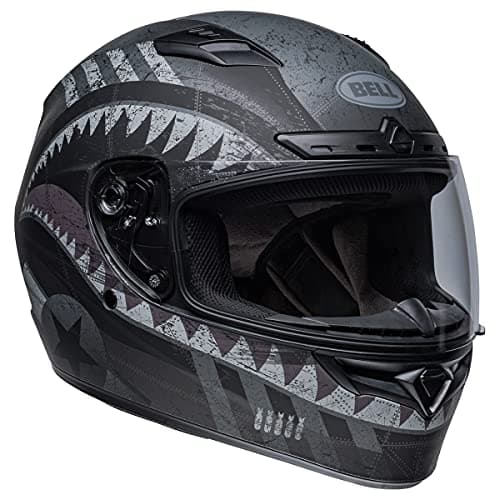
Bell Qualifier DLX MIPS - the feature pick, with the caveat we will not bury
The Qualifier DLX is the outlier here, and it ranks fourth for one reason only: it is the one helmet on this page whose ECE revision we cannot verify. Bell lists ECE for the model but does not publish the 22.05-versus-22.06 code for the US unit, so we will not assert the current standard on it. What is confirmed is DOT plus a MIPS rotational-management layer, which is a genuine addition on top of the US legal minimum rather than a marketing word. Who it is for: the rider who values convenience features and MIPS over a certification code they can name.
And the features are the appeal: MIPS at this price is unusual, and it ships with a ProTint photochromic shield that self-tints in sunlight and clears in shade, which is a feature normally reserved for much pricier helmets - our shield-types guide explains how those work. The honest cons: it is polycarbonate and heavy at around 1,626 g, the finish is functional rather than premium, and the unverified ECE revision is exactly the thing that drops it below three helmets that publish theirs. More in the Qualifier DLX review, and the step up is covered in Bell Qualifier DLX vs HJC RPHA 12.
Fit beats every spec on this page
A certified budget helmet that fits your head correctly protects you better than a flagship one size too large, because the certification tests assume a helmet that stays in place. That is not a platitude - it is the single most common way riders waste money at this end of the market, buying on price and then on reputation and never on shape. The RPHA 12 and K1 S both lean sporty-snug; the Gringo SV runs to its three shell sizes; the Qualifier DLX is the most accommodating shape of the four. Measure your head before you shortlist anything, using our head-measuring guide, and read helmet head shapes explained if helmets in your size have pinched before.
Where the budget bracket runs out
Two honest limits. First, none of these four has an independent SHARP score. SHARP tests a limited set of European models, and the US builds here were not among them, so the strongest evidence any of these can offer is a published type approval. If an independent star rating is what you want, our safest helmets guide covers the models that have one. Second, no helmet here is quiet. Wind-tunnel sealing and airtight window beading are flagship features, and if highway noise is your main complaint, earplugs will do more for you than any of these helmets - the physics is in our quiet-helmet guide.
It is also worth knowing what else this money buys outside the full-face class. If your riding includes dirt roads, the same budget gets a convertible dual-sport lid - the HJC DS-X1 is the cheapest one we can stand behind, with the certification caveat stated on its page. If you are shopping on looks first, read are Simpson helmets good? before you spend Bandit money, because the documentation story there is very different from the three publishers above.
So which budget full-face?
Want the best helmet on this page, full stop? The HJC RPHA 12 - genuine 22.06 in a ~1,474 g composite shell is flagship specification at a budget price, and nothing else here is close on weight. Need to spend less and still name your certification? The AGV K1 S. Want classic styling without giving up the chin bar or the code? The Biltwell Gringo SV. Want MIPS and a self-tinting shield and you are content with DOT plus MIPS as your floor? The Bell Qualifier DLX. All four are real helmets from real manufacturers; the ranking is about what each one can prove. For the full ranked list across every price, see our full-face helmet roundup, and for the lightest options at any money, best lightweight full-face helmets.
The Gringo SV is the one helmet here bought largely for its looks, so its homologation is worth reading on its own: Biltwell Gringo SV safety rating.