"Modular helmet with Bluetooth" means two different products, and most roundups blur them. One is an integrated smart helmet: the speakers, mic, battery and controls are built into the shell at the factory, and you buy the helmet and the intercom as one thing. The other is a comms-ready modular: a conventional flip-up with a recess, wiring channel and speaker pockets shaped for one specific intercom that the helmet maker sells separately, usually built for them by Sena or Cardo. This roundup ranks both kinds together, because that is how you shop for them, and it ranks them the way everything on this site is ranked: by the certification on the shell first, then by how well the Bluetooth is actually integrated, then by weight, quiet and price.
We haven't crash-tested these helmets or bench-tested their intercoms. Certifications come from the standards bodies and the manufacturers' own homologation statements, and every comms figure below (Bluetooth version, rider count, range, talk time) is taken from the helmet or intercom maker's current product page, which is listed in Sources. Where a maker does not publish a figure, we say so rather than fill it in.
How we ranked a Bluetooth modular
Certification leads. A helmet with a radio in it takes the same impacts as one without, and the comms carry no safety rating of their own, so the mark on the shell decides the order before any feature does. That is why a comms-ready helmet with ECE 22.06 P/J and an independent SHARP score outranks an integrated helmet that is DOT only, even though the integrated one is the more obvious answer to the search. Integration quality comes second: an intercom that drops into a purpose-built channel, with the speakers in molded pockets and no clamp on the shell edge, is quieter and cleaner than any universal bolt-on. Mesh is third, and only matters if you ride in groups: a Bluetooth-only intercom chains riders in a line that breaks when one drops out of range, while Mesh self-heals and scales to bigger groups. Then weight and quiet, because a modular already carries a hinge up high, and finally value. The two Senas here are the only picks where the radio is included in the price; for the other four you add the intercom on top, which the per-pick notes make explicit.
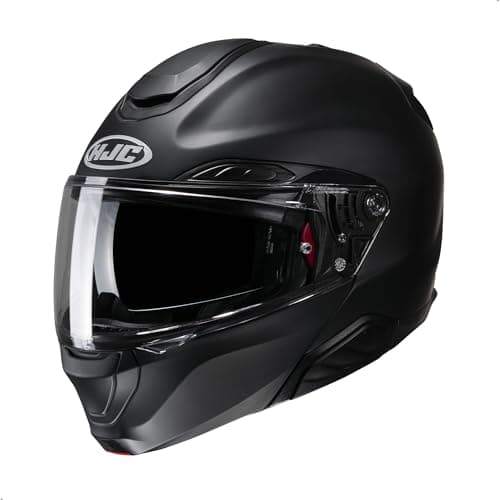
HJC RPHA 91 + Smart HJC — the best-certified Bluetooth modular
Our top pick, and it does not come with Bluetooth in the box. It wins because it is the best-certified helmet in this field by a distance (genuine ECE 22.06 with P/J, a 4/5 SHARP score) and because its comms integration is a purpose-built one. HJC states the RPHA 91 is compatible with its 2nd-generation Smart HJCsystem, which HJC describes as engineered in collaboration with Sena and tailored to its own helmets, so the unit sits in the shell rather than on it. You pick the tier: HJC's 11B is Bluetooth 5.1 with a 2-way intercom and a stated 400 m range; the 21B is Bluetooth 5.1 with a stated 1,600 m intercom range; and the 50Badds Mesh intercom (Open and Group) with a 9-way intercom and a stated 2,000 m range. All three list up to 13 hours of talk time, and all three name the RPHA 91 as a compatible shell. The honest cons: the intercom is an extra purchase that moves this from a mid-priced helmet to a premium all-in cost, the 11B and 21B were both showing sold out on HJC's US store when we checked (retail stock varies, so check before you order the helmet on the assumption), and the RPHA 91 is not as whisper-quiet as a Neotec 3. But for a rider who wants the certification done properly and the Bluetooth done cleanly, this is the one. Read the full RPHA 91 review and the safety-rating explainer.
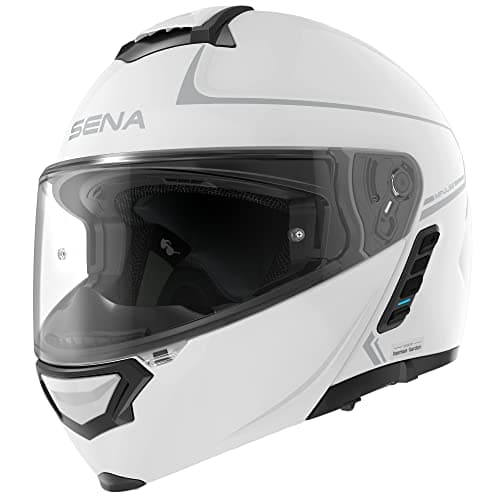
Sena Impulse — the best modular with Bluetooth built in
If you want the radio in the box, this is the flip-up to buy. Sena's page states Bluetooth 5.0, Mesh Intercom 3.0 in both Open Mesh and Group Mesh modes (Group Mesh up to 24 participants), Harman Kardon speakers and microphone, a stated intercom range of up to 2 km (1.2 mi) in open terrain, and talk time of up to 20 hours on Bluetooth or 13 hours on Mesh from a 1,300 mAh battery that charges in about 2.5 hours through a magnetic pogo connector. The helmet side is just as complete: a composite fiberglass shell, a retractable sun visor, an integrated rear-facing taillight, a Pinlock-ready shield with the insert included, built-in FM radio and voice commands. Sena lists the DOT version at 1,760 g in a medium. The honest cons are the ones that come with every integrated helmet: the shell is DOT-rated in the US (Sena sells a separate ECE version in Europe), there is no P/J or SHARP data to point to, it is heavier than the RPHA 91, and when the electronics age you replace the whole helmet rather than the unit. Full detail in the Impulse review.
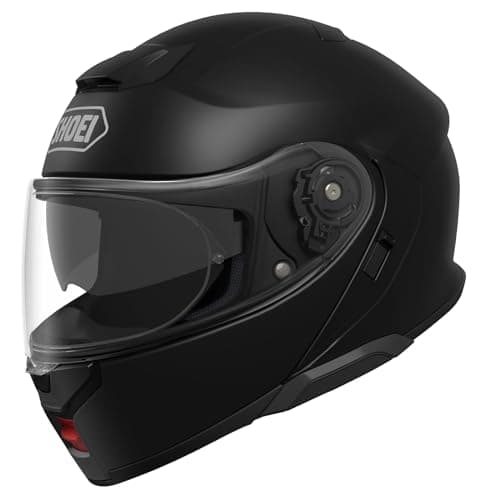
Shoei Neotec 3 + SRL3 — the quietest Bluetooth modular
The premium comms-ready pick. Shoei built the Neotec 3 around the Sena SRL3, which Shoei lists with Group Mesh for up to 24 members, HD speakers and Bluetooth 5.0, so a Neotec 3 with the SRL3 fitted has no external unit at all: the controls sit flush on the shell and the speakers live in the liner. Add the seal, the QSV-2 sun visor and the AIM composite shell, and you get what the market treats as the quiet-touring reference, which matters more with an intercom than without because you hear the road less and your riding partner more. The honest cons: the US Neotec 3 is a DOT build, not the ECE 22.06 P/J version Europe gets (that one scored 5/5 in SHARP; the US unit is a different homologation), the SRL3 is a separate premium purchase on top of the priciest shell here, and at 4.15 lb (about 1,880 g) it is the heaviest pick. If silence and finish lead and you have accepted the certification note, nothing here is more pleasant to ride in. See the Neotec 3 review.
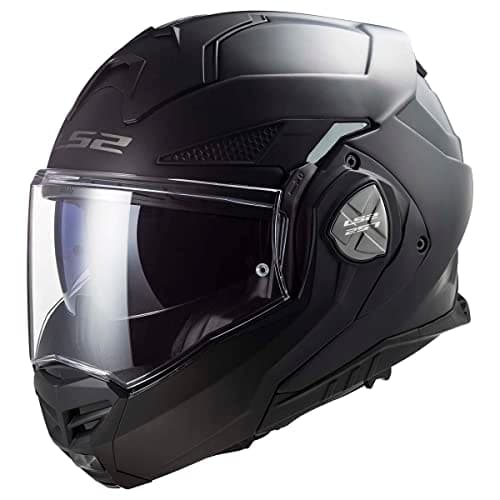
LS2 Advant X + LS2 4X — the lightest ECE 22.06 Bluetooth modular
The Advant X is the certification bargain of the modular field, a genuine DOT + ECE 22.06 P/Jflip-up in a forged-carbon shell at roughly 1,550 g, and its comms story is Cardo's rather than Sena's. LS2's purpose-made LS2 4X intercom is co-developed with Cardo and lists the Advant X and Advant X Carbon by name: live intercom for up to 4 riders, a stated range of up to 1.2 km (0.75 mi), 13 hours of talk time, 40 mm JBL speakers, always-on natural voice operation ("hey Cardo"), and Cardo's universal connectivity so it pairs with other brands' Bluetooth intercoms. It is described as waterproof, though LS2 does not publish an IP number. The honest cons: the 4X is a Bluetooth-only, 4-rider unit with no Mesh, so big-group riders should look at the Impulse or a bolt-on Packtalk instead; the 180-degree flip and the modular seams make the Advant X louder at highway speed than a sealed Neotec 3; and it uses a micrometric ratchet rather than a Double-D ring. For the rider who wants current ECE 22.06 P/J, a light shell and a clean 4-rider intercom, it is a lot of helmet for the money. Full detail in the Advant X review.
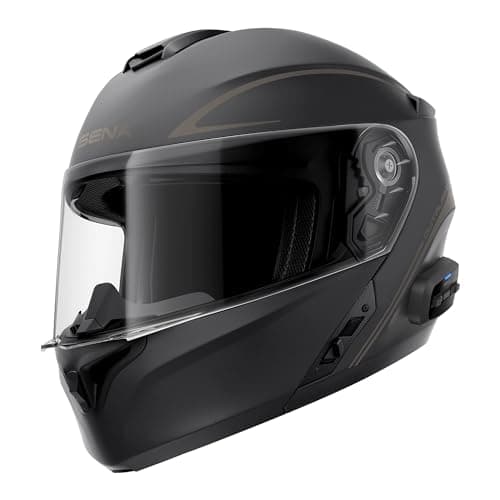
Sena Outrush R — the budget modular with Bluetooth built in
The cheapest way into an integrated flip-up. Sena lists Bluetooth 5.1, a rider-to-rider intercom for up to 4 riders with a stated range of up to 900 m (0.6 mi) in open terrain, up to 18 hours of talk time, a 2.5-hour charge, built-in speakers and mic, an inner sun visor, and a single-shell polycarbonate ABS construction at 1,730 g in a medium. Setup is a big jog dial and the Sena Motorcycles app. The honest cons are exactly what the price buys: it is Bluetooth only, so no Mesh and a 4-rider cap; the speakers are ordinary next to the Impulse's Harman Kardon set; Sena does not publish Pinlock, FM or voice-command features for it on its product page; the US unit is DOT-rated with no ECE 22.06 or SHARP data; and as with the Impulse, the comms cannot be upgraded separately. For a solo commuter or a fixed riding pair who want a flip-up with the intercom already in it and nothing to install, it is the honest value pick. See the Outrush R review.
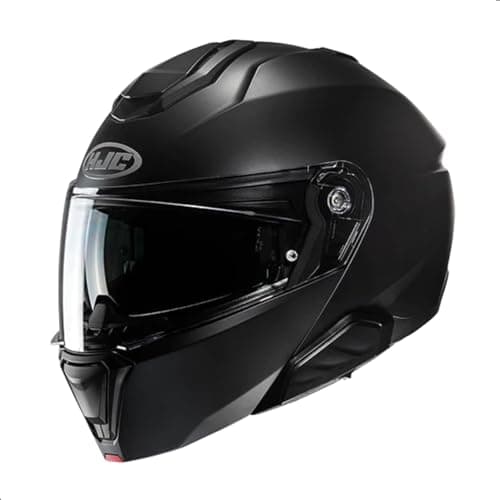
HJC i91 + Smart HJC — the budget comms-ready modular
The other way to get a cheap Bluetooth flip-up: buy HJC's budget modular and add the intercom later. HJC states the i91 is Bluetooth compatible with the 2nd-generation Smart HJC system, and HJC's 11B page lists the i91 by name among its applicable helmets. The 50B page's compatibility list names the RPHA models and the i71 but not the i91, so if you want the Mesh-capable 50B on an i91 specifically, confirm fitment with HJC before you buy. The helmet itself has the drop-down HJ-V12 sun visor, a Pinlock-prepared HJ-33 shield, and a polycarbonate composite shell HJC says meets DOT FMVSS 218. The honest cons: it is DOT only on the US listing (we do not assert ECE 22.06 on it, because HJC's European i91 exists in both 22.05 and 22.06 builds), the polycarbonate shell is heavier and less refined than the RPHA 91, and the intercom is still an extra purchase, which narrows the gap to the Outrush R once the radio is added. Full detail in the i91 review.
Built-in vs comms-ready: which should you buy?
Buy integrated (Impulse, Outrush R) if you want zero installation, one warranty and one brand to call, and if you accept that the helmet and the electronics retire together. The Impulse is the one to get if your group rides on Mesh; the Outrush R if you ride alone or with one partner. Buy comms-ready (RPHA 91, Neotec 3, Advant X, i91) if certification leads your decision, because the two best-certified helmets on this page are both comms-ready, and if you like being able to replace or upgrade the intercom without replacing the shell. The trade is a second purchase and a short install. There is a third route: any of the four comms-ready shells, and most other modulars, will also take a universal bolt-on such as the Cardo Packtalk Edge or the Sena 50S, which is the answer if you already own the helmet or want to move the intercom between helmets; the cost is a clamp on the shell edge and slightly more wind noise than a flush, purpose-built unit.
Two things to check before you order
First, Mesh compatibility inside your group. Sena Mesh and Cardo DMC do not talk to each other over Mesh, only over the ordinary Bluetooth intercom bridge, so a Sena-based helmet (Impulse, SRL3, Smart HJC) and a Cardo-based one (LS2 4X, Packtalk) will pair rider to rider but will not share one self-healing network. If your friends already ride on one system, that is a bigger deciding factor than any spec on this page. Second, the certification label on the actual unit: the RPHA 91 and Advant X carry ECE 22.06 P/J, while the two Senas, the US Neotec 3 and the US i91 are DOT builds, and both Senas are sold in separate DOT and ECE versions by region. The comms do not change any of that. Our are modular helmets safe? explainer covers what the P/J mark and the SHARP latch score mean before you ride any of them open.
So which Bluetooth modular?
If certification leads and you are happy to add the unit, buy the HJC RPHA 91 and the Smart HJC tier your group needs. If you want it built in and you ride in groups, buy the Sena Impulse. If silence and finish lead, buy the Shoei Neotec 3 with the SRL3, knowing the US build is DOT. If you want ECE 22.06 in a light shell with a clean Cardo-based intercom, buy the LS2 Advant X and the 4X. And if budget leads, the Sena Outrush R has the radio in the box, while the HJC i91 leaves it for later. Whichever you choose, get the fit right first: our head-measuring guide is the step that makes any certification, and any speaker position, actually work.