The best motorcycle helmet with Bluetooth built in is the Sena Impulse: an integrated modular running both Mesh 3.0 and Bluetooth 5.0, with Harman Kardon speakers and mic, a drop-down sun visor and an integrated rear taillight, on a DOT shell. Who it is for: the rider who wants everything in one box and rides in groups big enough that Mesh matters. Cheapest route in is the Sena Outrush R, and the fourth pick on this page is deliberately not an integrated helmet at all - because for a lot of riders the right answer is a better shell plus a bolt-on, and we would rather say so than sell you the category.
A word on what we can and cannot tell you. We do not crash-test helmets and we have no lab.Each certification below is the manufacturer's published homologation, cited at the foot of the page, and the comms specifications are the makers' own figures. One point matters more here than anywhere else on this site: the comms module carries no helmet rating whatsoever. Mesh version, speaker brand and talk time tell you nothing about the shell, and an integrated helmet should be judged as a helmet first.
What "built in" actually buys you
Three real things. Fit and finish: the speakers sit in purpose-moulded pockets at the correct depth, the mic is positioned by the designer rather than by you with a sticky pad, and there is no battery pod hanging off the side to catch wind. One charger, one app, one thing to remember. And price, usually - an Outrush R costs about what a decent mid-range modular costs on its own, so the comms are effectively bundled.
And three real costs. You cannot upgrade the comms independently - when the chipset is two generations old, you replace the helmet. You are buying one brand's opinion of a helmet, and Sena is a comms company, which is why every integrated helmet here is a DOT build and none carries ECE 22.06 or a SHARP score. And the helmet ages at the speed of the electronics, not at the speed of a shell - helmets get replaced on a schedule anyway (the reasons are in when to replace a helmet), but a dead battery in a perfectly good shell is a genuinely annoying way to get there.
How we ranked them
The shell first, because it is still a helmet: what certification the maker publishes for the US unit, and what format it is. Then the network - Mesh versus plain Bluetooth, because that is the single biggest functional difference in comms and it decides whether a group of six works at all. Then audio and features - speaker quality, sun visor, lighting. Then value, measured honestly against the cost of a better helmet plus a separate unit.
| Pick | Format | Network | Shell certification (US) | Standout feature |
|---|
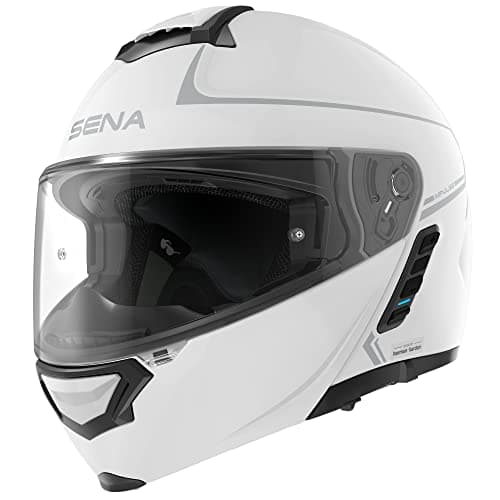
| Sena Impulse | Integrated modular | Mesh 3.0 + BT 5.0 | DOT (Sena sells ECE separately in Europe) | Harman Kardon audio, sun visor, rear taillight |
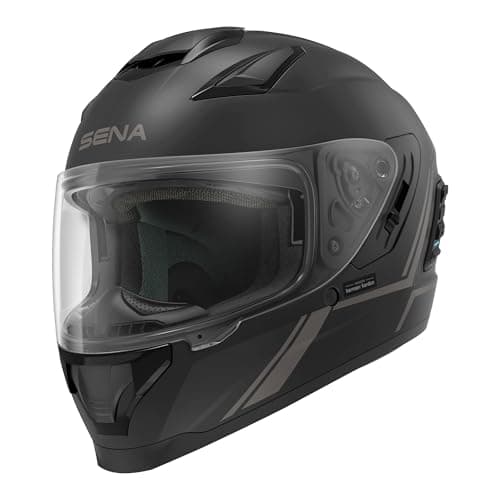
| Sena Stryker | Integrated full-face | Mesh 3.0 + BT 5.0 | Not published by Sena as a named revision - treat as the DOT US build | Harman Kardon speakers and mics |
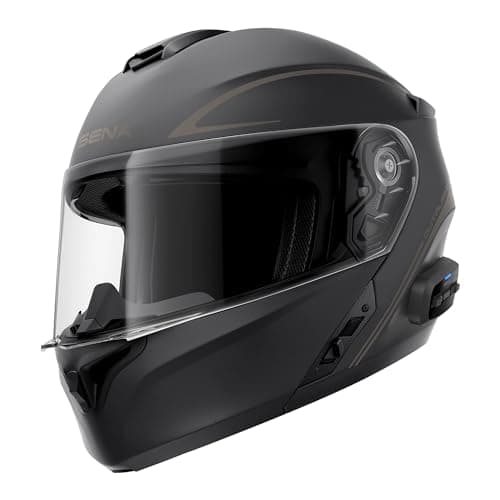
| Sena Outrush R | Integrated modular | Bluetooth 5.1 only | DOT (ECE version sold separately in Europe) | Comms-equipped modular for mid-modular money |
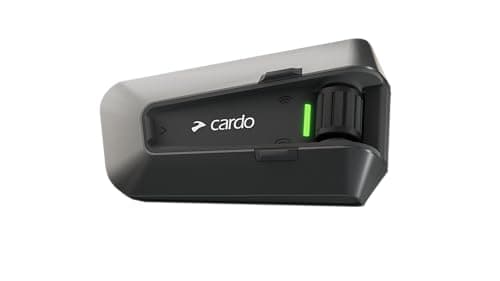
| Cardo Packtalk Edge (bolt-on) | Fits the helmet you already own | DMC dynamic Mesh, up to 31 riders | n/a - your helmet's certification applies | JBL 40 mm speakers, IP67 |
Sena Impulse - the complete one-box answer
The Impulse is the only helmet here that leaves nothing on the table. It runs both Mesh and Bluetooth, so a group ride self-heals as riders drop in and out instead of collapsing the way a four-rider Bluetooth chain does. It has Harman Kardon speakers and microphone, a drop-down internal sun visor, and an integrated rear-facing taillight - a visibility feature nothing else in this roundup offers. Who it is for: the rider who wants helmet, comms, audio and visibility in a single purchase and rides with more than two other people.
The honest cons: Sena sells the Impulse as a DOT version in the US and a separate ECE version in Europe, so confirm the label on the unit you receive - and that DOT build is the weakest certification story in this comparison relative to what a dedicated helmet maker would publish. It is not SHARP-tested. And like every integrated helmet, the comms cannot be upgraded on their own. Full detail in the Sena Impulse review.
Sena Stryker - the full-face version of the same idea
If you do not want a flip-up, the Stryker is the integrated full-face: Harman Kardon speakers and mics, both Mesh 3.0 and 4-way Bluetooth, and the cleanest possible installation because it is the helmet. Who it is for: the full-face rider who wants Mesh without a bolt-on and likes the fit.
The honest cons: you are buying the helmet and the comms together with no mixing of brands, Sena publishes no IP waterproof rating for it, so treat it as water-resistant rather than immersion-rated, and we have no named ECE revision or SHARP result to show you for the shell. See the Sena Stryker review, and the direct comparison with the cheaper option below is Stryker vs Outrush R.
Sena Outrush R - the cheapest way in, and the one with the real catch
The Outrush R is the value pick and the most-bought integrated helmet for a reason: it is a flip-up with comms built in for roughly the price of a mid-range modular alone, with a big glove-friendly jog dial and a simple one-brand setup. Who it is for: the solo or two-up rider who wants intercom and phone audio without a second purchase or a second app.
The honest cons, and the first is the decisive one: it is Bluetooth only - there is no Mesh, so groups are capped at four riders and range is shorter, and no firmware update changes that. Sena publishes no IP water rating, and the US unit is a DOT build with the ECE version sold separately in Europe. If you ride in groups of five or more, buy Mesh - either the Impulse above or a bolt-on. More in the Outrush R review.
Cardo Packtalk Edge - why the fourth pick is not an integrated helmet
We put a bolt-on in this roundup deliberately, because for a lot of people searching for a Bluetooth helmet the better buy is the best helmet you can afford plus a Packtalk Edge on the side. The Edge runs true dynamic Mesh for up to 31 riders with Cardo's Mesh Boost update, has JBL 40 mm speakers, is IP67 rated - genuinely weatherproof rather than water-resistant - and attaches to the helmet you already own. Who it is for: the rider who wants a helmet with a certification they can name, and comms that can be moved to the next helmet.
That route is how you get ECE 22.06 and comms at the same time, which no integrated helmet on this page offers: an HJC RPHA 91 (22.06 P/J, SHARP 4/5) or an LS2 Advant X (22.06 P/J at ~1,550 g) with an Edge clipped on is a stronger safety story than any one-box helmet currently sold. The honest cons of going this way: it costs more in total, the magnetic Air Mount is a proprietary part to keep track of, and the 31-rider ceiling assumes everyone in the group has the Mesh Boost update - mixed groups drop back to 15. Detail in the Packtalk Edge review.
Integrated or bolt-on? The decision in two lines
Buy integrated if you want one box, one app and one charger, you are replacing your helmet anyway, and a DOT shell is acceptable to you. Buy a helmet plus a bolt-on if you want a named certification like ECE 22.06 on the shell, you already own a helmet you like, or you expect to upgrade the comms before the helmet. There is no third answer, and the cost difference is smaller than it looks once you price the helmet you actually want. The whole bolt-on shelf is ranked at Bluetooth helmets and intercoms, with the budget end at best budget intercoms.
Things people get wrong about Bluetooth helmets
Mesh is not "better Bluetooth". It is a different topology: a self-healing network where riders can drop out and rejoin without re-pairing the chain, which is why a Bluetooth group of six is misery and a Mesh group of six is fine. Cross-brand does not do Mesh. Sena Mesh does not bridge to Cardo DMC; mixed groups fall back to plain Bluetooth, so match the group, not the review - we cover that in Sena vs Cardo. And the speakers are the ceiling on audio quality, not the phone: 40 mm drivers in a sealed pocket are what make music listenable at speed, which is why the music question has its own page at best intercoms for music. Pairing anything to anything is covered in how to pair a Sena unit.
So which one?
Want everything in one box, including Mesh and a taillight? The Sena Impulse. Want that in a full-face? The Sena Stryker. Want the cheapest integrated flip-up and you ride alone or in a pair? The Sena Outrush R. Want a certification you can name on the shell and comms you can keep? Buy a certified modular and a Cardo Packtalk Edge.