HUB 06 · Buying Guides & How-To
How to Stop Your Helmet Visor Fogging Up
Fog on the inside of your visor is condensation from your own breath — and there's a clear hierarchy of fixes, from the one that genuinely works to the ones that just help. Here's what stops it, in order.
We earn a commission when you buy through our Amazon links, at no extra cost to you. It never changes a ranking, and we tell you when the cheaper helmet is the better buy. How this works.

Fog on the inside of your visor is condensation: warm, moist breath meets a cold shield and turns to a film of tiny droplets. It's worst on cold, damp days and at low speed when there's no airflow — exactly when you least want to be blind at a junction. The good news is that it's one of the most solvable problems in motorcycling, and there's a clear hierarchy of fixes. We'll take them in order of how well they actually work.
The best fix: a Pinlock insert
If your helmet is Pinlock-ready — most modern mid-range and premium lids are, including the Shoei RF-1400 and HJC RPHA 91 — this is the answer, and nothing else on this page comes close. A Pinlock insertis a second lens that clips onto pins inside your visor and seals with a silicone bead, creating an insulating air gap. The inner lens stays warm and its moisture-absorbing material keeps it clear, so fog simply doesn't form. It's the closest thing to a permanent fix short of a heated visor. See our Pinlock inserts and shields roundup for the right one for your helmet, and the installation guide — it takes about two minutes. The only catch is that inserts are shield-specific, so you must match the insert to your exact visor.
The rider's habit: crack the visor and breathe down
Free, and it works in a pinch. Cracking the visor to its first detent lets a little airflow sweep moist air out — most helmets have a "city position" exactly for this. Combined with a closed chin vent redirecting airflow up the inside of the shield, it clears a lot of fog. Many riders also learn to breathe downward, directing breath away from the visor. None of this is as reliable as Pinlock, but it costs nothing and helps immediately, especially at a stop.
The breath deflector / chin curtain
Most helmets include a breath deflector (or breath guard) that clips above the chin bar to channel your exhaled breath downward and out, away from the visor. If yours came with one and you removed it, refit it — it makes a real difference on cold days. A chin curtainhelps too, though it can slightly increase fog by trapping warm air, so on very foggy days some riders remove the curtain and rely on the deflector plus a cracked visor. It's worth experimenting with what your helmet came with before spending anything.
Anti-fog sprays and coatings: the last resort
Sprays and wipe-on coatings do work, but modestly and temporarily — they lower the surface tension so condensation spreads into a thin clear film rather than droplets, and they wear off within days to weeks and need reapplying. They're a reasonable stopgap if your helmet isn't Pinlock-ready, or a backup for extreme cold, but they're not a substitute for a Pinlock insert. Avoid household glass cleaners and anything abrasive on a visor — they can damage the anti-scratch and UV coatings; use only products made for polycarbonate shields.
What not to do
Don't wipe a fogged visor with your glove while riding — you'll smear it and can scratch the coating. Don't rely on riding faster to clear it; that works above 30 mph or so but leaves you blind exactly at the low-speed junctions where fog is worst and crashes happen. And don't buy a cheap universal "Pinlock-style" insert that isn't cut for your shield — it won't seal. If your visor is also scratched or hazed, a fresh shield is the right first step; see when to replace your visor.
Fog in freezing conditions
The colder it gets, the harder fog is to beat, because the temperature gap between your warm breath and the cold visor is what drives condensation. A Pinlock insert still wins here — its insulating air gap is exactly what a freezing morning needs — but even a Pinlock can be overwhelmed if you close everything up and breathe hard in sub-zero cold. On the worst days, combine the Pinlock with a cracked visor and an open chin vent for a little airflow, and fit the breath deflector. Riders who commute through real winters sometimes run a Pinlock and an anti-fog spray on the outer edges as belt-and-braces.
One cold-weather trap to avoid: don't bring a cold helmet into a warm room and expect the visor to clear instantly — condensation forms on the outside then, too, and wiping a cold visor with a warm cloth can smear it. Let the helmet come up to temperature, and keep a clean microfiber in your jacket for the outside of the shield. Fog is beatable in any weather; it just takes the right layered approach as the mercury drops.
The bottom line
If your helmet is Pinlock-ready, buy the matching Pinlock insert and be done with fog for good. If it isn't, refit the breath deflector, learn to crack the visor at stops, and keep an anti-fog spray as backup. Fog is a two-dollar-to-thirty-dollar problem, not a reason to be unsafe — and on a wet winter commute, solving it is the best small upgrade you can make.
Low-cost add-ons
Small stuff that actually helps
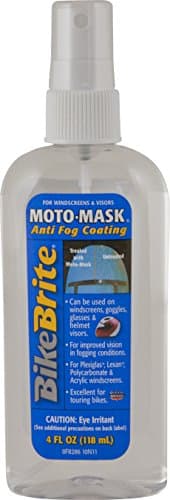
Visors that are not Pinlock-ready
Bike Brite Moto-Mask Anti-Fog Coating
The answer for a visor that cannot take a Pinlock insert. A treatment is second-best to a Pinlock lens and our guide says so — but on a shield with no pins, it is the fix you actually have.
Skip it if your visor IS Pinlock-ready — buy the insert cut for your shield instead. It works better and it does not wear off.
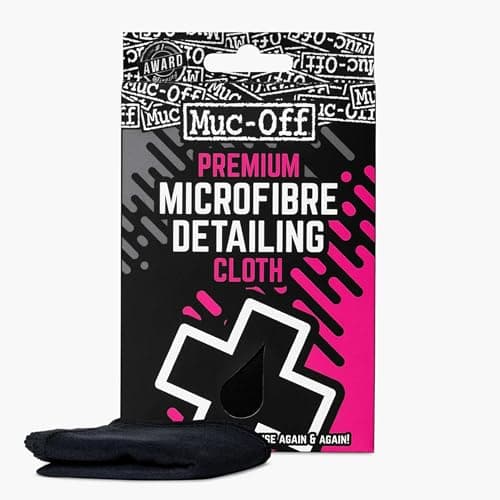
Visor wipe-downs without micro-scratching
Muc-Off Microfiber Detailing Cloth
A known motorcycle-care brand's microfiber cloth, sold for helmets, visors and goggles. Unglamorous, and the item most likely to save your visor from the scratches paper towel leaves.
Skip it if you already keep clean, dedicated microfiber cloths for the visor — this adds nothing over one you own.
#ad · Prices as of Sep 18, 2026, pulled live from Amazon; where we have no verified price we show none. We may earn a commission.
Questions
Frequently asked
Why does the inside of my motorcycle helmet visor fog up?
What's the best anti-fog solution for a motorcycle helmet?
Do anti-fog sprays actually work?
Keep reading
Related
Receipts
Sources
We do not run a crash lab, and we do not pretend to. Certifications are cited to the standards body or the manufacturer's stated homologation; where a US model's certification differs from its European namesake, we say so. Where we could not verify something, we say so on the page rather than quietly leaving it out. Read our full method.