A cruiser is the hardest bike on this site to buy a helmet for, and it is not because cruiser helmets are a separate species. It is because everything around the helmet is different. You sit bolt upright with your chest square to the air, there is usually no fairing to hide behind, the sun is on your face from the first mile to the last, and the culture around the bike quietly pushes you toward wearing less helmet rather than more. Those four facts reshuffle which features matter and in what order, and they are what the six picks below are ranked on.
We have not crash-tested anything and we do not own a lab. Everything here is built from published manufacturer specifications, the homologation printed on the box sold in the US, independent SHARP results where they exist, and aggregated owner reports - exactly as our methodology sets out. Where a certification claim differs between the American and European versions of the same helmet - which on the touring lids cruiser riders gravitate to is very often the case - we say so instead of quoting whichever number flatters the helmet.
What actually changes when the bike is a cruiser
You meet the air face-on. A sportbike rider is tucked, so the wind arrives at the top of the shell and slides over it. Sitting upright on a cruiser, the same wind arrives at the eye port and the chin bar, and it arrives after hitting your chest first. Shell shapes tuned in a wind tunnel for a crouched rider are not being asked the same question in that posture, which is why touring-shaped helmets so often feel calmer on a cruiser than a sport lid with a better spec sheet does.
Your windshield is part of the helmet system.This is the cruiser-specific problem nobody warns first-time buyers about. A screen that is too tall pulls chaotic low-pressure air in from the sides and below; a screen that is too short throws turbulent air directly at your chest and face. Either way the pulses land on the helmet, and the result is buffeting - a low droning shake that can genuinely blur your vision. The widely repeated fix is a screen whose top edge sits around nose level when you are upright in the saddle, so clean air is pushed up and over your head rather than tumbling into it. No helmet on this page fixes a badly-sized windshield. Some cope with one better than others, and that is what "seal" is doing in our scoring.
Sun is a safety feature, not a comfort feature. There is no fairing, no screen tint and usually no visor peak between your eyes and a low sun. Swapping to a dark shield means carrying a clear one for the ride home; sunglasses mean threading arms past a cheek pad. A drop-down internal sun visor solves it with one lever, mid-corner, without stopping. On a cruiser it is the single highest-value feature on the spec sheet, and it is why our top pick is the touring full-face rather than the better-certified one.
Weight lands differently on a vertical spine. Upright, there is no tank to brace on and no forward lean to carry the mass; the helmet sits straight down on your neck and every gram is felt at hour four rather than hour one. It is also why a helmet that catches wind - a big shell, a peak, a bad screen interaction - is more tiring on a cruiser than on anything else. Our helmet weight guide goes through what actually drives the number.
And then the chin bar. This is where cruiser culture and the certification data disagree most sharply. A full-face is the only common helmet type that guards the chin with a tested bar, a large share of helmet impacts land there, and the standards that test for it simply cannot be earned by a helmet that has no bar to test. We are not going to pretend otherwise, and we are also not going to pretend nobody wants an open-face. So the ranking below runs from most protective to least, one honest open-face is included at the bottom, and what you give up to get it is written out rather than implied. The full type-by-type breakdown lives in types of motorcycle helmets.
How we ranked these six
In this order: coverage and the certification the US box actually carries, then sun management, then seal and quiet in unfaired air, then weight on an upright neck, then comms integration, and only then price. Style is real and we are not going to sneer at it - two of these six are here largely because they look right on a cruiser - but it never moved a helmet up past a certification it does not hold.
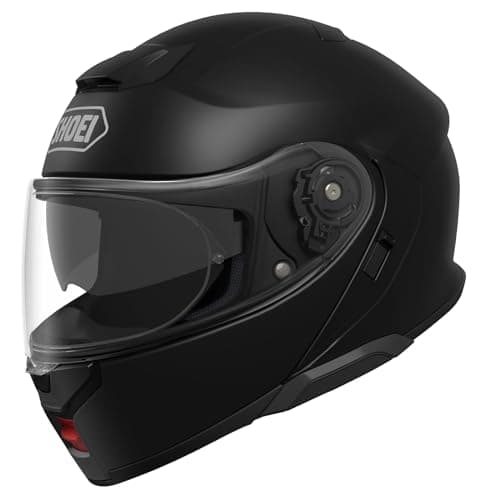
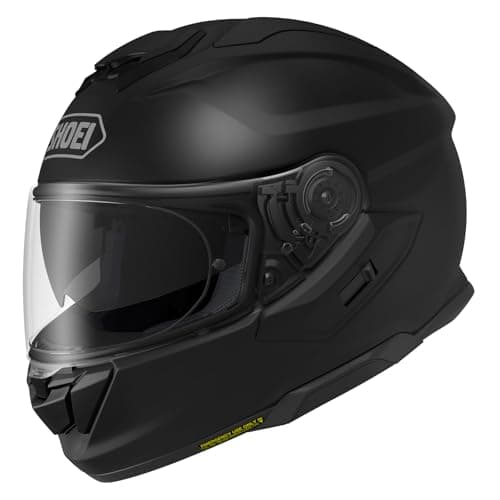
Shoei GT-Air 3 - the best all-round cruiser helmet, sun visor and all
The GT-Air 3 is our top pick here despite not being the best-certified helmet on the page, and the reason is the list above. It is a touring-shaped full-face with a genuinely good drop-down internal sun visor, an AIM composite shell at around 1,774 g, a seal and shield mechanism that behave in dirty air, and a purpose-built channel for the Sena SRL comms so you are not clamping a battery to the outside of a helmet that already meets the wind face-on. For a rider who does long daylight miles upright behind a screen, that combination is worth more than a stronger mark on a helmet with no sun visor.
The honest cons, and they matter: the US-market GT-Air 3 is a DOT build. The European GT-Air 3 is ECE 22.06 and scored a full 5/5 with SHARP, but that is a different homologation from the one on the box you receive here, and we are not going to let the European result do the American helmet's marketing. It is also heavier than a sport full-face and priced like the flagship it is. Full detail in the GT-Air 3 review.
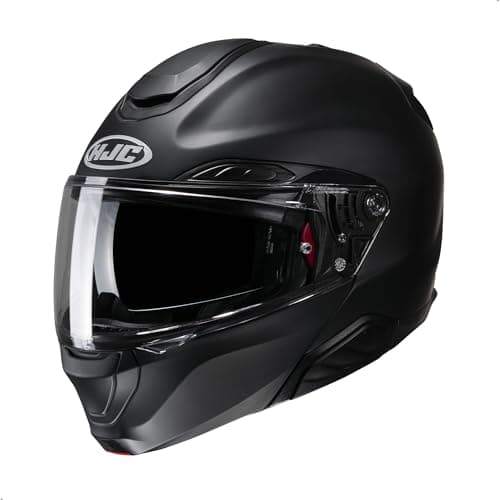
HJC RPHA 91 - the best-certified pick, and the chin bar lifts
If the certification is what you want to buy, this is the helmet on this page that gives it to you. The RPHA 91 carries genuine ECE 22.06 with P/J dual-homologation - legally approved to ride with the chin bar raised, not merely tolerated - plus an independent 4/5 SHARPresult, in a PIM EVO composite shell around 1,740 g, at roughly half a Shoei flagship's money. For a cruiser rider that P/J mark is unusually relevant: it is the closest thing to having both a certified full-face for the highway and an approved open-face for the slow parade through town, in one helmet, without buying two.
The honest cons: it is not as quiet as a Neotec 3 and it does not seal as tightly in turbulent air, the interior is a notch less plush than the premium Japanese brands, and it runs XS-2XL, so it runs out of sizes sooner than the budget flip-ups do. See the RPHA 91 review and the independent data in its safety rating.
Shoei Neotec 3 - for long two-up highway days behind a big screen
If most of your cruiser miles are interstate, two-up, behind a tall windshield, quiet stops being a luxury and starts being the thing that decides whether you can still hold a conversation at the fuel stop. The Neotec 3 is the quiet benchmark among modulars, with an excellent seal, a drop-down sun visor and a dedicated channel for the Sena SRL3 - which matters more than usual when you are riding with a passenger you actually want to talk to. The flip-up front is also the easiest of these six to live with at lights, at gas pumps and anywhere you need your face back for thirty seconds.
The honest cons are the same two we state everywhere: the US Neotec 3 is DOT only - the 5/5 SHARP score and the 22.06 P/J mark belong to the European unit - and at around 1,880 g it is the heaviest helmet on this page, on the riding position least able to disguise it. It is also the most expensive. Detail in the Neotec 3 review, and the two are compared directly in Neotec 3 vs GT-Air 3.
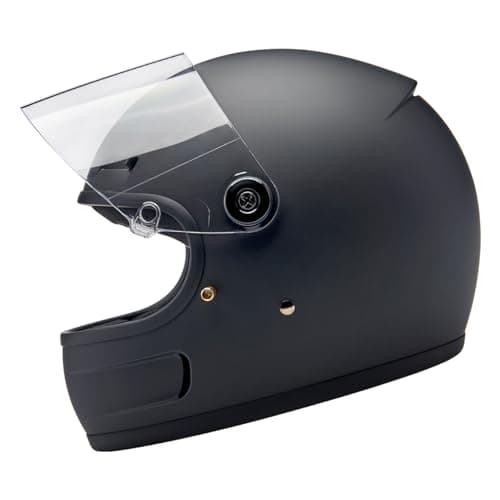
Biltwell Gringo SV - the classic look, with the chin bar kept
This is the pick for the rider who is on this page because the other five look wrong on the bike. The Gringo SV is a retro-shelled full-face that carries "US DOT FMVSS No. 218 compliant / ECE R22.06 certified"in Biltwell's own words - which makes it one of very few classic-styled lids holding the current rotational-impact revision rather than a 22.05 carry-over. Underneath the styling it is a serious helmet: injection-molded ABS over a dual-density EPS liner, three shell sizes with five EPS options across XS-2XL, front, side and rear vent ports, molded EPS ear pockets that take a comms unit, a removable washable liner, and a CE-certified polycarbonate shield with anti-fog and anti-scratch treatments on a D-ring strap with a quick-release pull tab.
The honest cons are real and you should weigh them. There is no drop-down sun visor and Biltwell publishes no Pinlock provision, so you are managing glare and fog with one shield and whatever you do to it - our fogging guide covers the options when there are no Pinlock pins. It is heavy for a full-face at a published 3.69 lb (about 1,674 g), it is ABS rather than composite, and the vent set is basic next to a touring helmet - it is a classic shell with vent ports added, not an aerodynamics project. Buy it knowing exactly that, and it is the most honest-looking helmet here.
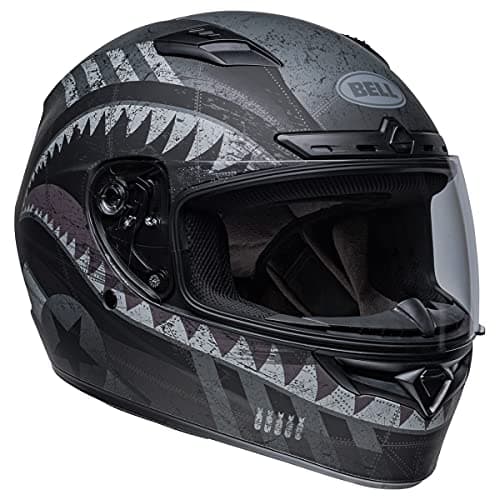
Bell Qualifier DLX MIPS - the budget pick that brings something real
Most budget full-faces save money by giving you nothing but the legal minimum. The Qualifier DLX does two unusual things at its price: it includes a MIPS rotational-management layer, and it ships with a ProTint photochromic shield in the box - a shield that darkens in sunlight and clears again afterward. On a cruiser, where nothing else shades your eyes, a self-tinting shield is the poor man's internal sun visor and it is a genuinely good answer. Add Velocity Flow ventilation, a removable washable liner and a size range running XS-3XL, and it is the most helmet per dollar here.
The honest cons: it is polycarbonate and heavy at around 1,626 g, the finish is nowhere near the Shoeis, and the certification story is muddier than we like. Bell lists ECE for this model but does not publish a 22.05 or 22.06 revision for the US unit, so we do not assert it - buy it as a DOT plus MIPS helmet and check the label on the one you receive. Full write-up in the Qualifier DLX review.
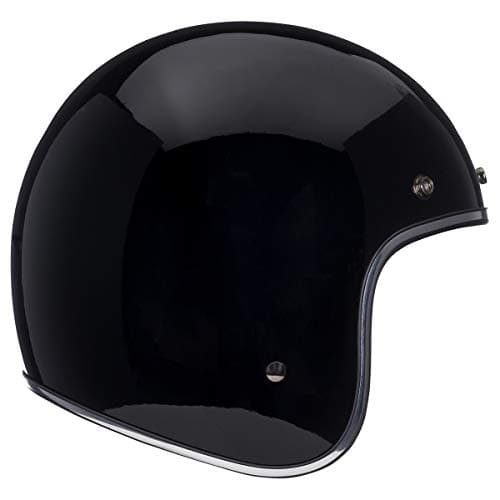
Bell Custom 500 - the open-face, if you are set on one
We debated leaving this off, and decided that would be dishonest. A large share of the people searching for a cruiser helmet want a three-quarter lid, and if you are going to buy one anyway you should buy a properly made one rather than a gas-station novelty with a counterfeit sticker. The Custom 500 is that helmet. Bell builds it on five separate shell and EPS sizes, which is more shell scaling than most full-faces manage and means a small head is not getting a large shell padded out from the inside. The thin-profile composite shell sits low rather than ballooning, the strap is a stainless D-ring with a leather pull tab, and the integrated 5-snap pattern accepts the entire aftermarket of bubble shields, flat shields and peaks.
The honest cons are not cosmetic. There is no chin bar, so the single most-struck region of a helmet is uncovered, and no amount of shell quality changes that - it is why this helmet sits last and scores lowest here. There is no shield, no seal and no sun visor in the box, so eye protection and wind noise are entirely on you. There are no published cheek-pad thickness options, so the fit is the fit, and it is widely reported to run small. On certification: it is sold in the US as a DOT helmet, but the ECE story is a mess - Motolegends describes it as "both DOT and CE approved" without naming a revision and US retail listings contradict each other between 22.05 and 22.06, so we mark ECE unverified and tell you to read the label rather than guess on your behalf.
The windshield is part of the helmet, whether you like it or not
It is worth restating on its own, because riders replace a helmet to fix a noise problem the helmet did not create. Buffeting on a cruiser is a pressure-pulse phenomenon: turbulent, low-pressure air behind the screen meets the fast clean air above it, and the interface lands on your helmet as a droning, shaking pulse rather than as a steady rush. A screen that is too tall drags chaotic air in from the sides and underneath; a screen that is too short fires turbulence straight at your chest and up into your face. The common recommendation is a top edge at roughly nose level when you sit upright, and a slightly reclined screen angle, so the air is lifted over you cleanly.
Fix that first. Then, if it is still loud, a well-sealed helmet with a good chin curtain and a neck roll will do the rest - our how to make your helmet quieter guide runs the fixes in cost order, and the quietest helmets ranks the lids that start from a better place. What will not work is buying a quieter helmet and leaving a badly-sized screen in front of it.
Why a sun visor is worth more on a cruiser than anywhere else
On a faired bike you have a tinted screen edge, a lower head position and often a peak in your sightline. On a cruiser you have none of that, and you are frequently riding the kind of long straight road where the sun sits in the eye port for an hour at a time. A drop-down internal sun visor deals with it in one motion at speed. The alternatives are all worse in a specific way: a dark shield leaves you illegal or blind after dusk unless you carry a second; clip-on sunglasses fog and shift; prescription sunglasses are a second expensive pair. A photochromic shield like the one in the Qualifier DLX box is a real middle option, with the caveat that it transitions on UV, not on brightness, and it will not go fully clear instantly. We compare the three approaches in photochromic vs tinted vs clear.
What you are actually giving up with an open-face
Be clear-eyed about the trade rather than arguing about it. An open-face covers the top, back and sides of your head and leaves your face exposed. It can be genuinely DOT approved and, in Europe, can hold a J homologation - the standards exist and a good open-face meets them. What it cannot do is hold a certification for coverage it does not have. There is no Snell open-face rating, SHARP does not star-rate this class, and the chin - one of the most frequently struck areas on a helmet - has nothing in front of it. That is the whole trade, stated once, without drama.
If what you actually want is the feeling of an open-face rather than the exposure, there are two middle paths on this page. A P/J-homologated modular like the RPHA 91 is certified to be ridden open, so you can run it up at low speed and drop it for the highway. And a retro full-face like the Gringo SV gives you most of the look of a classic lid with the bar and the 22.06 mark intact. Both are covered in are modular helmets safe and DOT vs ECE vs Snell.
What we left off, and why
We did not include half helmets. They are the category where counterfeit DOT stickers are most common, they carry the least coverage of anything road-legal, and we could not point at a specific current model whose certification we were able to verify from the maker rather than from a marketplace listing. Absence here is not a verdict on every half helmet ever made; it is us declining to rank something we could not check. We also left off several helmets we like - the HJC i91, the LS2 Advant X and the Scorpion EXO-GT930 among them - because each is already the better answer on a page of its own rather than on this one. The GT930 in particular converts to a true open-face, which makes it worth a look if that is the appeal; it is ECE 22.05 rather than 22.06, and we say so on the commuter modular roundup.