Buy the Sena 60S if you ride in real weather or long days - it is the same Mesh network as the 50S with a published IPX7 water rating, 24 hours of Bluetooth talk time and a 1.5-hour USB-C charge, and it now sits at a lower price than it launched at because the 60S EVO succeeded it in May 2026. Who the 50S is for: the rider who already owns one, or who wants into Sena Mesh for less and is not fussed about an immersion rating. The thing nobody tells you plainly: both units run Mesh 3.0, because the 50S got it by firmware - so the upgrade argument is the seal and the battery, not the network.
Every spec below is Sena's own published figure, cited at the foot of the page. We have not bench-tested either unit and we do not measure battery life ourselves; where Sena does not publish a number - as with the 50S's water rating - we say that instead of borrowing a reviewer's guess.
The specs that actually differ
| | Sena 60S | Sena 50S |
|---|
| Mesh | Mesh 3.0 (Mesh 2.0 retained for older units) | Mesh 3.0 by firmware (Mesh 2.0 retained) |
| Bluetooth | 5.3 | 5.0 |
| Water rating | IPX7 (published) | Not published by Sena |
| Talk time | 24 h Bluetooth / 17 h Mesh | Shorter; the 60S figures are well ahead |
| Charge | 1.5 h, USB-C | Slower |
| Audio | 2nd-generation Harman Kardon | Harman Kardon |
| Cellular intercom | Wave Intercom, falls back to Mesh | Wave by firmware |
| Control | Jog dial | Jog dial |
Why the Mesh version is not the deciding factor
This is the part that confuses the comparison. Sena shipped Mesh 3.0 to the 50S as a firmware update, along with the cellular Wave Intercom feature - so the older unit is not stuck on an older network. Both headsets support large self-healing group rides of up to 24 riders, both keep Mesh 2.0 on board so they can still talk to older Sena units, and both mean the same thing when a rider drops out of range and rejoins without re-pairing the chain.
The practical consequence: if your only reason to upgrade is "newer Mesh", there is not one. If your reason is that your 50S has been through three wet winters and you want a published IPX7 seal, or that you are tired of charging mid-ride, the 60S is a genuine step. We cover how Mesh differs from plain Bluetooth, and why it matters at group sizes above four, in best intercoms for group riding.
Sena 60S - the one to buy new
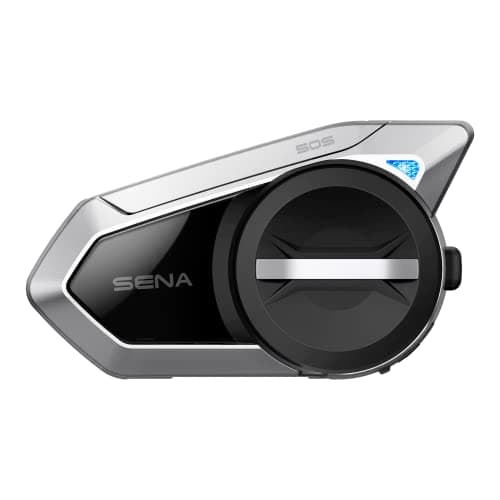
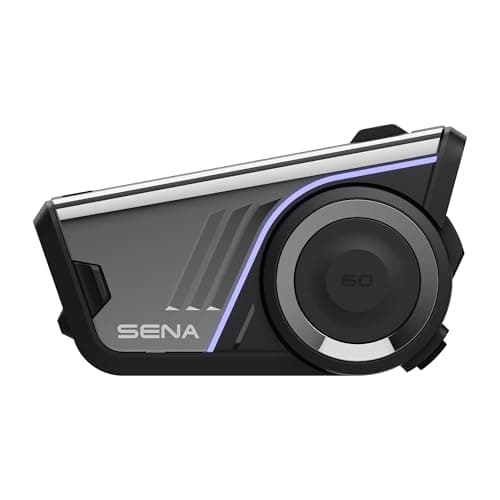
The 60S is the full-spec Sena bolt-on, and it is a better buy in late 2026 than it was at launch, because the 60S EVO (May 2026) and 60X (July 2026) now sit above it and the price has moved accordingly. What you get over the 50S is concrete: a published IPX7 rating - the one spec the 50S never had on the record - 24 hours of Bluetooth and 17 hours of Mesh talk time, a 1.5-hour USB-C charge, second-generation Harman Kardon audio, and Bluetooth 5.3. Who it is for: the rider who does long days or wet days and wants the seal and the battery on the record.
The honest cons: it is a clear price step over the 50S for a network they share; it is no longer Sena's flagship; Wave needs cellular coverage, the app running in the background, and your phone's data and battery; and Sena Mesh still does not bridge to Cardo DMC, so a mixed-brand group drops to plain Bluetooth. Full detail in the Sena 60S review.
Sena 50S - still the unit most Sena groups are running
The 50S is the previous-generation Mesh bolt-on and remains the most common unit in Sena groups, which matters more than it sounds: comms gear is only as good as what your riding partners have. It has the same glove-friendly jog dial, Harman Kardon speakers, Mesh 3.0 via firmware with Mesh 2.0 retained for older units, and it pairs cleanly with other Sena units and integrated Sena helmets. Who it is for: the rider who wants into Sena Mesh for the least money, or who already owns one and is wondering whether to upgrade.
The honest cons: a bulkier bolt-on profile than the Cardo Edge, no published IP water rating, and a group mixing updated and un-updated units has to drop to Mesh 2.0. It is also only good value if you are already committed to the Sena ecosystem. See the Sena 50S review.
Cardo Packtalk Edge - the cross-brand sanity check
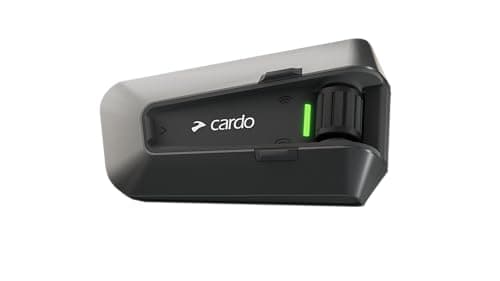
Before you buy either Sena, it is worth knowing what the other ecosystem offers at the same money, because the single most expensive mistake in comms is buying the wrong network for your group. The Packtalk Edge runs Cardo's DMC dynamic Mesh for up to 31 riders with the free Mesh Boost update, has JBL 40 mm speakers, and is IP67- a step beyond the 60S's IPX7 in dust as well as water. Who it is for: the rider whose group runs Cardo, or who is starting fresh and has no ecosystem loyalty.
The honest cons: it is a premium price for a comms unit, the magnetic Air Mount is a proprietary part to keep track of, and the 31-rider ceiling assumes every unit in the group has the Mesh Boost update - mixed groups drop back to 15. We put the two platforms side by side in Sena vs Cardo, and the Edge against the 50S specifically in Packtalk Edge vs Sena 50S.
Should you upgrade a 50S you already own?
Three honest tests. Does your current unit survive rain? If you have had moisture problems, the IPX7 rating is the upgrade and it is a good reason. Do you run out of battery before you run out of day? 24 hours of Bluetooth talk time is a different kind of trip. Is anything actually broken or missing? If the answer is no to all three, keep the 50S - it has Mesh 3.0 and Wave, and the money is better spent on the helmet it is bolted to, which is the component with a certification. Our ranked list of those is at best motorcycle helmets of 2026.
Fitting and pairing, whichever you pick
Both units are bolt-ons, which means the install quality is on you: speakers need to sit directly over your ear canals in the helmet's moulded pockets (if your helmet pinches them, that is a cheek-pad question - cheek pads and liners explained), and the mic position decides whether anyone can understand you at 70 mph. The step-by-step pairing process for either unit is in how to pair a Sena Bluetooth comms unit. And note what neither unit is: comms carry no helmet certification of any kind, so no spec on this page tells you anything about the shell.
The verdict
Buying new, buy the 60S - IPX7, 24-hour battery, 1.5-hour charge and second-generation audio for a modest step up, now that it is no longer the flagship. Buying used or on a budget, the 50S is genuinely fine, because it shares the network. Already own a 50S? Keep it unless water ingress or battery life is your actual complaint. And if your group runs Cardo, buy the Packtalk Edge and match the group - no Sena will Mesh with them. The full comms shelf is at Bluetooth helmets and intercoms.