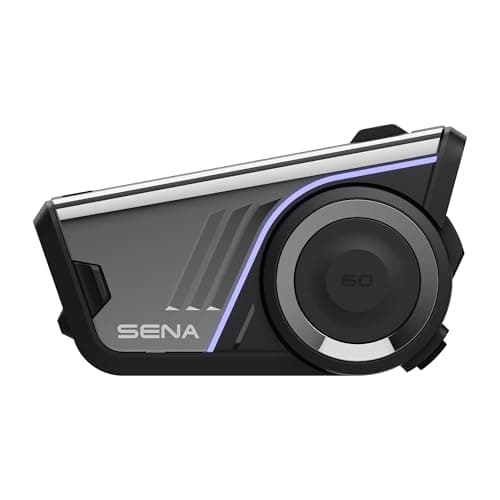
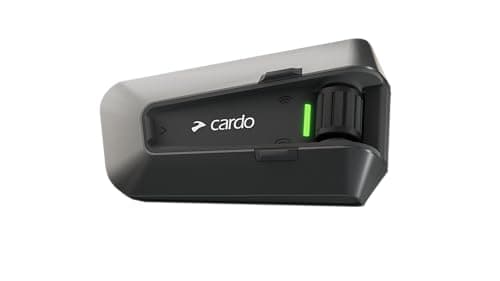
Buying from scratch with nobody to match? Take the Cardo Packtalk Edge: true dynamic mesh (DMC) that self-heals as riders drop in and out, JBL 40 mm speakers, and a published IP67 rating - genuinely weatherproof rather than water-resistant. Who it is for: the rider who wants the most capable bolt-on and does not already own comms. If you ride with people on Sena, or you want published battery numbers and a cellular fallback, take the Sena 60S: Mesh 3.0, Wave cellular intercom, second-generation Harman Kardon audio and, at last, a published IPX7 rating.
Before any of the specs, the rule that decides this for most riders: Sena Mesh and Cardo DMC do not bridge. Put a Sena and a Cardo in the same group and you both fall back to plain Bluetooth - which works, but you lose the self-healing, the rider count and most of the reason you paid for mesh. So if your regular group already runs one brand, that is your answer and the rest of this page is interesting rather than decisive. We have not bench-tested these units and we do not own an anechoic chamber; every figure below is the manufacturer's own published specification, and where a maker publishes nothing we say so instead of borrowing a number.
Mesh: the one thing the money actually buys
Cardo calls its network DMC, and the design point is that it is dynamic: riders join and leave and the network re-forms around them without anyone re-pairing. Cardo's free Mesh Boost update raised the group ceiling from 15 riders to 31 - with the caveat that the ceiling assumes every unit in the group has the update, and a mixed group drops back to 15.
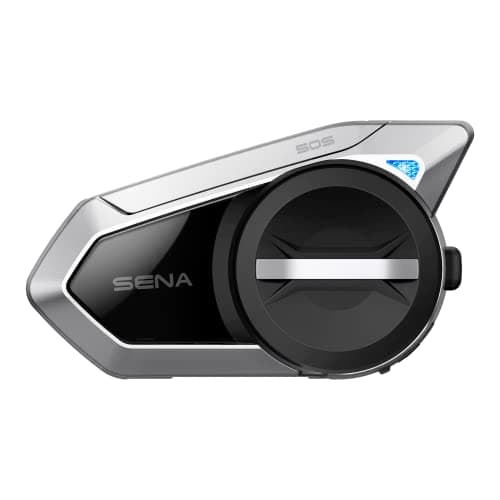
Sena answers with Mesh 3.0, which supports large self-healing groups - up to 24 on the 50S - and deliberately keeps Mesh 2.0 on board so it can still talk to older Sena units. The 60S adds something Cardo does not offer at all: Wave, a cellular intercom that works over your phone's data connection and falls back to Mesh when coverage drops. If your group rides far apart - different roads, a sweeper twenty minutes back - that is a real capability rather than a spec-sheet line.
Our verdict on the network itself: Cardo's DMC is the more elegant implementation and the higher ceiling, Sena's Mesh 3.0 is more backward-compatible and Wave covers a case mesh cannot. Both are a different world from the daisy-chained Bluetooth group a budget unit gives you - see our group-riding picks for what that difference looks like on the road.
Audio: JBL against Harman Kardon
Both brands partner with a serious audio name, and both put the partnership where you can hear it. Cardo runs JBL - 40 mm drivers on the Packtalk Edge and 40 mm HD on the Spirit HD, dropping to 32 mm only on the cheapest Spirit. Sena runs Harman Kardon, with second-generation speakers and mic on the 60S and Harman Kardon on the 50S, and keeps 40 mm HD drivers even on the budget 5S and 5R.
The honest position is that driver size is the spec that matters and both brands give you 40 mm once you are past the entry unit. We have no measured frequency response for any of them and will not invent one, so treat the brand names as a signal of intent rather than a ranking. If audio is specifically what you are shopping for, our intercoms for musicpage ranks on exactly that - and your helmet's wind noise will do more to your listening than either brand does. The quietest helmets matter more than you expect.
Weatherproofing: the clearest win on paper
This is where published specs separate the lineups rather than the brands. The Cardo Packtalk Edge publishes IP67 and the Sena 60S publishes IPX7 - both genuine immersion-grade claims you can hold a maker to. The Sena 50S never got a published water rating, and Cardo publishes no IP rating for the Spirit line at all. So at the top both brands are sealed; below the top, neither is, and the marketing on both sides will imply otherwise. Buy the rating, not the adjective.
Battery and controls: Sena publishes more, Cardo mounts better
Sena is consistently the more forthcoming brand about battery. The 60S publishes 24 hours Bluetooth / 17 hours Mesh talk time and a 1.5-hour USB-C charge; the budget 5S publishes 18 hours and the 5R an outlier 36 hours. Cardo publishes quick-charge figures for the Spirit line - two hours of talk from a 20-minute charge, a full charge within two hours - but no headline total talk time, so the ceiling is not on the record.
On controls the brands have genuinely different philosophies. Sena's jog dial works well in gloves and the budget 5S and 5R add an LCD screen so you can verify a connection at a glance instead of counting beeps. Cardo leans on voice control and its magnetic Air Mount, which is the nicest helmet mount in the business and also a proprietary part to keep track of. Neither is wrong; one is tactile and one is hands-free.
At the budget end, both brands hit the same wall
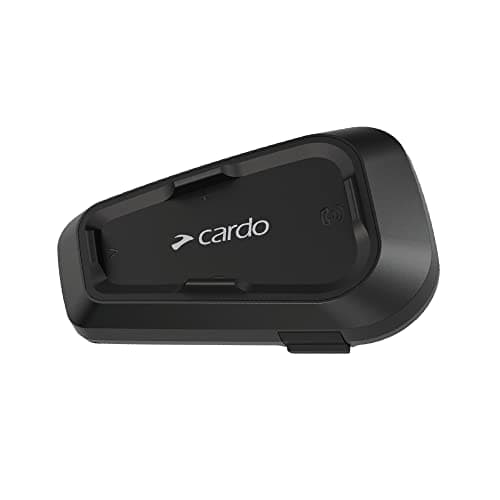
At the budget end of both ranges, both Sena and Cardo sell two-rider Bluetooth units - no mesh, no third rider, and no firmware update that changes it. The Cardo Spirit HDis our pick of that shelf: 40 mm HD speakers, FM radio with six presets, both a hybrid/boom and a wired mic in the box so it fits any helmet type, plus the Cardo Connect app, over-the-air updates and a stated two-year warranty. Sena's answer is the 5S (LCD screen, 18 hours, Audio Multitasking) or the 5R (36 hours, fewer features). If the cheaper 32 mm Cardo Spirit is tempting you instead, we settle that one in Cardo Spirit vs Spirit HD. Pick on ecosystem and battery, and read the budget intercom guide before you assume the cheap end does groups.
So: Sena or Cardo?
Match your group - that beats everything else on this page. Starting fresh and want the best bolt-on? Cardo Packtalk Edge, for DMC, JBL 40 mm and a published IP67 seal. Already in the Sena ecosystem, or want published battery figures, a sealed IPX7 unit and the cellular Wave fallback? Sena 60S. Running an existing Sena group on a budget? The 50S still does most of the job and got Mesh 3.0 by firmware - the model-level comparison is in Packtalk Edge vs Sena 50S. Riding as a pair and nothing more? The Cardo Spirit HD, and keep the change.
How to choose between the two brands
Ask your riding group first, not the spec sheet.Cross-brand groups drop to plain Bluetooth, which costs you the self-healing network and the rider count. One rider on the wrong brand degrades the whole group's experience, not just their own.
Buy a published water rating if you ride in weather.IP67 on the Packtalk Edge and IPX7 on the Sena 60S are specific, testable claims. "Water-resistant" with no rating is not, and it is what you get on the 50S and the whole Spirit line.
Do not pay for mesh you will not use. If you ride solo or always as a fixed pair, mesh is money spent on a capability that never activates - a two-rider unit from either brand does the same job for a third of the price.
Check the mic type against your helmet.A boom mic suits an open-face or flip-front; a wired mic suits a full-face. Cardo ships both in the Spirit boxes; Sena's 5S spec sheet lists a wired boom microphone only, so confirm the kit contents before you buy for a full-face. Our Sena pairing guide covers setup once it is installed.