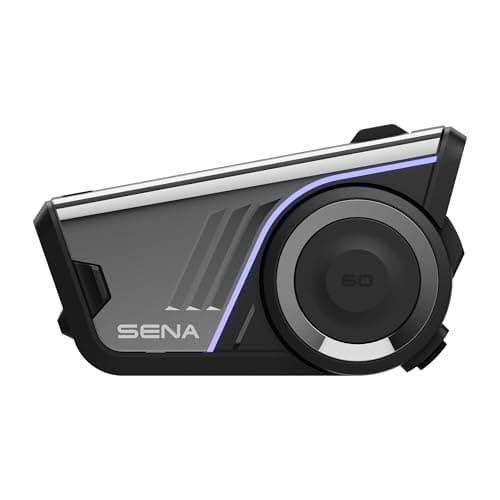
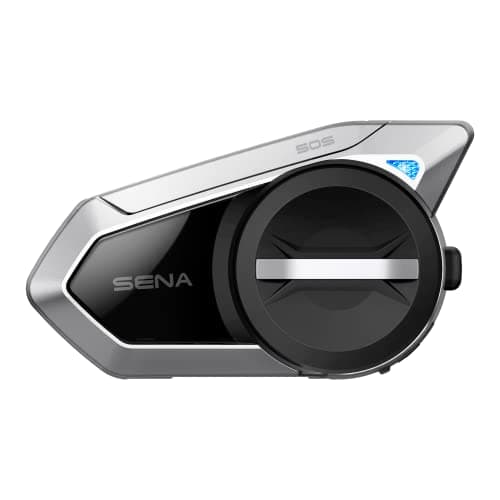
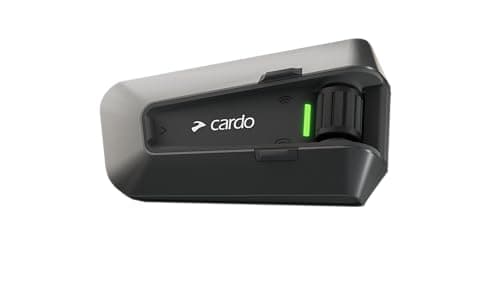
For group riding, buy the Cardo Packtalk Edge: Cardo publishes "up to 31 riders in a single true DMC group" following its free Mesh Boost update, up to 1 mile between two units and up to 5 miles across a full group, with an IP67 rating on the record. Who it is for: anyone building a group from scratch, or riding with a group already on Cardo. The one condition that overrides everything below: match the brand your group already runs, because Cardo DMC and Sena Mesh are separate networks. If your group is on Sena, buy Sena - the 60S if you want the current flagship with a water rating, the 50S if you want the same 24-rider Group Mesh for less.
Everything on this page is from Cardo's and Sena's own published specifications and support documents, cited at the foot. We have not measured range or battery life, and we are not going to invent numbers for either - where a figure is the manufacturer's claim, we say so.
Why Bluetooth intercoms fail in a group
A plain Bluetooth intercom pairs devices in a chain. It works beautifully for two riders, it is usually rated for three or four, and it has a structural flaw in a group: the chain depends on every link. When the rider in the middle drops back for fuel or falls out of range, the riders beyond them lose the conversation, and somebody has to re-pair at the next stop. That is why multi-rider Bluetooth claims on cheap units - the LEXIN B4FM listing claims up to ten riders - need reading carefully: a published ceiling is not the same as a network that survives riders moving around, and we cover that unit honestly in our budget intercom guide rather than here.
Mesh solves exactly that. Every unit is a node: the network relays through the riders in between and re-routes automatically when someone drops out and rejoins. That is also why the group range figure is larger than the unit-to-unit figure - a strung-out line of bikes extends the network instead of breaking it. For a group of more than three, Mesh is not a luxury feature, it is the feature.
Cardo Packtalk Edge - the biggest published group, and a water rating
The Edge shipped rated for 15 riders in DMC. Cardo's free Mesh Boost over-the-air update raised that to up to 31, which is the largest published ceiling of anything we cover - with one caveat Cardo states plainly and most retailers do not: a mixed group that still contains un-updated units is limited to 15 riders until everyone upgrades. Range is published as up to 1 mile between two units and up to 5 miles across a group, and it carries IP67, 40 mm JBL speakers, 13 hours of talk time and the magnetic Air Mount.
Who it is for: large groups, mixed-weather riders, and anyone starting a group where you get to pick the brand. The honest cons: it is the most expensive unit here, and DMC does not talk Mesh to Sena - across brands you fall back to standard Bluetooth and lose the self-healing behaviour. Full detail in the Packtalk Edge review.
Sena 60S - the Sena flagship, with IPX7 and a cellular fallback
If your group is on Sena, the 60S is the current flagship: Mesh 3.0 and 2.0 with Open Mesh on six channels for what Sena describes as a virtually unlimited number of riders and Group Mesh for up to 24, at a stated 2 km in open terrain. It is the first Sena intercom with a water rating on the record (IPX7), runs Bluetooth 5.3, publishes 24 hours of Bluetooth and 17 hours of Mesh talk time on a 1.5-hour charge, and adds Wave Intercom - a cellular, app-based mode that connects riders with no distance limit, provided everyone has signal, data and the app running.
Who it is for: Sena groups who want the newest hardware, riders who get separated by more than Mesh range, and anyone who wants a published IP rating from Sena. The honest con is the upgrade case: the 50S got Mesh 3.0 by firmware in March 2025 and publishes the same 24-rider Group Mesh, the same 2 km range and Wave support - so the 60S is a worthwhile buy new and a thinner argument as an upgrade. The 60S review works through that in detail.
Sena 50S - the same group ceiling, for less
The 50S is the intercom most riders in a Sena group already own, and for group riding it does the same core job: Group Mesh up to 24 riders, Open Mesh across six channels, a stated 2 km range, Harman Kardon speakers and the jog dial that remains the easiest control to use in gloves. Who it is for: joining an existing Sena group on a budget. The honest con is weatherproofing - Sena publishes no IP rating for the 50S, where the Edge is IP67 and the 60S is IPX7 - plus shorter talk time than the 60S. See the 50S review, or Packtalk Edge vs 50S for the head-to-head.
The cross-brand catch, stated once
Cardo DMC and Sena Mesh are different, incompatible networks. Two riders on different brands can still talk over standard Bluetooth, so nobody is locked out of a conversation - but you lose the dynamic, self-healing Mesh that is the entire reason to buy these units for group riding. In practice this makes brand-matching the first decision and the spec sheet the second. Ask the group what they run before you order anything.
So which one?
Picking for a new or mixed group, or want the largest published ceiling and a proper IP rating? Cardo Packtalk Edge. Already on Sena and buying new? Sena 60S. Already on Sena and watching the budget? Sena 50S. And if your "group" is really you and one regular pillion or riding partner, none of this applies - a two-rider Bluetooth unit does that job for a fraction of the money, which is what our budget intercom picks are for.
How to read group-intercom specs without getting sold
Rider ceilings assume everybody is updated.Cardo's 31-rider DMC figure requires every unit in the group to have taken the Mesh Boost update; mixed groups are limited to 15 until they do. Sena publishes 24 for Group Mesh. Treat any number as the manufacturer's best case.
Group range and pair range are different numbers. Up to 1 mile between two units and up to 5 miles across a group is not a contradiction - the group figure exists because Mesh relays through riders in between. A line of bikes is the thing that makes the big number true.
Check the IP rating, or its absence. The Packtalk Edge is IP67 and the 60S is IPX7; Sena publishes no IP rating for the 50S. That is not a claim that the 50S fails in rain - it is a claim that nobody has published a figure, which is exactly the kind of silence we flag rather than fill in.
Mount position and speaker depth decide comfort. Speaker pockets vary, and a 40 mm driver in a shallow pocket presses on your ear. If your helmet has a documented comms channel - several of the Bluetooth-ready modulars do - use it rather than taping a unit to a smooth shell.
Set it up before the ride, not at the trailhead. Pair the phone first, then the intercom, then the group - in that order. Our Sena pairing guide walks through it, and the same sequence logic applies to Cardo.