The cheap end of the comms shelf has the loudest marketing and the thinnest spec sheets on this site, and it hides one fact that reframes every purchase on this page: under $200, a motorcycle intercom is a two-rider Bluetooth device. Not a group network, not Mesh — you and one other headset, which in practice means you and a pillion, or you and the person you always ride with. Every unit below from a brand you have heard of says exactly that in its own published specifications. The five picks that follow are ranked on what the money genuinely buys, and this page is as much about that ceiling as it is about the picks.
We have not bench-tested these units and we do not own an anechoic chamber. Every figure below comes from the manufacturer's current product page, quoted the way the manufacturer states it, and where a maker does not publish a number — Cardo publishes no IP rating and no headline talk time for the Spirit line — we say so rather than borrowing a reviewer's measurement and dressing it up as a spec. Our methodology sets out how the scores are built. One reminder matters more here than almost anywhere else on the site: a comms unit carries no helmet safety certification. The shell it clamps to does. Choose the helmet on its certification first, then bolt comms onto the helmet you already trust — which is the whole argument for a bolt-on over an integrated smart helmet.
What this price cannot buy: Mesh
Every unit on this page is a Bluetoothintercom. A Bluetooth intercom links a fixed chain of headsets, and the chain is only as good as its weakest link — when one rider drops out of range, the riders behind them drop out too, and somebody has to re-pair. Dynamic Mesh (Cardo's DMC, Sena's Mesh) is a self-healing network instead: riders join and leave, the network re-routes around them, and nobody re-pairs anything. That is the single biggest functional difference in the whole comms category, and it is the thing the budget shelf does not have.
The cheapest genuine Mesh units from both brands sit in a clearly higher bracket — closer to the flagship bolt-ons in our comms roundupthan to anything here. Sena's entry point is the Spider ST1, and it comes with a wrinkle worth knowing before you shop on price alone: Sena builds it on the Mesh and Wave platforms, publishing Mesh Intercom 3.0, Group Mesh for 24 riders and up to 1.2 miles between two units, but it is not a plain Bluetooth intercom unit — so it will not do a straightforward Bluetooth intercom link to a friend's non-Mesh headset. Cardo's cheapest Mesh unit is the Packtalk Neo (2nd-generation Mesh, up to 15 riders, 40 mm high-definition speakers), and Cardo's four-rider Bluetooth unit, the Freecom 4X, publishes 1.2 km of range and JBL 40 mm drivers. All three of those cost meaningfully more than everything on this page.
So the honest triage is this: if you ride in a changing group of four or more, none of these five is your answer. Read the Cardo Packtalk Edge review or the Sena 60S review and buy Mesh once. If you ride solo with music and GPS, two-up with a pillion, or in a settled pair, a budget unit does the job the flagship does for a fraction of the money, and the rest of this page is for you.
The six things that separate cheap intercoms
1. Rider count, and who admits to it.Cardo publishes "connects up to 2 riders" for both the Spirit and the Spirit HD. Sena publishes "supports up to: 2 riders" for the 5S and the 5R. Four of the five picks here are two-rider devices by their maker's own specification, and no firmware update changes that. The only unit claiming a group is the LEXIN, whose ten-rider figure is a marketplace listing claim rather than a number from a technical page we can check.
2. Speaker diameter, and thickness. Drivers are where cheap comms units actually get cheap. The Spirit HD, the 5S and the 5R all use 40 mm speakers — the same diameter as the flagships. The Cardo Spirit drops to 32 mm, and that is the single largest audio compromise on this page. Sena also publishes driver thickness (7.2 mm on the 5S, 6.8 mm on the 5R), which matters more than riders expect: a deep speaker in a helmet with shallow ear pockets presses on your ear at hour two. Our guide to cheek pads and liners covers how much room is actually in there.
3. What the maker will put in writing about water.This is where the budget shelf gets conspicuously quiet. Cardo states that its units are waterproof but publishes no IP figure for the Spirit line. Sena publishes no IP or water rating for the 5S or the 5R. The LEXIN listing claims IP67, with no standards documentation behind it that we can find. Contrast the flagships, where the number is on the record: IP67 for the Packtalk Edge, IPX7 for the Sena 60S. Our position at this price is simple — expect weather resistance, plan for a wet weekend, and do not read "waterproof" as "immersion-rated."
4. Battery, and how fast it refills. Sena publishes real numbers here, and they are not what you would guess from the prices: 36 hours of talk time on the cheaper 5R against 18 hourson the 5S, with the 5S taking the win on charge speed at 1.5 hours to the 5R's 2.5. Cardo publishes only quick-charge figures for the Spirit line — two hours of talk time after a 20-minute charge, and a full charge within two hours — and no headline total. An unpublished spec is a spec nobody can hold the maker to, and we rank accordingly.
5. The microphone has to match your helmet. A boom mic on a stalk is right for an open-face or a flip-front you ride with the chin bar up; inside a sealed full-face, a wired mic tucked into the chin bar is usually tidier. Both Cardos ship a hybrid/boom microphone anda wired microphone in the box, which is why they suit any helmet type. Sena's spec sheets list a wired boom microphone (183 mm on the 5S, 150 mm on the 5R), so full-face riders should check the kit contents rather than assume. The LEXIN listing advertises both a boom and a button mic.
6. Support: warranty, app and firmware. The reason to buy a brand at all is the part you only notice in year two. Cardo states a 2-year warranty and pushes software updates over the air through the Cardo Connect app. Sena states a 2-year warranty on the 5R and configures through the Sena Motorcycles app; if you are new to that process, our guide to pairing a Sena comms unit walks through phone, intercom and group pairing. LEXIN publishes nothing comparable per model, so the support question there is genuinely open.
How we ranked these five
In this order: audio hardware, because drivers are where the money goes and cannot be fixed later; then what the maker publishes, because a documented spec beats an advertised one; then battery and charge time; then whether it can do a group at all; then price. One bias stated out loud: when a marketplace listing claims more than a manufacturer's technical page does, we rank the documented unit above the louder one, and we say which is which.
1. Cardo Spirit HD — the best budget intercom
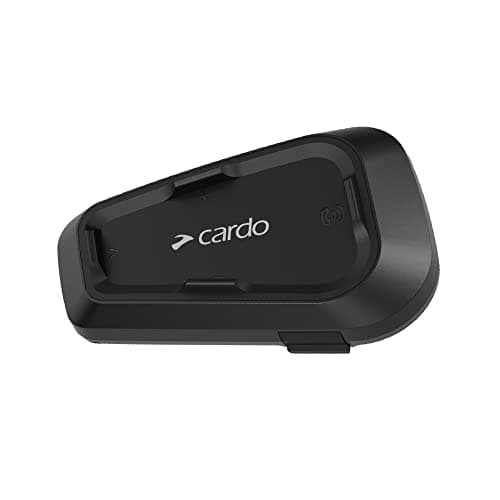
The Spirit HD is the unit we would buy at this price, and the reason is boringly practical: it keeps the 40 mm HD speakers, and it keeps the brand infrastructure. Cardo publishes 40 mm HD drivers, a range of up to 600 m / 0.4 mi, a built-in FM radio with six channel presets, both a hybrid/boom and a wired microphone in the box, over-the-air software updates through the Cardo Connect app, and a 2-year warranty. For a unit at the bottom of a flagship maker's range, nothing important has been hollowed out except the network.
The honest cons: it connects two ridersand that is the end of the story. Cardo calls its units waterproof but will not publish an IP figure for this line, so it does not get the benefit of the doubt the IP67 Packtalk Edge earns. And Cardo publishes quick-charge numbers without a headline talk time, which is a strange omission at a price where battery life is a real purchase driver. If you want the flagship version of this unit's argument, the Packtalk Edge is what the Spirit HD is a scaled-down version of.
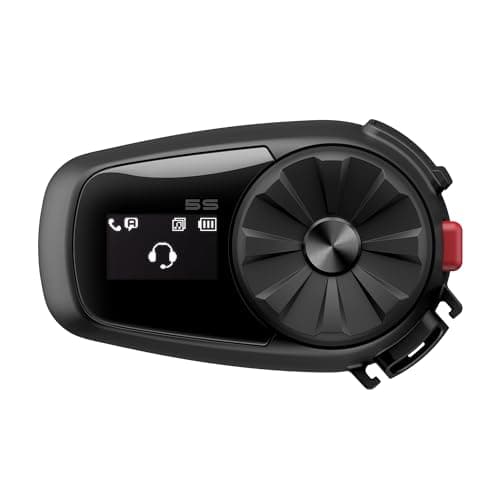
2. Sena 5S — the LCD screen and the fast charge
If the person you ride with runs Sena, or you want the friendliest interface on this page, the 5S is the pick. Sena publishes Bluetooth 5.1, 40 mm HD speakers at 7.2 mm thick, up to 700 m of open-terrain range, 18 hours of talk time, a 1.5-hour charge, and an integrated LCD screen— Sena's own pitch for it is that it lets you verify connections and settings at a glance, which is a genuine advantage over counting beeps inside a helmet. Audio Multitasking and music sharing are on its feature list, and it pairs over Bluetooth with other Sena units and with Sena-equipped helmets.
The honest cons: two riders again, no published water rating at all, and the awkward internal comparison that it costs more than the 5R while publishing half the talk time. The spec sheet also lists a wired boom microphone only, so if you ride a sealed full-face and want a button-style mic, confirm what is in the box. For where Mesh, Wave and a real IPX7 rating start on the Sena side, read the 50S and 60S reviews.
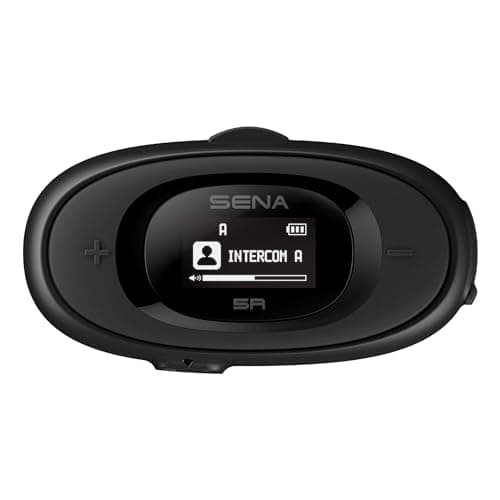
3. Sena 5R — 36 hours, and fewer features
The 5R is the most interesting spec sheet on this page. Sena publishes 36 hours of talk time — double the 5S, and the longest figure anywhere in this price class — on a unit that keeps the LCD display, the 40 mm HD speakers (6.8 mm thick, the slimmest here) and a stated 2-year warranty, with Bluetooth 5.1 and the same 700 m range. For a rider who does long days and charges rarely, that is the number that matters, and it comes at less money than the 5S.
The honest cons: this is the feature-trimmed unit, and the trimming is visible. Sena's 5R page does not list Audio Multitasking, music sharing or FM radio, all of which the 5S advertises; charging takes 2.5 hours rather than 1.5; and, like every Sena here, it carries no published water rating. It is a plain two-way intercom with an enormous battery, which is exactly the right trade for some riders and the wrong one for anyone who wanted to share music with a pillion.
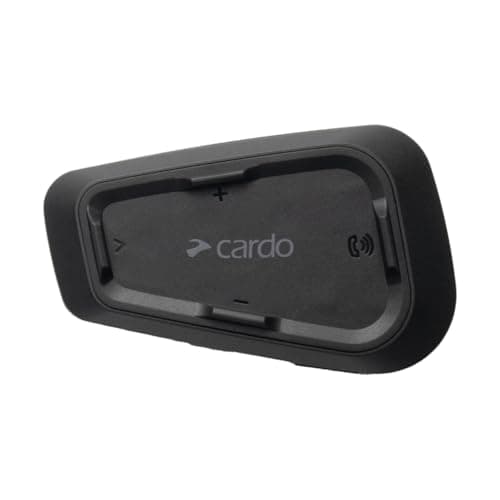
4. Cardo Spirit — the cheapest way into a real brand
The plain Spirit exists for one reason: it is the least you can spend and still get the app, the over-the-air updates, the 2-year warranty and both microphone types. Cardo publishes 32 mm speakers, up to 400 m / 0.25 mi of range, two riders, and the same quick-charge figures as the Spirit HD. It is also physically small on the shell, which suits a helmet with a shallow comms channel.
The honest cons, and they are real: 32 mm speakers instead of 40 mm is the biggest single step down on this page, and you hear it on a loud bike or at highway speed; 400 m is the shortest published range here; and Cardo lists the FM radio on the Spirit HD, not on the Spirit. Our advice is to treat the gap between these two Cardos as the best-value upgrade in this whole bracket — if the extra is findable, spend it on the drivers rather than discovering what 32 mm sounds like at 70 mph.
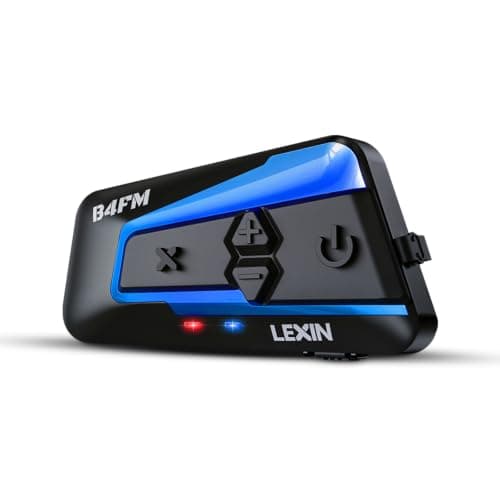
5. LEXIN B4FM — the cheap group option, with its claims labeled
We include this unit because pretending the cheapest shelf does not exist would be dishonest: for a rider who needs three or four people talking on a weekend and cannot spend flagship money, the marketplace brands are the only option, and LEXIN's B4FM is the established one. Its listing claims intercom for up to 10 riders, an IP67 rating, FM radio, music sharing and noise cancellation, and it undercuts the cheapest premium-brand unit on this page.
The honest cons are the whole reason it ranks fifth. Those figures are the listing's own claims: LEXIN does not publish per-model technical pages the way Cardo and Sena do, so there is no manufacturer's spec sheet to check them against, and an IP67 claim with no documentation behind it is marketing rather than a rating. The group itself is a daisy-chained Bluetooth connection rather than Mesh, and a ten-rider chain is the most fragile version of the thing Mesh exists to fix. There is no published multi-year warranty comparable to the 2-year cover Cardo and Sena both state. Buy it clear-eyed, as the cheap way to get a specific group talking this season, not as the unit you will still be running in three years.
The one place budget units have an advantage
At the top of the range, brand matching is the whole game: Cardo DMC and Sena Mesh do not interoperate, which is why our Packtalk Edge vs Sena 50S comparison opens by telling you to buy whatever your group already runs. Down here that constraint mostly evaporates, because none of these units has Mesh to lose. They all connect to any other brand's headset over plain Bluetooth. That makes a budget unit a genuinely smart pillion unit, a second-helmet unit, or the cheap way for a new rider to talk to a partner running a flagship — as long as everyone understands the new rider is on the Bluetooth link, not in the Mesh group.
What no intercom at any price can fix
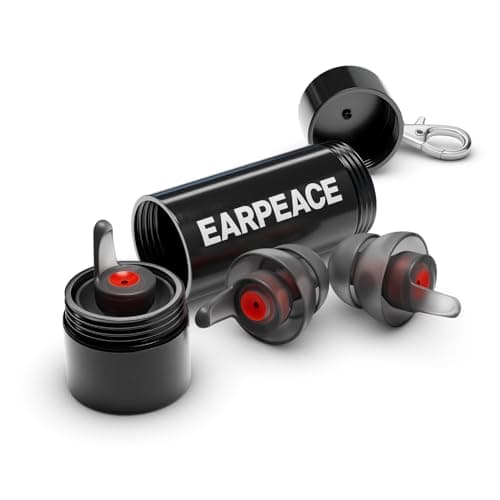
Wind noise. At highway speed the loudest thing inside your helmet is moving air, and turning an intercom up chases a sound that gets louder as fast as you do. The fixes are the helmet and your ears, not the speakers: our guide to making a helmet quieter covers the cheap wins, and the quietest helmets roundup ranks shells on third-party noise evidence. Filtered earplugs are the part riders resist and then swear by — they cut broadband wind noise far more than they cut speech, so intercom clarity usually goes uprather than down, which is why a pair is the one accessory listed under this page's picks.
The verdict
Buy the Cardo Spirit HD unless you have a reason not to: 40 mm drivers, both mics, FM radio, over-the-air updates and a warranty, for two riders. Buy the Sena 5S if your riding partner runs Sena or you want the LCD and the 1.5-hour charge; buy the Sena 5R if 36 hours of talk time is worth giving up music sharing and FM for; buy the Cardo Spirit if the budget is absolutely fixed and you can live with 32 mm speakers; buy the LEXIN B4FM only if you need more than two riders talking and cannot stretch, with its claims understood as claims. And if you ride in a changing group, save your money for a Mesh unit rather than a Bluetooth chain that will frustrate you by the third ride — the full comms roundup ranks those. If you would rather the comms were built into the helmet, the Sena Outrush R is the honest cheap integrated route, and the best Bluetooth modular helmets roundup ranks built-in against comms-ready shells, certification first.