HUB 04 · Bluetooth & Comms Helmets
LEXIN B4FM Review
The cheapest way to get a group talking - and the clearest example on this site of why a spec sheet you cannot check is not the same as a spec sheet.
We earn a commission when you buy through our Amazon links, at no extra cost to you. It never changes a ranking, and we tell you when the cheaper helmet is the better buy. How this works.
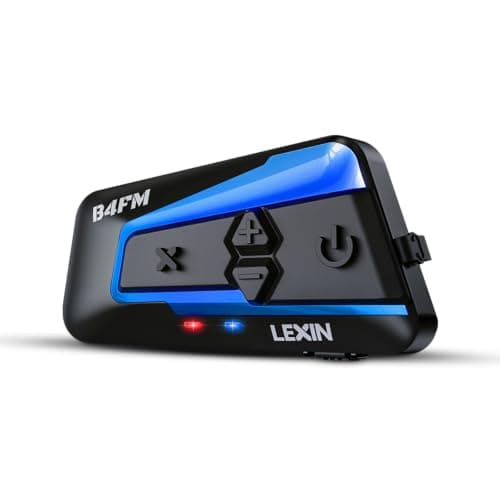
Cheapest multi-rider option
The cheapest way to get a group talking — a marketplace unit claiming ten riders and an IP67 seal, where every number is the listing's rather than a maker's technical page.
Price as of October 21, 2026. Prices change — Amazon's at checkout is the one that counts.
#ad · we may earn a commission from this link to LEXIN B4FM
The LEXIN B4FM is the unit people find when they search for a group intercom and see what Cardo and Sena charge. Its listing promises 10 riders, an IP67 seal, FM radio, music sharing and noise cancellation, for less than the cheapest premium-brand headset on our budget intercom roundup. Who it is for: a riding group on a tight budget that wants to try comms before committing real money to them. What you need to understand first:every one of those numbers is the marketplace listing's own claim, and there is no manufacturer spec sheet to check them against.
That is the review. The rest of this page explains why it matters, what the unit genuinely gets you, and the specific situations where it is the right buy anyway. We have not bench-tested this headset, we do not measure range or battery life, and we will not repeat a claim as a fact.
The claims, and what stands behind them
Here is the honest version of a spec table. The left column is what the product is sold on. The right column is where that figure comes from.
| Claim | Source behind it |
|---|---|
| Intercom for up to 10 riders | Amazon listing title; third-party listings elsewhere say 4 |
| IP67 waterproof | Amazon listing title and retailer copy; no maker spec page found |
| FM radio | Amazon listing title |
| Music sharing | Amazon listing title |
| Noise cancellation | Amazon listing title |
| Range (1,600 m / 2,000 m / 1.2 mi) | Retailer listings, disagreeing with each other |
| Battery (12 h / 15 h talk) | Retailer listings, disagreeing with each other |
| Bluetooth version (3.0 / 5.0) | Retailer listings, directly contradicting each other |
| Warranty | No published multi-year warranty comparable to Cardo's or Sena's two years |
Compare that with how we were able to write up the Cardo Spirit and Spirit HD: every number on that page came off Cardo's own product pages, and where Cardo publishes nothing - the IP rating, the total talk time - we could say so precisely, because there was a spec sheet to find the hole in. Here there is no hole to find, because there is no sheet.
None of this means the B4FM is bad. Marketplace brands build perfectly serviceable hardware and often undercut the majors on features for real reasons. It means you are buying on the seller's word, and you should price that risk in rather than treat the feature list as equivalent to a published one.
Ten riders is a daisy chain, not a Mesh
This is the most important technical point on the page, and the listing will not tell you.
A conventional Bluetooth intercom links riders in a chain: rider 1 pairs to rider 2, rider 2 to rider 3, and so on. Everybody's call passes through the units between them. When one rider drops back for fuel, falls behind on a climb, or rides into a dip, the chain breaks at that point and every rider beyond them is dropped. Someone re-pairs at the next stop.
Mesh - Cardo DMC and Sena Mesh - works differently. Each unit is a node that can route through any other node in the group, so when a rider falls out of position the network re-routes around them automatically and nobody re-pairs anything. That is what you are actually paying for when a group unit costs three times as much.
So the ten-rider claim deserves a clear reading: even taken at face value, a ten-unit Bluetooth chain is the most fragile possible version of a chain, because it has nine links that can break. One retailer listing for this unit says four riders rather than ten, and one user summary reports that only two of the paired units can talk at once with others having to switch in. We cannot reconcile those accounts, and that is precisely the point: on a premium unit, the maker publishes the group architecture and the rider ceiling, and you can hold them to it. If your group matters, read best intercoms for group riding before you buy anything.
IP67 is the claim we would most like checked
An IP67 rating means dust-tight and protected against temporary immersion in water, and it is a real, defined, testable standard. It is also the claim on this listing with the biggest gap between what it would mean if verified and what backs it up.
For context, Cardo publishes IP67 for the flagship Packtalk Edge and publishes no IP rating at all for its budget Spirit line, which sells for more than the B4FM. Sena publishes no water rating for the 5S or 5R either. In other words, the two companies with the most to lose from an inaccurate claim decline to put a number on their cheap units, while a marketplace listing puts the strongest number in the industry in its product title.
Draw your own conclusion; ours is that the device is probably fine in rain, because almost all of them are, and that we would not deliberately submerge it on the strength of a listing title. If a published, defensible water rating is a requirement for you, there is exactly one unit in this price conversation that has one, and it is not this one.
What it genuinely gets you
Being fair to the product. At this price you get a bolt-on headset with speakers, a microphone, a mount and a charging cable that will let you talk to another rider and listen to your phone - and that is not nothing. The step from no intercom to any intercom is by far the biggest improvement in the sequence; the step from a cheap one to an expensive one is real but much smaller.
The feature list is also genuinely broad for the money. FM radio and music sharing are features Cardo reserves for its pricier Spirit HD and Sena splits across models. If the listing is accurate about them, you are getting a feature set that costs noticeably more elsewhere, and the published Amazon availability and price make the unit easy to try.
And a pragmatic case we will state plainly: if you are kitting out four riders at once, the math changes. Four budget headsets cost less than one flagship. For a group that rides together twice a year and mostly wants to say "fuel stop" without pulling over, a chain of cheap units that occasionally needs re-pairing is a rational purchase. For a group that rides every weekend, it is a false economy and you will buy twice.
Support is the real gamble
A comms unit lives outdoors on the side of a helmet, gets dropped on gravel, and depends on firmware to keep pairing with phones that change their Bluetooth stack twice a year. Over a three-year ownership period, the thing that decides whether a headset is still working is not the spec sheet - it is whether the company behind it is still shipping updates and honoring a warranty.
Cardo publishes a two-year warranty and over-the-air updates through the Cardo Connect app. Sena does the same through its own app. We found no comparable published warranty for the B4FM. That is the cost that does not appear on the price tag, and it is the single strongest argument for spending more - an argument we make in full in Sena vs Cardo.
Fitting it, and what it will not do
Practical notes that apply to any bolt-on unit. Check your helmet's speaker pockets - a shell with molded EPS recesses takes a speaker without pressing on your ear, and a shell without them gets uncomfortable within an hour. Helmets built with comms in mind, like those in our Bluetooth modular roundup, make this painless. On a three-quarter lid such as the Bell Custom 500, with no chin curtain and unobstructed pockets, almost any unit installs cleanly.
Pair in the right order - phone first, then the intercom, then the other riders. Out of sequence is the most common reason a pairing refuses to take, and the logic in our comms pairing guide is brand-agnostic.
And the point we make on every comms page: an intercom carries no helmet safety certification. The shell does. Bolting any headset to an uncertified helmet changes nothing about what happens in a crash, which is why we rank helmets on the mark inside the shell first and treat comms as a separate purchase - see DOT vs ECE vs Snell vs SHARP.
Who should skip it
Skip the B4FM if you need the group feature to work reliably. A Bluetooth chain of more than two or three riders is fragile by design, and if comms are part of how your group rides safely rather than a convenience, buy Mesh and buy the brand the rest of the group already runs.
Skip it if you expect to still be using the unit in three years, because the support story is the weakest part of the package. Skip it if a published water rating or a published battery figure is something you want to be able to point at. And skip it if music quality is the reason you are buying - spend the difference on the Cardo Spirit HD and its 40 mm drivers instead.
Where the B4FM lands
We keep the B4FM on the site because it is the honest answer to a real question: what is the cheapest way to get a group talking? It is this. It is also the unit on which we can verify the least, and we would rather say that out loud than print its listing claims as a spec table and let you assume somebody checked them.
Buy it as a low-stakes experiment - a group testing whether it wants comms at all, a second helmet, a bike you ride occasionally. Do not buy it as the comms system a regular riding group depends on. The next step up is a two-rider premium unit with a published spec sheet and a warranty, compared head to head in Cardo Spirit vs Spirit HD; the step after that is Mesh, in our group riding guide.
The scorecard
How it scores, and who should skip it
- Audio
- 5.5
- Range/Mesh
- 6
- Ease of use
- 6.5
- Weatherproofing
- 6
- Value
- 8.5
Pros
- The only unit at this price that attempts a group at all — the listing claims intercom for up to 10 riders where every premium-brand unit here stops at two
- Claims an IP67 rating, which is a stronger seal than Cardo or Sena will put in writing for anything in this price class
- FM radio, music sharing and noise cancellation all advertised, at a price below the cheapest premium-brand unit on the page
Cons
- Those figures are the marketplace listing's own claims — LEXIN publishes nothing like Cardo's or Sena's per-model spec sheets, so there is no maker's page to check them against
- A daisy-chained Bluetooth group, not Mesh — when one rider drops out of range the chain goes with them, and a ten-rider chain is the most fragile version of that
- No published multi-year warranty comparable to the 2-year cover Cardo and Sena state, so long-term support is the real gamble
Don't buy this if…
…you want a unit that will still be supported in three years, or you need to join a group that runs Cardo or Sena Mesh — you will be the rider on plain Bluetooth.
Price as of October 21, 2026. Prices change — Amazon's at checkout is the one that counts.
#ad · we may earn a commission from this link to LEXIN B4FM
How we picked
We do not crash-test helmets
We compiled published specifications, cited each helmet's certification (DOT, ECE 22.06, Snell, SHARP) from the standards body or manufacturer homologation, and aggregated owner reports, then scored against a published method. The scores are judgments from documented research — not measurements we took. We do not run a crash lab. Certifications reflect the US-market build; where it differs from the European version, we say so and cite it.
Questions
Frequently asked
Does the LEXIN B4FM really connect 10 riders?
Is the LEXIN B4FM waterproof?
Is the LEXIN B4FM better than a Cardo Spirit?
Does the LEXIN B4FM work with Cardo or Sena units?
How long does the LEXIN B4FM battery last?
Keep reading
Related
- Best budget Bluetooth intercomsWhere the B4FM ranks against the premium-brand units.
- Cardo Spirit vs Spirit HDThe next step up, with spec sheets you can check.
- Best intercoms for group ridingWhat Mesh does that a Bluetooth chain cannot.
- Sena vs CardoThe two ecosystems, and why support is the real spec.
- Cardo Packtalk Edge reviewThe published IP67 and DMC Mesh benchmark.
- DOT vs ECE vs Snell vs SHARPThe certification lives on the helmet, not the headset.
Receipts
Sources
- Amazon - LEXIN B4FM Motorcycle Bluetooth Headset, 10 Riders Helmet Bluetooth Intercom, Universal IP67 Communication Systems with Music Sharing, Noise Cancellation, FM Radio (listing title; availability and price verified via the Amazon product API)
- Cardo - Spirit HD and Spirit (published 2-year warranty, Cardo Connect app with over-the-air updates, no IP rating published for the Spirit line)
- Cardo - Packtalk Edge (IP67 published, DMC Mesh)
- Sena - 5R (36 h talk time) and 5S (18 h talk time), both 2-rider units with no published water rating
We do not run a crash lab, and we do not pretend to. Certifications are cited to the standards body or the manufacturer's stated homologation; where a US model's certification differs from its European namesake, we say so. Where we could not verify something, we say so on the page rather than quietly leaving it out. Read our full method.