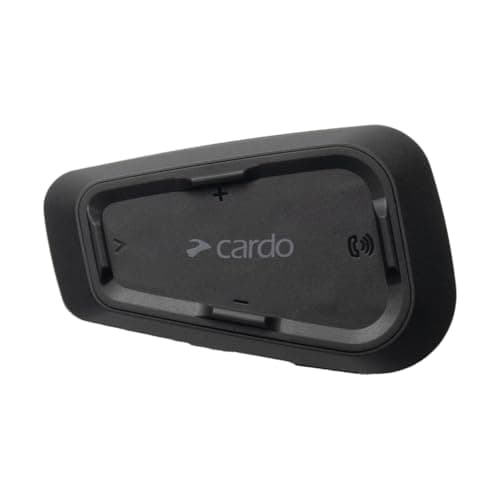
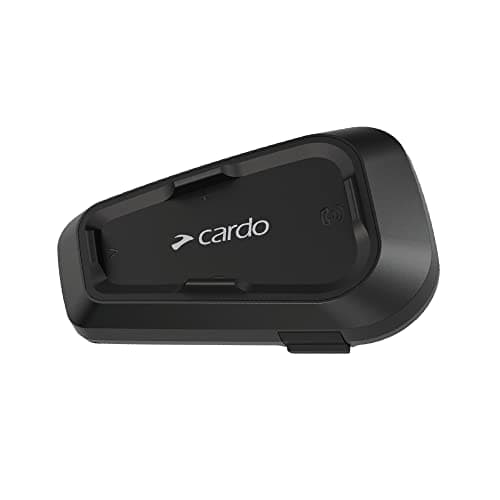
Buy the Cardo Spirit HD unless the budget genuinely will not stretch. It is the same unit as the plain Spirit with the one component you cannot upgrade later - 40 mm HD speakers instead of 32 mm - plus 600 m of published range instead of 400 m and the FM radio Cardo lists only on the HD. Buy the plain Spirit if you want into the Cardo ecosystem at the lowest possible price and you mostly use the intercom for talking rather than music. The thing nobody puts in the comparison table: both units connect two riders and neither has Mesh, so if you are buying for a group, neither of these is the answer.
Every figure below is Cardo's own published specification or Sena's, cited at the foot of the page. We have not bench-tested range, battery life or audio on either unit, and where a maker publishes nothing - as Cardo does for the water rating and total talk time on this whole line - we say that instead of borrowing a reviewer's estimate.
The specs that actually differ
| | Cardo Spirit HD | Cardo Spirit |
|---|
| Speakers | 40 mm HD | 32 mm |
| Published range | Up to 600 m / 0.4 mi | Up to 400 m / 0.25 mi |
| FM radio | Yes - 6 channel presets | Not listed |
| Riders | Up to 2 | Up to 2 |
| Mesh | No | No |
| Mics in the box | Hybrid/boom + wired | Hybrid/boom + wired |
| Fast charge | 2 h talk from 20 min; full in 2 h | 2 h talk from 20 min; full in 2 h |
| Total talk time | Not published | Not published |
| IP rating | Not published ("waterproof") | Not published ("waterproof") |
| App + OTA updates | Cardo Connect | Cardo Connect |
| Warranty | 2 years | 2 years |
That is the whole difference. Four rows differ; seven are identical. Any comparison that makes this look like a bigger gap than that is selling you something.
The speakers are the decision
If you read one section, read this one. The Spirit HD uses 40 mm drivers - the same diameter Cardo fits to its flagship Packtalk Edge, where they are tuned by JBL. The plain Spirit drops to 32 mm.
Eight millimeters sounds like nothing written down. It is the difference between music you enjoy at highway speed and music you turn off, because a smaller driver has to move the same air with less cone area and it runs out of low end first - exactly the part of the signal that wind noise masks. Inside a helmet, at 70 mph, with a bike underneath you, the bass is already fighting; a 32 mm speaker loses that fight. Our best intercoms for music guide covers why driver size, not the Bluetooth codec, is the spec that decides this.
The practical point: speaker diameter is the one thing on this list you cannot fix after the fact. Range you will probably never test. FM radio you may never switch on. Speakers you hear on every single ride, and the only upgrade path is a new unit.
The qualification, in fairness to the Spirit: if you bought an intercom to talk to your pillion and take phone calls, 32 mm is adequate for voice. Voice lives in the midrange, which is where a small driver is weakest-but-fine rather than genuinely poor. It is music that exposes it. And if your helmet is a quiet one - the quietest motorcycle helmets narrows that list - the gap closes a little further.
Range: 600 m versus 400 m, and why it changes almost nothing
Cardo publishes up to 600 m / 0.4 mi for the Spirit HD and up to 400 m / 0.25 mi for the Spirit. Both are line-of-sight maximums in open terrain, and both collapse the moment a building, a hill or a truck gets between the two units.
Here is the honest reading. Two riders in convoy are usually two seconds apart, which at 60 mph is about 54 m. You are using five to fifteen percent of either unit's range. The 600 m figure buys you margin when your partner stops for fuel and you carry on to the next exit - useful, but not the reason to spend the difference. Treat range as a tiebreaker, not an argument.
What range would genuinely matter for is group riding, and that is exactly the use case neither unit supports. Both cap at two riders and neither runs Mesh. A Bluetooth intercom pairs in a chain, so a third rider who drops back takes the riders behind them off the call; Mesh treats each unit as a node and re-routes around the gap. If three or more of you ride together regularly, close this page and read our intercoms for group riding guide instead, because no firmware update turns either Spirit into a Mesh unit.
FM radio, and what else the HD does not add
Cardo lists a built-in FM radio with six channel presets on the Spirit HD and does not list one on the Spirit. Whether that is worth anything is personal: a lot of riders stream from a phone and never touch it, and plenty of others want traffic and local stations without burning phone battery or data.
More useful is knowing what the HD does not add, because the marketing does not make this obvious. It does not add a third rider. It does not add Mesh. It does not add a published IP rating. It does not add a published total talk time. Both units ship the hybrid/boom microphone and the wired microphone, both get the Cardo Connect app with over-the-air updates, both carry the two-year warranty, and both use the same fast charge - two hours of talk from a twenty-minute top-up, full charge inside two hours.
The two things Cardo does not publish for either unit
We flag absent data rather than filling it in, and the Spirit line has two notable gaps.
No IP rating. Cardo says all its units are waterproof and both Amazon listings repeat the word, but there is no IP figure published for the Spirit or the Spirit HD. By contrast the Packtalk Edge is rated IP67 - dust-tight and protected against temporary immersion. Treat both Spirits as weather-resistant rather than immersion-rated. That is not an accusation that they leak; it is an observation that nobody has published a tested number, which is a different thing from a good one.
No total talk time. Cardo publishes quick-charge data for both and no battery ceiling for either. If you want a published number, Sena gives one - and that is the third unit on this page.
Where the Sena 5R beats both
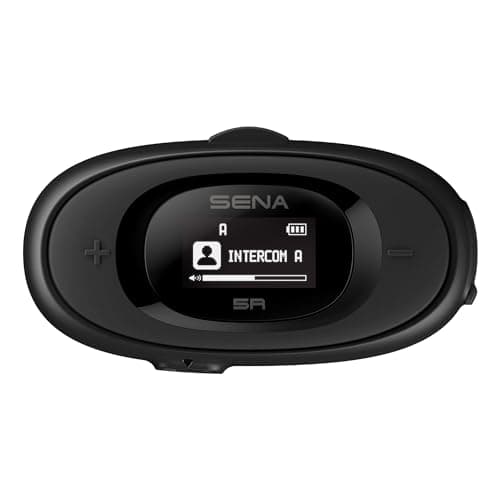
We include the Sena 5R here because at this price it wins on the one spec Cardo will not state. Sena publishes 36 hours of talk time, roughly 700 m of range, 40 mm HD speakers and an LCD status screen that tells you what the unit is doing instead of making you count beeps. For an all-day touring rider who charges once and forgets about it, that is a stronger argument than FM radio.
What you give up by choosing it: Sena does not list Audio Multitasking, music sharing or FM radio on the 5R - those are 5S features - the charge takes 2.5 hours against Cardo's two, and Sena publishes no IP or water rating for it either. It is also still a two-rider unit. The ceiling is the price bracket, not the brand. We set all five of these units side by side in best budget Bluetooth intercoms, and the broader brand question is in Sena vs Cardo.
One genuine Cardo advantage worth naming: both Spirits advertise cross-brand connectivity on their listings, so a Cardo unit can hold a two-way Bluetooth intercom call with a rider running a Sena. It is plain Bluetooth, not Mesh, and it is the escape hatch when your riding partner already bought the other brand.
Fitting either one to the helmet you own
Two checks before you order. First, speaker depth. A 40 mm driver needs a molded ear pocket; in a helmet with shallow recesses it presses on your ear and you notice within an hour. This is the one case where the Spirit's 32 mm drivers are an advantage - they fit shells the HD struggles in. Helmets with purpose-built comms channels, like those in our Bluetooth modular roundup, take either happily.
Second, microphone type. Use the boom mic on an open-face or a flip-front where it can reach round, and the wired mic in a sealed full-face where a boom has nowhere to sit. Because both units ship both mics, helmet format is not a buying constraint here - it is just a question of which one you install. On a three-quarter lid such as the Bell Custom 500, with unobstructed speaker pockets and no chin curtain to fight, either unit is about as easy an install as exists.
When you set up, pair the phone first, then the intercom, then your partner's unit. Out of order is the single most common reason a pairing "will not take"; the sequence in our comms pairing guide is brand-agnostic even though the worked example is a Sena.
The verdict
Spirit HD for most people. The premium over the plain Spirit is modest in this bracket and it buys the speakers, which is the component you cannot change your mind about. Plain Spirit if the budget is hard, if you use the intercom mainly for voice, or if your helmet has shallow ear pockets that a 40 mm driver will fight - you still get the Cardo app, the over-the-air updates, both mics and the same two-year warranty, which is the whole reason to buy a brand at this level. Sena 5Rif a published 36-hour battery and an LCD screen matter more to you than FM radio and Cardo's ecosystem.
And none of the three if you ride in a group. Two riders is a hard ceiling on all of them, and buying a two-rider unit for a four-rider group means buying twice.
Last thing, because it gets forgotten: an intercom carries no helmet certification. The shell does. Choose the helmet on the mark inside it - DOT vs ECE vs Snell vs SHARP explains what each one buys - and treat the comms unit as a separate decision made afterward.