MIPS is a low-friction layer inside the helmet that lets the shell and liner rotate a small amount relative to your head. ECE 22.06 is a certification that includes a test for rotational injury. They are two completely separate facts about a helmet. That sentence is the entire point of this page, because the yellow MIPS dot gets read as a safety grade and it is not one. A helmet can carry MIPS and sit on the superseded ECE 22.05 standard. A helmet can be ECE 22.06 certified with no MIPS layer anywhere in it. Both of those helmets exist, both are in our registry, and both are below.
We have no lab and we have not tested anything here. What follows is what MIPS states about its own system, what the ECE 22.06 regulation adds over 22.05, and then four helmets we already rank that happen to cover every combination of the two - which is the most useful way we know to make the distinction concrete.
What MIPS actually is
In MIPS' own words, "the Mips system consists of a low friction layer that is mounted inside the helmet", sitting "generally between the padding and the EPS foam protective layer". In a crash that layer is "designed to move slightly inside the helmet".
The injury mechanism it targets is rotation, not a straight-on hit. MIPS states that "rotational motion is a common cause of concussions and more severe brain injury in oblique hits to the head", and that "the brain is more sensitive to rotational motion than linear motion" because its shear properties are closer to water or gel than to a solid.
That is the mechanism in plain terms: hit the road at an angle and your helmet does not just stop, it twists. A few millimeters of slip between the shell assembly and your scalp takes some of that twist out before it reaches your neck and brain. The physics is uncontroversial and it is the same reasoning behind the ECE 22.06 revision.
What MIPS does not publish
Here is where we have to be careful, because this is a safety-critical claim and the internet is full of invented percentages. On its own technology page MIPS describes the system as "designed to help reduce the rotational motion" of certain impacts, and says this is "intended to help reduce the risk of brain injury". It gives no percentage and no numeric reduction figure there. The quantitative claims you see quoted around the internet are not on that page, and we will not repeat a number we cannot source.
MIPS does publish a scale claim - "more than 100 000 helmets tested" at its lab north of Stockholm - and it publishes an explicit limit, in capitals: "no helmet or impact protection system can protect a user from all injuries". A manufacturer stating the boundaries of its own product in its own warning text is worth more than most marketing, and we would rather quote that than a figure we found on a forum.
What ECE 22.06 adds, and why people confuse the two
ECE 22.06 is a UNECE type approval with independent lab testing and batch checks. Against the 22.05 standard it replaced, the headline addition is exactly the thing MIPS exists to address: a rotational / oblique impact test, plus up to around eighteen impact points instead of a handful, and testing at multiple speeds. We go through the full list of changes in ECE 22.06 explained.
So both things are about rotation, which is precisely why they get blurred together. The difference is what kind of fact each one is:
| MIPS | ECE 22.06 |
|---|
| What it is | A component fitted inside the helmet | A type approval the whole helmet holds |
| Who decides | The helmet maker chooses to license and fit it | An independent approval authority tests and grants it |
| Rotation | Tries to reduce rotational motion reaching the head | Tests whether the helmet limits rotational acceleration |
| Pass or fail | No pass/fail - it is either fitted or it is not | A hard pass/fail with a number behind it |
| Legal status in the US | None. MIPS is not a legal requirement anywhere | Not required in the US either - DOT is the legal floor |
Read that table again and the hierarchy falls out of it. A certification is a third-party verdict on the finished helmet. MIPS is a part. If you only get to know one fact about a helmet before buying it, the certification is the more informative one - because a helmet that passes the 22.06 oblique test has demonstrated an outcome, where a helmet with MIPS has demonstrated a design intention.
That is not a knock on MIPS. It is the reason we show both fields on every helmet card rather than collapsing them into one score.
Every combination, in four helmets we already rank
These four are not here as a shopping list for "best MIPS helmet" - that would be ranking by component, which is the mistake this page is about. They are here because between them they cover all four states, and seeing the combinations is what makes the distinction stick.
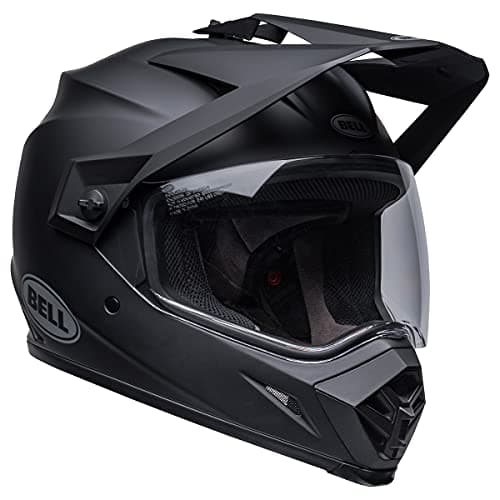
1. Bell MX-9 Adventure MIPS - MIPS plus the current certificate, plus independent stars
This is the complete version of the story: DOT + ECE 22.06 + MIPS, and on top of that a SHARP rating of 4 out of 5, which is a fourth and entirely independent body putting a number on the same helmet. Polycarbonate shell, around 1,696 g. It is also the cheapest helmet on this page.
The honest cons. Polycarbonate is the heaviest construction in its class and you feel it on a long day; the peak generates real lift at highway speed, which is the standing trade-off on a dual-sport shell; and it is loud compared with a road-biased helmet. Full detail in our Bell MX-9 Adventure review.
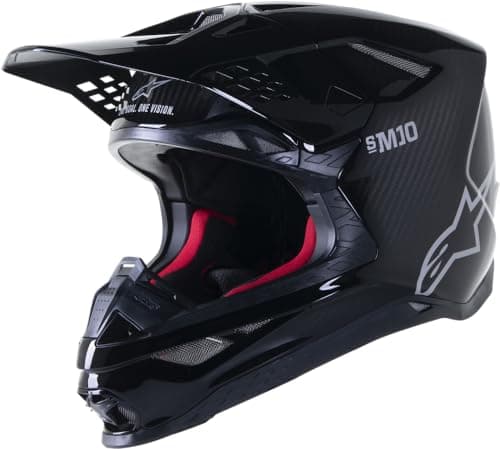
2. Alpinestars Supertech M10 - MIPS, ECE 22.06, and a published margin
The M10 is the same combination as the Bell at a much higher level of construction, and Alpinestars does something almost nobody does: it publishes how far past the standard the helmet tested. It states the S-M10 exceeds the ECE 22.06 peak rotational acceleration requirement by 76% and linear impact limits by up to 46%. MIPS is fitted. The shell is 3K carbon, uni-directional carbon and aramid at a published ~1,260 g in size M for the ECE build.
The honest cons. It is a motocross helmet - no face shield, so you ride it with goggles, which rules it out as a road helmet. And Alpinestars sells it in ECE-only and ECE/DOT versions that differ by around 100 g, with US listings often not naming which, so we mark DOT unverified on it rather than assume. Context in are Alpinestars helmets good?
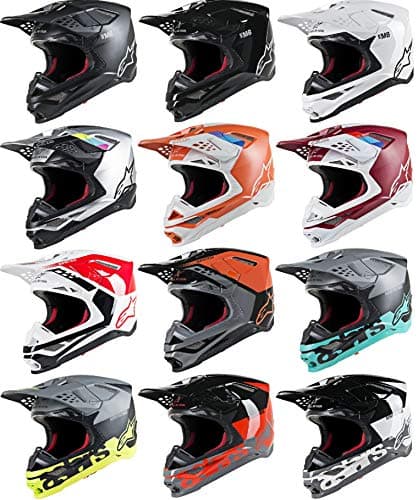
3. Alpinestars Supertech M8 - MIPS without the current certificate
This is the pick that proves the point. The M8 has MIPS and a carbon composite shell with an aramid layer - and retail listings consistently put it on DOT + ECE 22.05, the superseded revision. ECE 22.05 has no oblique rotational test at all.
So here is a helmet with the hardware answer to rotational injury and the older certificate that never measured it. Is it a bad helmet? No - MIPS is real and the construction is good. Is it the same as an ECE 22.06 helmet? Also no, and anyone reading the MIPS dot as proof of a current certification would get that exactly backwards.
The honest cons. The 22.05 certificate is the main one, and it is why this sits third here despite good hardware. It is also an older design in the line with patchy size and colorway availability, and like the M10 it is a goggles-only off-road helmet.
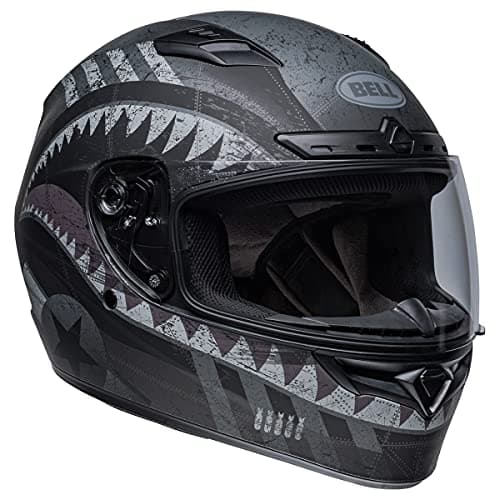
4. Bell Qualifier DLX MIPS - MIPS on the US legal floor
The Qualifier DLX is the budget road helmet in this group and the fourth combination: DOT with a MIPS layer, a polycarbonate shell at around 1,626 g, and a photochromic shield included in the box, which is genuinely unusual at the price. Bell also lists ECE for the model but does not publish the 22.05-or-22.06 revision for the US unit, so we do not assert it - check the label on the helmet you receive.
The honest cons. DOT is self-certified by the manufacturer, so it is the weakest paper trail of the four, and the unnamed ECE revision means you cannot assume the rotational test was run. Polycarbonate and not light. The MIPS layer is a real addition at this price, and it is not a substitute for an independently verified certification.
So does MIPS matter when you are buying?
Yes, as a tiebreaker. Not as a filter. Our honest ordering:
- Fit first. A helmet that does not match your head shape is worse in a crash than one that does, whatever is inside it - a MIPS layer cannot help a helmet that is already moving on your head. Start with how to measure helmet size and head shapes explained.
- Then the certification, and the revision. ECE 22.06 over 22.05 over DOT alone. This is the one field that reflects an independent verdict on the finished helmet.
- Then independent test data, if it exists. A SHARP star rating is a fourth opinion from a body with no commercial interest. See the safest helmets we can document.
- Then MIPS, between two helmets that are otherwise equal. If two helmets fit you the same and carry the same certification, the one with the rotational-management layer is the better buy. That is a real tiebreaker and worth using.
What MIPS is not is a reason to buy a DOT-only helmet over an ECE 22.06 helmet, or a 22.05 helmet over a 22.06 one. If you take one thing from this page, take that.
How to read a helmet's rotational-protection story without being sold to, in four checks.
Check the ECE revision, not just the letters
"ECE approved" is not a specification. 22.06 includes the oblique rotational test; 22.05 does not. The Alpinestars M10 and M8 on this page are from the same line and sit on either side of that boundary, which is as clear an illustration as the market provides. Where a maker will not name the revision for a US unit, treat it as unnamed rather than assuming the newer one - our position on that is set out in DOT vs ECE vs Snell vs SHARP.
Treat MIPS as a yes/no, not a grade
There are no MIPS tiers for a buyer to compare and no published per-helmet reduction figures to rank by. Either the low-friction layer is in there or it is not. Anyone selling you a ranking of MIPS helmets by how much MIPS they have is inventing the metric.
Do not pay a large premium for the layer alone
MIPS adds cost, and the cheapest helmet on this page carries MIPS, ECE 22.06 and a SHARP 4/5. If a helmet is asking a big premium and MIPS is the main thing it has over a certified rival, you are paying for a component rather than an outcome. Our broader take on that trade is in are expensive helmets worth it?
Remember what a liner cannot fix
A loose helmet, a worn-out liner or a helmet past its service life undoes more protection than any rotational system adds back. The cheapest safety upgrades available to most riders are a correctly sized shell, fresh cheek pads and replacing a helmet on schedule - see when to replace a helmet.