Yes - Alpinestars helmets are good, and the Supertech R10 is one of the best-documented helmets sold anywhere. But the useful answer to this question is not a yes. It is a map, because the Alpinestars helmet range is much smaller than the brand's presence in a dealership suggests. There is one road helmet. There are two off-road helmets. There is no Alpinestars modular, no Alpinestars adventure helmet with a peak, and no Alpinestars commuter lid. Who this page is for: anyone who typed the brand name into a search box and wants to know whether to keep going, or whether the helmet they actually need comes from someone else.
We have not worn or crash-tested any of these helmets. What we do is read the homologations, and Alpinestars is unusually forthcoming about them - it publishes not just which standard a helmet meets but by how much it beats the limits. That is rare, and it earns the brand real credit on a site that ranks helmets by what they can prove.
How we ranked these three
The criteria are the same ones we apply to every brand page, in this order:
- Certification first, and the revision matters. ECE 22.06 includes an oblique rotational-impact test that ECE 22.05 does not. A 22.05 helmet is not uncertified, but it was never tested for the injury mechanism the newer standard exists to measure. We explain the difference in ECE 22.06 explained.
- What the maker publishes, not what a retailer repeats. Where Alpinestars states a figure on its own product pages we use it; where only a retail listing carries it we say so.
- Whether the helmet suits the riding you actually do. A motocross helmet with a 76% margin over the rotational standard is still the wrong helmet for a 400-mile highway day, and we will say that out loud rather than let a spec sheet win the argument.
- Weight, as published, in a named size. Unqualified helmet weights are marketing. All three figures below are size-specific.
Prices are not a ranking criterion and we do not quote them in prose - the buy modules on this page carry the current figure. What is worth saying up front is that the Alpinestars range sits in the premium bracket throughout; there is no cheap Alpinestars helmet.
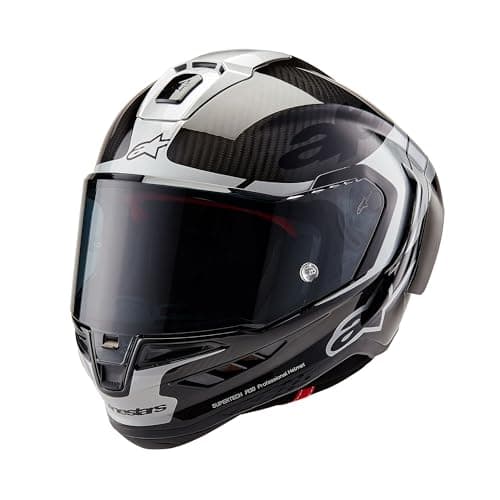
1. Supertech R10 - the road helmet, and the documented one
If the question is "are Alpinestars helmets good", the Supertech R10 is the answer, because it is the only helmet in the range you can ride on the street with a face shield, and because Alpinestars documents it better than almost anyone documents anything.
The headline facts, all from Alpinestars' own product pages: the R10 is ECE 22.06 certified and FIM-homologated - the racing standard, which is a separate and stricter gate on top of ECE. Alpinestars states the helmet exceeds the ECE 22.06 linear impact limit by 37% and the rotational limit by 65%, figures that came out of its MotoGP program. The shell is multi-layer carbon over an eight-piece multi-density EPS liner, with a low-friction inner liner, in four shell sizes. Published weight is approximately 1,540 g in size M.
Publishing a margin over the standard is the part that matters. Every certified helmet on our safest helmets page passed the same test; almost none of them tell you by how much. Alpinestars does, and the numbers are large.
The honest cons. This is a race helmet and it behaves like one - no drop-down sun visor, no touring comfort agenda, and it is the most expensive helmet featured anywhere on this site. More practically for a US buyer: Alpinestars sells the R10 in both ECE06/DOT and ECE06/FIM builds depending on the SKU, and a marketplace listing does not always tell you which one is in the box. If you need DOT for US road legality, confirm it on the label rather than assuming it. And at roughly 1,540 g it is not light in absolute terms - a carbon ADV helmet like the Klim Krios Pro undercuts it.
Who should skip it: anyone looking for one helmet to commute, tour and ride weekends in. For that money you can have a Shoei RF-1400 and change the shield twice. The R10 earns its place on a track day and in a race paddock.
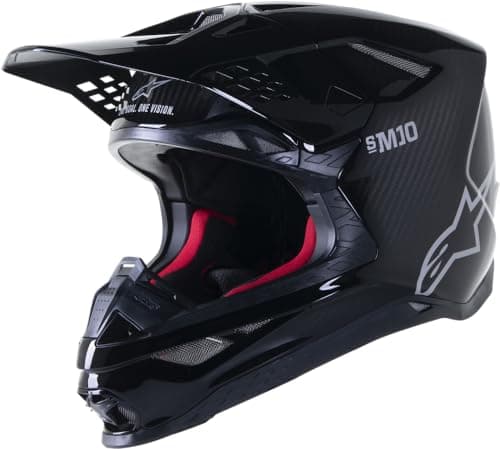
2. Supertech M10 - the off-road flagship, with MIPS
The M10 is the helmet that shows what Alpinestars can do when weight is the enemy. The shell is three bonded layers - a 3K carbon outer, a uni-directional carbon layer for radial strength, and an aramid layer for penetration resistance - and Alpinestars publishes a weight of approximately 1,260 g in size M for the ECE build. For a full-coverage off-road helmet, that is excellent.
It carries MIPS and ECE 22.06, and here again Alpinestars quantifies the margin: it states the S-M10 exceeds the ECE 22.06 peak rotational acceleration requirement by 76% and linear impact limits by up to 46%. Ventilation is 28 ports - 18 intake, 10 exhaust - and there is an emergency visor release for a crash scene.
The honest cons. It is a motocross helmet. There is no face shield, so you ride it with goggles, which means wind, cold and noise on any sustained road section - the trade-off we go through in dual-sport vs adventure helmets. Second, and more awkwardly: Alpinestars states the S-M10 is sold in two versions, ECE R22.06 and ECE R22.06/DOT, and those two builds are about 100 g apart on the scale (~1,260 g ECE against ~1,360 g DOT in size M). A US marketplace listing frequently does not say which one it is shipping. We mark DOT as unverified on this helmet for that reason, and you should check the label.
Who should skip it: riders who split their miles between pavement and trail. You want a shield and a peak on the same helmet, which is what a dual-sport lid like the HJC DS-X1 or the Fly Racing Trekker gives you for far less money.
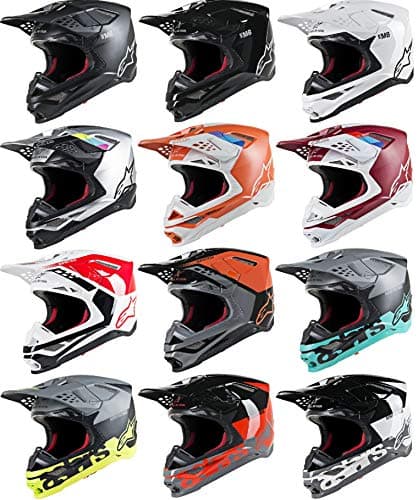
3. Supertech M8 - the cheaper carbon, with the older paperwork
The M8 sits below the M10 and it is a genuinely nice piece of construction: carbon composite shell with an aramid layer, MIPS fitted, at a retailer-published weight of about 1,300 g with a +/- 50 g tolerance. Motocross Action Magazine weighed a size medium at 1,360 g in its own team test, which broadly agrees - and an independent measurement is worth more than a marketing figure.
The honest cons, and this is the big one. US and European retail listings consistently show the M8 as DOT and ECE 22.05 - the superseded revision. Alpinestars publishes no 22.06 homologation for this model and we do not assume one. ECE 22.05 has no oblique rotational-impact test. The M8 does have MIPS, which is a hardware answer to the same injury mechanism, so this is not a helmet with nothing to say about rotational forces - but the certificate is the old one, and on this site the certificate is how we rank. Beyond that: it is an older design in the line, several variants are being closed out at retail, so sizes and colorways come and go.
Who should skip it: anyone shopping on the certification code. The M10 above it has the same MIPS and the current standard. If your budget is the constraint, a cheaper helmet with current certification beats an expensive helmet with old certification - that is the argument we make in are expensive helmets worth it.
The gap in the range nobody mentions
Here is the thing that should change your shopping if you came to this page from a brand search. Alpinestars does not make:
- A modular / flip-up helmet. Not one. If you want a chin bar that lifts, the brand is not in that market at all - start at our modular helmet hub instead, where the Shoei Neotec 3 and HJC RPHA 91 are the helmets Alpinestars would be competing with if it built one.
- An adventure helmet with a peak and a shield. The M10 and M8 are motocross helmets; they take goggles. For a genuine ADV lid see the adventure helmet hub.
- A touring or commuter helmet with a drop-down sun visor. That whole category - the one most riders actually need - is served by Shoei, HJC, AGV, Scorpion and LS2, not by Alpinestars.
- A helmet with integrated Bluetooth. Alpinestars builds no comms-equipped shell, so plan on a bolt-on unit from our intercom roundup.
None of that is a criticism. Alpinestars built a race helmet and a dirt range and did both seriously. It simply means the brand answers a narrower question than most riders are asking when they search it.
So - are Alpinestars helmets good?
On the evidence, yes, with a strong caveat about which one. The Supertech R10is as well-documented as any road helmet we have looked at: ECE 22.06, FIM homologation, and published margins of 37% and 65% over the standard's linear and rotational limits. The Supertech M10 is an excellent, light, ECE 22.06 off-road helmet with MIPS and a published 76% rotational margin. The Supertech M8 is good hardware carrying an older certificate, and on a certification-first ranking that costs it the podium.
What Alpinestars is not is a one-stop helmet brand. If your riding is track days or dirt, it belongs on your shortlist. If your riding is commuting, touring or adventure, the honest recommendation is to shop the category rather than the badge - our helmet brands comparedpage sets Alpinestars' rivals side by side, and best motorcycle helmets of 2026 ranks across all of them.
Three things decide whether a premium helmet is worth its price, and a brand name is not one of them.
Read the revision, not just the letters
"ECE certified" is not a specification. ECE 22.06 added an oblique rotational test and a much wider range of impact points; ECE 22.05 did neither. Two helmets from the same brand, in the same line, can sit on either side of that line - the M10 and the M8 do exactly that. Our DOT vs ECE vs Snell page is the reference for what each standard actually tests.
Check which market version you are buying
This is the recurring trap with European brands on a US marketplace, and Alpinestars is a clear case: the Supertech R10 ships in ECE06/DOT and ECE06/FIM builds, and the S-M10 ships in ECE-only and ECE/DOT builds that differ by around 100 g. The homologation on the label is the fact. The listing bullet is a claim. If DOT matters for where you ride, verify it on the helmet itself.
Buy the shape your riding needs before the brand you like
A 76% rotational margin on a motocross helmet does not help you at 70 mph behind a screenless naked bike with goggles fogging. Match the format to the miles first - types of motorcycle helmets walks through the five formats - then rank the certified options inside that format. That order is the whole method of this site.
And MIPS is not a substitute for a certificate
Both off-road Alpinestars helmets here carry MIPS, and MIPS is a real rotational-management layer. It is not a homologation, and a helmet is not ECE 22.06 because it has MIPS. Treat them as two separate facts, both worth having.