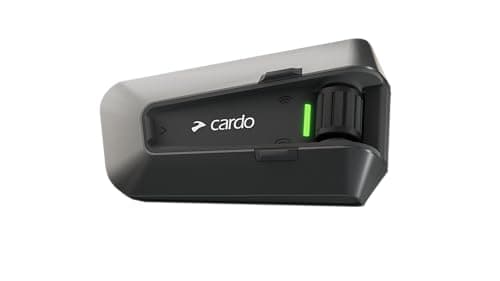
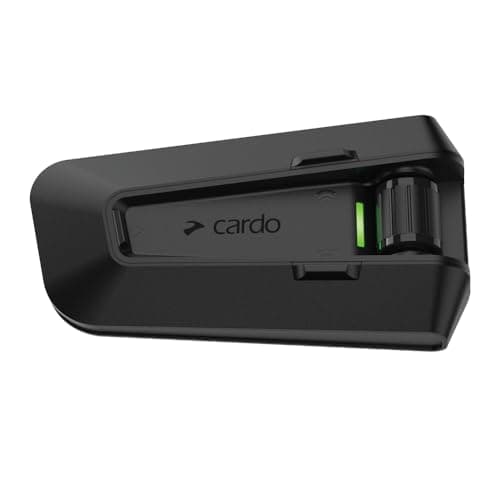
Buy the Packtalk Pro for one reason: automatic crash detection. Everything else it adds over the Edge is a refinement. Both units run Cardo's dynamic Mesh, both are IP67, both have JBL speakers and both fit the helmet you already own. The Pro layers on a crash-detection system, larger 45 mm JBL drivers and a 3-year warranty. Who should pay the difference: riders who often ride alone, far from help, and want someone notified if they go down. Who should not: anyone who rides in a group and already has the Edge, because the Mesh experience is the same.
We have not range-tested either unit or staged a crash to see whether the detection fires. Every figure on this page is Cardo's published specification as carried on major US retail spec sheets, and we flag the one feature whose limitations are easy to miss.
The specs, side by side
| Spec | Packtalk Pro | Packtalk Edge |
|---|
| Mesh | 2nd-gen DMC, up to 15 riders | DMC, 15 riders (31 with Mesh Boost) |
| Rider-to-rider range | Up to 1 mile / 1.6 km | Up to 1 mile / 1.6 km |
| Group range | Up to 5 miles / 8 km | Up to 5 miles / 8 km |
| Bluetooth | 5.2, two channels | 5.2, two channels |
| Speakers | 45 mm JBL | 40 mm JBL |
| Talk time | Up to 13 hours | Up to 13 hours |
| Charging | Up to 2 h; 2 h talk from 20 min | Up to 2 h; 2 h talk from 20 min |
| Crash detection | Yes (app + cell service required) | No |
| Water rating | IP67 | IP67 |
| Warranty | 3 years | 2 years |
Look at that table honestly and the shape of the decision is obvious: the two units are the same intercom. Same Bluetooth, same range figures, same IP67 seal, same fast-charge behavior, same roller wheel, same magnetic Air Mount. Four rows differ, and only one of them is a reason to spend money.
Crash detection: what it is, and what it needs
This is the Pro's headline and the first time a mainstream bolt-on intercom has offered it. The system reads your phone's inertia sensors together with an IMU inside the headset itself, and if it decides you have crashed it can alert an emergency contact.
Now the part that the box does not shout about, and that you need to understand before you pay for it. Crash detection is a connected service, not a standalone sensor. For it to work you need:
- a paired smartphone, powered on and in range;
- the Cardo Connect app running;
- a live connection to Cardo's cloud - which means cell service.
Read that list against where you actually ride. The rider who benefits most from automatic crash detection is the one riding alone in empty country - and empty country is exactly where cell coverage fails. That is not a reason to dismiss the feature; on a commute, a highway tour or a populated backroad it is a genuine safety net that nothing else in this class offers. It is a reason to be clear-eyed about it rather than treating it as a satellite beacon. If remote solo riding is your use case, a dedicated satellite messenger does a job this cannot.
Cardo also notes that the feature is available in selected regions. Check it covers yours before the feature decides your purchase.
45 mm JBL vs 40 mm JBL: the upgrade that is smaller than it sounds
The Pro moves to 45 mm JBL drivers from the Edge's 40 mm. Larger drivers generally mean more low-end authority, which is the thing wind noise steals first at highway speed.
Two caveats keep this from being a reason to upgrade on its own. First, JBL speakers are now standard on the Pro where they were once a paid add-on for the Packtalk line, so some of the "upgrade" is Cardo bundling what it used to sell separately. Second, and more important: speaker size is not what limits intercom audio on a motorcycle. Wind noise is. A quieter helmet, properly fitted earplugs and speaker pockets deep enough to put the drivers over your ear canal all move the needle further than 5 mm of driver. Our how to make your helmet quieter page is, genuinely, a better audio upgrade than this one.
Mesh: identical in practice, with one footnote
Cardo describes the Pro as second-generation Dynamic Mesh Communication for up to 15 riders. The Edge runs DMC with the same 15-rider group, and Cardo's free Mesh Boost update raised the Edge's ceiling to 31 riders - though that only applies when every unit in the group has the update, and mixed groups drop back to 15.
Either way, this is not where the decision lives. Both units self-heal as riders drop out and rejoin, which is the entire point of Mesh and the thing a Bluetooth chain cannot do. We lay out why that matters on best intercoms for group riding. If you are choosing between these two units because of group size, stop - choose on crash detection and spend the difference on a second unit for whoever you ride with.
Battery: the number neither unit wins
Cardo publishes up to 13 hours of talk time for the Pro, and the Edge sits in the same place. Both charge in up to 2 hours and both do 2 hours of talk from a 20-minute top-up, which is the spec that actually saves you on a long day - a coffee stop buys you a whole afternoon.
Worth keeping in perspective: 13 hours is a respectable figure for a Mesh unit, but Mesh radios are hungry, and cheaper Bluetooth-only units publish much more. Sena states 36 hours for its 5R and 18 for the 5S. If battery life is the spec you buy on and you only ever talk to one person, you are shopping in the wrong class entirely and should be reading our budget intercom roundup.
The verdict
Buy the Packtalk Proif automatic crash detection is a feature you want and you ride where phones have signal. It is the only bolt-on intercom that offers it, the 3-year warranty is a year longer than the Edge's, and the 45 mm JBL speakers are a real if modest improvement. For a solo commuter or tourer who wants a safety net, it earns the premium.
Buy the Packtalk Edge for everything else, and that covers most riders. You get the same dynamic Mesh, the same 1-mile rider-to-rider range, the same IP67, the same fast charging and JBL audio, for meaningfully less money. It remains our top overall bolt-on pick, and the money you save is better spent on a second unit so there is somebody to talk to.
And if you are deciding between ecosystems rather than between these two Cardos, the underlying question is a different one - Sena vs Cardo is the page for that, and Packtalk Edge vs Sena 50S settles the cross-brand Mesh comparison.
A flagship intercom is only worth flagship money for specific reasons. These are the ones worth paying for, in order.
Mesh, if you ride in a group of three or more
This is the one upgrade that changes the experience rather than refining it. A Bluetooth chain breaks when any rider in the middle drops out; Mesh re-forms the network around them. Both units here have it, which is why the Edge is enough for most people.
A published IP rating, if you ride in weather
IP67 is a specific, testable claim and both Packtalks carry it. Plenty of cheaper units publish nothing at all about water ingress - including, notably, Sena's budget range. If your bike is your year-round transport, a rating in writing is worth real money.
Crash detection, if you ride alone with signal
Judge this one on your actual riding, not on the idea of it. It needs a phone, the app and cell service. Commuters and highway tourers get a genuine safety net. Riders whose solo miles are in canyons and forest roads with no bars should understand they are buying a feature that may not be available when they need it most.
What not to pay for
Speaker diameter, past a point, and advertised range. Range figures are quoted in open terrain with line of sight; hills, trees and traffic cut them hard, and both units here quote the same number anyway. Spend the difference on earplugs and a quieter helmet - the quietest helmets page explains why the shell matters more than the speakers.