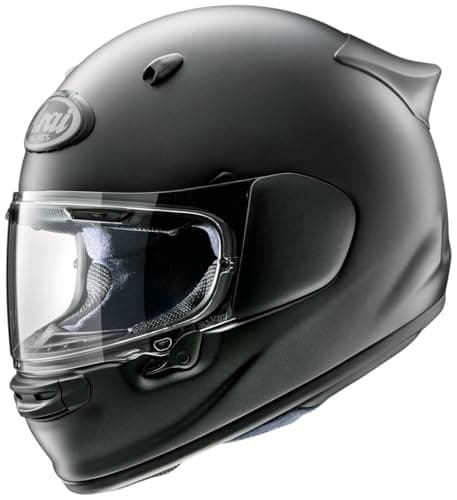
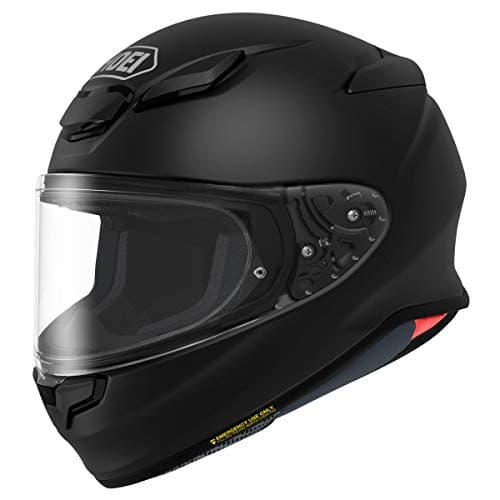
For most riders the answer is the Shoei RF-1400: at about 1,385 g it is the lightest helmet on this page, it carries DOT + Snell M2025, and its European twin - sold as the Shoei NXR2 - scored a perfect 5/5 with SHARP. If your head is round-oval and sport-touring shells pinch your temples, buy the Arai Contour-X instead and stop fighting the fit. That is the real Shoei-versus-Arai decision, and it is about your head, not the badge.
The thing that surprises people: on US-market certification these two brands are hard to separate, because neither of these models carries ECE 22.06 in the US. Both companies sell DOT + Snell builds here and keep the ECE 22.06 versions for Europe, frequently under a different model name. We have not crash-tested anything; everything below is from the standards bodies and each maker's published homologation.
Certification: the same answer from both, and a naming trap
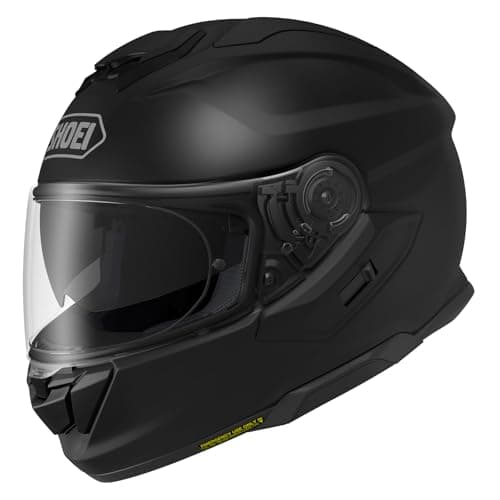
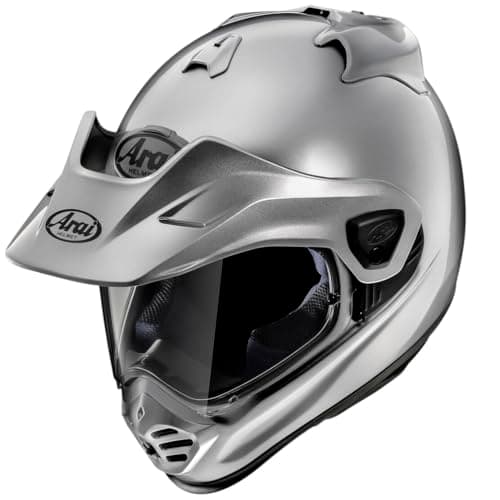
Here is the exact picture for the four models on this page. The Shoei RF-1400 is DOT + Snell M2025; its European twin the NXR2 scored 5/5 with SHARP. The Arai Contour-X is DOT + Snell M2025; the European version is sold as the Quantic, is ECE 22.06, and scored 4/5. The Shoei GT-Air 3 is a DOT build in the US, while the European GT-Air 3 is ECE 22.06 with a 5/5 SHARP score. And the Arai XD-5 is DOT + Snell M2025D, where the European Tour-X5 is ECE 22.06 and scored 4/5.
Two things follow. First, the renaming is the trap: Shoei RF-1400 / NXR2, Arai Contour-X / Quantic, Arai XD-5 / Tour-X5, Shoei Hornet X2 / Hornet ADV. A European review praising a 22.06 rating and a SHARP score is very often describing a helmet with a different homologation from the one in the US box, as our certification explainersets out. Second, Snell M2025 is not a consolation prize - it is an independently-tested standard built around high-energy and repeat same-site impacts, a different philosophy from ECE's rotational focus, and clearly above the DOT self-certified floor.
Fit: the difference that actually decides it
Arai is the one major manufacturer that openly designs to different internal head shapes and publishes shape guidance for its range - a point webBikeWorld has made for years, alongside the Hohenstein Institute 3D-scanning work showing "remarkable variations in head shapes within the same head circumference." Most makers, Shoei included, do not state an internal shape at all.
In practice that means: if a conventional sport-touring shell presses your temples while leaving room front-to-back, your head is rounder than the helmet and an Arai is the brand to try. If Arai's rounder interior feels tight front-to-back on you, a Shoei (or an AGV) shell will likely suit you better. Our head-shape guide covers how to work out which you are in about fifteen minutes in a shop, and why circumference alone does not tell you.
Shell philosophy: smooth versus engineered
Arai's signature is a smooth, continuous shell with as few protrusions as possible, designed to glance off an obstacle rather than catch on it, hand-laid in composite. Shoei's is the multi-ply AIM and AIM+ composite shell developed in its own wind tunnel - RevZilla publishes the drag and lift figures Shoei quotes for the RF-1400 - with aerodynamic and noise work that shows up as a calmer helmet at speed. Both are legitimate engineering positions, and neither resolves into "safer"; they resolve into different helmets to wear.
Features: Shoei wins the conveniences
If you want a drop-down sun visor and first-party comms, Shoei is the brand. The GT-Air 3has the QSV-2 internal sun visor and channels for Shoei's Sena-built SRL units, and the Neotec 3 does the same for touring modulars - see our sun-visor picks. Arai does not build internal sun visors into these helmets, consistent with its shell-integrity position, and has no first-party comms system; you fit a bolt-on. That is a real, everyday difference, and for commuters it often outweighs everything above.
Adventure: XD-5 versus Hornet X2
The brand question repeats in adventure, with the same answer. The Arai XD-5 is the round-oval ADV benchmark with a well-behaved peak; the Shoei Hornet X2 is the road-biased alternative. Both are DOT + Snell builds in the US, so again it is fit and peak behaviour that decide - we put them side by side in XD-5 vs Hornet X2. If you want ECE 22.06 in an adventure helmet in the US, neither brand sells it to you here; the Klim Krios Pro does.
The verdict, by rider
Want the lightest, best-documented road helmet of the four? Shoei RF-1400. Round-oval head, long days, premium finish? Arai Contour-X. Commuting, touring, sun visor and comms? Shoei GT-Air 3. Adventure touring with a round-oval head? Arai XD-5. And if the deciding factor is genuinely ECE 22.06 on a US shell, then the honest answer is that this comparison is the wrong one - look at the AGV K6 S or the HJC RPHA 91 instead.
How to decide between them in a shop
Measure first. Circumference above the brow sets your size band; it does not set your shape. Our measuring guide covers the method and the common error of sizing up to escape a shape mismatch.
Wear each one for ten to fifteen minutes. Hot spots do not appear in thirty seconds. A helmet that is uniformly snug is right; a helmet with one point of pressure is the wrong shape, and no amount of break-in fixes shape.
Read the label, not the review. Check the mark on the actual US box - DOT, Snell, and whether an ECE code is present and whether it starts 06 or 05. This is the single most valuable two seconds in helmet buying, and it is the thing a borrowed European review cannot tell you.
Decide the sun-visor question before the badge question. If you commute into low sun, a helmet with an internal visor will get worn more than a purer helmet without one - and getting worn is what makes a helmet protective.