The best Snell-certified motorcycle helmet is the Shoei RF-1400: DOT plus Snell M2025 in a multi-ply AIM+ composite shell at a published ~1,385 g, and its European twin scored a perfect 5 out of 5 at SHARP. It is also the cheapest route into Snell that we can document, which makes the decision unusually simple. Who this page is for: a rider who has read that Snell is the stricter standard and wants to know which helmets actually carry it - and what it costs, in money and in trade-offs.
Start with the number that frames the whole page. Out of 30-plus helmets in our catalog, four carry Snell - and they come from exactly two brands. Snell is voluntary. A manufacturer has to submit helmets, pay for testing, and keep paying for ongoing verification, and most makers decide the money is better spent elsewhere. So this is a short list by nature, not because we stopped looking.
On prices: we do not print dollar figures in prose, because they go stale and a stale number is worse than none - each pick's buy module carries the live price and that card is authoritative. Qualitatively, Snell is a premium shelf: the cheapest helmet on this page is the Shoei RF-1400, and nothing Snell-certified that we rate approaches mid-range money. We have not worn or crash-tested any of these. What we have done is read the homologation each maker publishes and the independent test data where it exists.
What Snell actually tests that DOT and ECE do not
Snell is run by the Snell Memorial Foundation, an independent US non-profit lab. It tests units the manufacturer submits and buys samples off the shelf to verify that production matches what was certified - which is a meaningfully different arrangement from DOT. Three things worth understanding before you pay for it:
- It is voluntary, which cuts both ways. A helmet without Snell has not failed Snell; most makers never enter. But a helmet with Snell has been through a test regime its maker chose to be judged by, and kept paying to stay in.
- M2025 is a split standard. The current revision divides into M2025D, the companion to DOT with a stiffer-shell, high-energy repeat-impact philosophy, and M2025R, written to sit alongside ECE R22.06. Snell split them because, in its own words, ECE 22.06 is incompatible with previous Snell standards. Both revisions added a new oblique/rotational test. M2025 has been in force since August 1, 2024, with production of the previous M2020D and M2020R helmets stopping by March 1, 2025, so a Snell helmet bought new today should carry an M2025 label.
- It is not a substitute for DOT. DOT (FMVSS 218) is the US legal floor and it is self-certified by the manufacturer. Every helmet below carries DOT as well - Snell sits on top of it, it does not replace it. The full comparison is in DOT vs ECE vs Snell vs SHARP.
The trade nobody mentions: Snell usually means no ECE 22.06 in the US
This is the most useful fact on the page and it is the reason we rank Snell helmets on their own page instead of mixing them in. Look at what our catalog records for these four US builds: every one of them is DOT plus Snell, and none is ECE 22.06. The European versions of three of them are 22.06 helmets - the Shoei NXR2, the Arai Quantic and the Arai Tour-X5 - sold under different names, with different homologation.
So on the US market the choice is usually Snell or ECE 22.06, not both. If what you wanted was the independently lab-tested European approval with the oblique rotational test and production-conformity sampling, a US Snell flagship does not give you that, and several cheaper helmets do - that is the argument of ECE 22.06 explained and the reason our under-$300 roundupcan rank a $250 helmet above a $900 one on certification. If what you wanted was Snell's high-energy-impact philosophy and the off-the-shelf verification that comes with it, these four are your options. Both are defensible. Pretending you get both for your money is not.
How we ranked the four
Certification and revision first (all four are Snell M2025 builds, so this is a tie at the top and the D/R sub-standard breaks it where a maker publishes one), then independent test data, then published weight in a stated size, then format and fit breadth. Where a maker does not publish whether a build is M2025D or M2025R, we record it as M2025 and do not assert a sub-standard.
1. Shoei RF-1400 - the best Snell helmet, and the cheapest way into Snell
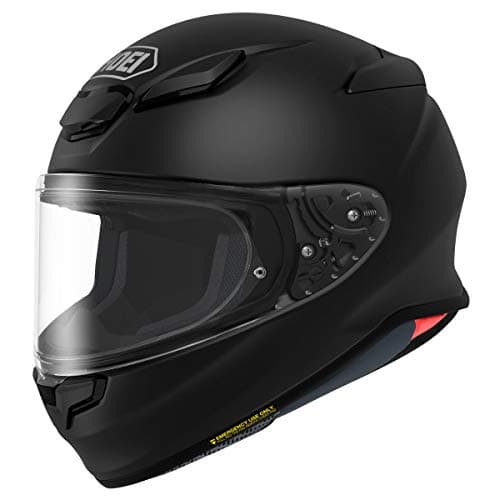
The RF-1400 wins on every axis we can measure. It is DOT plus Snell M2025, it is the lightest helmet on this page at a published ~1,385 g in a multi-ply AIM+ composite shell, and its European twin the NXR2 holds a 5-out-of-5 SHARP rating- the top result SHARP awards. It is also the one Snell helmet we rate that does not require flagship-touring money, which makes it the honest answer to "what is the best budget Snell helmet": there is no cheap Snell road helmet, and this is the floor.
What you feel day to day is the shield seal. Shoei's CWR system shuts properly and stays shut, which drives both rain ingress and wind noise, and it is why the RF-1400 ranks near the top of our quietest helmets page. Full detail in the Shoei RF-1400 review.
The honest cons. The 5/5 SHARP score belongs to the European NXR2, not to the US unit - same helmet family, different homologation - and we do not transfer star ratings across differently-certified builds. The US RF-1400 is not ECE 22.06. There is no drop-down sun visor, so you commit to a shield tint or carry a spare. And Shoei's interior is closer to intermediate oval, so it is not the pick for a round-oval head.
Who should skip it:anyone who needs a sun visor for commuting - the GT-Air 3 is Shoei's answer there, though it is a DOT build rather than a Snell one - and anyone whose head Shoei pinches.
2. Arai Contour-X - the Snell helmet for round-oval heads
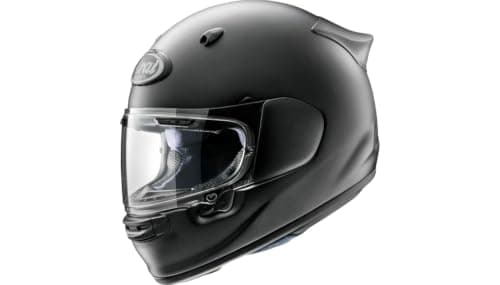
Arai is the other Snell house, and the Contour-X (the US name for the Quantic) is its all-day sport-touring helmet: DOT plus Snell M2025 in a PB e-cLc laminate at ~1,530 g, built on Arai's long-standing smooth-shell philosophy - a continuous outer surface with no hard protrusions, designed to glance off an impact rather than catch on it. The European Quantic holds a 4-out-of-5 SHARP rating.
Its real differentiator is fit. Arai builds the roundest interiors of any brand we rate, which is a genuine relief for heads that Shoei and AGV squeeze at the temples - and fit is not a comfort nicety, since every certification on this page was earned with a correctly fitted helmet. More in the Arai Contour-X review, the shape question in head shapes explained, and the brand pair in Shoei vs Arai.
The honest cons. It costs substantially more than the RF-1400 and it is about 145 grams heavier. Like every helmet here, the US build is not ECE 22.06 - the European Quantic is. There is no internal sun visor. And the round interior that rescues round-oval heads is actively wrong for a long-oval head, so this is the most fit-dependent pick on the page.
Who should skip it: long-oval heads, and anyone who wants the lightest or cheapest Snell build - both of which are the Shoei above.
3. Shoei Hornet X2 - the Snell adventure helmet that behaves like a touring lid
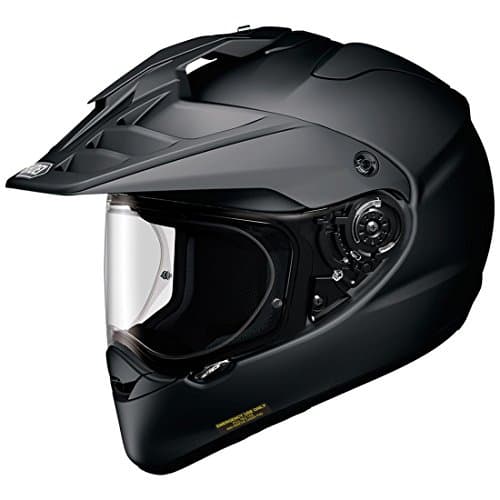
If your riding is adventure-shaped but mostly on sealed roads, this is the Snell answer. The Hornet X2 (sold as the Hornet ADV in some markets) is a DOT plus Snell ADV helmet in AIM+ composite at a published ~1,778 g, and what distinguishes it from most peaked helmets is that it is quiet: the peak is shaped to work with the shell rather than fight it, and Shoei's shield seal does the rest. On a highway transit stage it feels much more like a touring helmet than a dirt lid. Write-up in the Shoei Hornet X2 review.
The honest cons. It is the heaviest helmet on this pageat ~1,778 g, and on an ADV helmet that weight sits further from your head's center of gravity than on a road lid. It has never been SHARP-tested, so unlike the two road helmets above there is no independent star rating in any market. The US build is not ECE 22.06. And its peak generates more lift off-road than the newer Arai below, which is the one place it clearly loses.
Who should skip it: riders whose mileage is genuinely 50/50 or more off-road. A lighter, dirt-focused lid serves you better, and the trade-offs are laid out in dual-sport vs adventure helmets.
4. Arai XD-5 - the only M2025D build here, and the best peak at speed
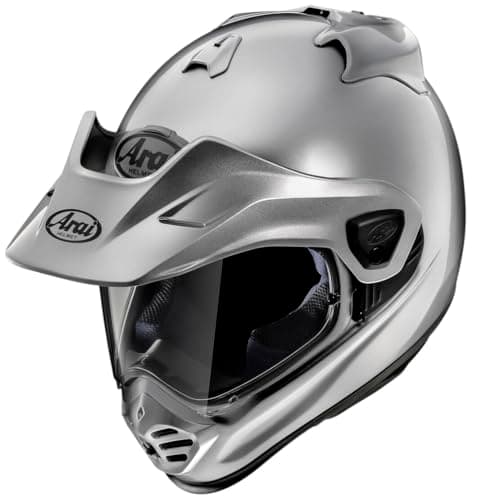
The XD-5 (the US name for the Tour-X5) is the one helmet on this page where Arai publishes the sub-standard: DOT plus Snell M2025D, the stiffer-shell, high-energy-repeat-impact companion to DOT. Super-fiber composite shell at a published ~1,683 g, with a removable peak that is genuinely engineered rather than bolted on - it sheds wind instead of lifting your head at highway speed, which is the single most common complaint about ADV helmets. Arai's rounder interior applies here too. The Arai XD-5 review has the detail, and the certification split is covered in the XD-5 safety rating.
The honest cons. It is the most expensive helmet on this page by a wide margin. Like the rest, the US build is not ECE 22.06 - and this is the sharpest version of that trade on the site, because the European Tour-X5 is ECE 22.06 and scored 4/5 at SHARP, so the US buyer pays flagship money and gets a different certification than the reviews they have probably read. It is also heavier than a carbon ADV helmet like the Klim Krios Pro by well over 200 grams.
Who should skip it: anyone who specifically wants ECE 22.06 rotational-test homologation in the US. The US XD-5 is a Snell build; the ECE 22.06 adventure answer in our catalog is the Klim Krios Pro, which is lighter and cheaper.
Is Snell actually safer?
Honest answer: it is a different test, not a strictly higher bar, and the evidence does not let anyone claim otherwise cleanly. Snell M2025D emphasizes stiffer shells and repeated high-energy impacts. ECE 22.06 and Snell M2025R emphasize rotational injury, more impact points and multiple speeds. A helmet optimized for one is not automatically worse at the other, and no public dataset ranks the two regimes against each other on real-world outcomes.
What we can say is this. Snell is independently tested with off-the-shelf verification, which DOT is not. It is voluntary, so it tells you something about a maker's willingness to be judged. And in the US it typically arrives instead of ECE 22.06 rather than alongside it. If you want the most independently-validated helmet we can document regardless of which standard it came through, that list is in the safest helmets we can document.
The verdict
Buy the Shoei RF-1400. It is the lightest, the cheapest and the best-documented Snell helmet we rate, with a 5/5 SHARP result on its European twin and a shield seal that makes it quiet enough to tour in. For most riders wanting Snell, the decision ends there.
Buy the Arai Contour-X if your head is round-oval, because fit beats every spec on this page. Buy the Shoei Hornet X2 if you want Snell on a peaked helmet and most of your miles are sealed. Buy the Arai XD-5 if you want the M2025D build and the best-engineered peak at highway speed, and you have accepted the price.
And if, having read all of that, what you actually wanted was the current independently lab-tested European standard rather than Snell specifically - buy an ECE 22.06 helmet instead, and spend a great deal less. That is not a cynical note; it is the single most common mismatch we see between what riders think they are buying and what the label on a US flagship says.
And if that last paragraph describes you, the counterpart list is the best ECE 22.06 helmets— the same treatment applied to the other independent standard, with the cheapest helmet that carries it named in the first paragraph.