A dual-sport helmet is not an adventure-touring helmet with dirtier graphics. On a shelf the two are nearly indistinguishable — peak on top, chin bar, oversized eye port — and they are built around opposite assumptions about how you will spend the day. A touring ADV lid assumes you are sitting down at 75 mph with the shield shut. A dual-sport helmet assumes you are standing on the pegs at 15 mph in your own dust with goggles on, that you will do that for an hour, and that you then have to ride home on the slab. The six helmets below are ranked on the second job, and where one of them is really the first kind wearing a peak, we say so.
We have not crash-tested any of these and we do not own a lab. Certifications come from the standards bodies and the manufacturers' published homologation, specs from the makers and from retailers who list them, independent results from SHARP where they exist, and ride impressions from aggregated owner and reviewer reports — exactly as our methodology sets out. Because this is adventure, the US-versus-Europe certification trap is everywhere, so every mark below is the one on the box sold in the United States.
Who this page is for — and who should read the other one
Start with an honest estimate of your road-to-dirt split, because it decides the whole question. RevZilla's Common Tread puts it simply: if 90% of your riding is pavement, buy a street helmet; for genuinely mixed terrain, buy an adventure helmet; if you are mostly off-road, buy a dirt helmet. This page lives at the mixed-to-dirt end of that line. If your bike is a big ADV machine that sees a gravel road twice a summer, you will be happier with the quieter, better-sealed lids in best adventure touring helmets, and you should stop reading here.
If, on the other hand, you ride a genuine dual-sport — a DR, a KLR, a 500 EXC with a plate, a middleweight ADV bike you actually take down trails — then the features that make a touring helmet good are the ones that will annoy you. A tight seal means no airflow at trail speed. A heavy composite shell means a sore neck by the second technical section. A shield that will not come off means no goggles when the dust arrives. Those are the trade-offs this list is built around.
The five things that decide a dual-sport helmet
1. Does it genuinely run goggles, or merely tolerate them?There are two different designs hiding behind the phrase "goggle compatible." In the first, the shield stays on and the goggles live underneath it — Fly Racing designs the Trekker's shield "specifically to accommodate goggles and goggle straps when in the closed position." In the second, the shield comes off entirely and the helmet becomes a peaked dirt shell with a huge aperture; HJC calls this an "easy converting system from shield and visor to visor-only," and the Krios Pro and AX9 do the same thing. Bell advertises a third, simplest route on the MX-9 Adventure: it is "designed to work with any dirt goggle out there," so when you need them you "simply flip up the shield and throw 'em on." Do not assume the third route works on every helmet. webBikeWorld found that on the DS-X1 the shield does not raise high enough to mount goggles comfortably without removing it first. That is the kind of detail nobody discovers until they are standing in dust at the trailhead.
2. Weight, because you are standing up. On a touring helmet weight is a fatigue question you notice at hour six. On a dual-sport helmet it is a control question you notice in the first twenty minutes, because you are out of the saddle with your head moving constantly and nothing supporting your neck. The spread on this page is roughly 400 g between the lightest carbon convertible and the heaviest modular, which is the single biggest functional difference in the list. Our helmet weight guide explains what actually drives the number, and why a heavier helmet with a peak is worse than the raw grams suggest.
3. Ventilation at 15 mph, not 75.Street helmets are ventilated by ram air: the faster you go, the more of it there is. Off-road you are working hardest exactly when there is no air at all. RevZilla's comparison is blunt about the gap — dirt helmets get "large vents and air channels cut into the EPS layer," while adventure helmets "vent better than a typical street helmet" without matching a dirt lid. Every helmet here is an adventure-style compromise, so read the vent story as a ranking within a category that is already behind a true motocross shell. Our ventilation explainer covers how the channels actually work.
4. The peak, and what it does at highway speed.The peak is what makes a dual-sport helmet useful off-road — it shades a low sun, deflects roost, and gives you something to duck behind under branches. It is also the part that punishes you on the ride home. As RevZilla puts it, "the peaks tend to catch air and pull at the rider's head during high speeds," which is why the better adventure helmets use reinforced, vented or channel-cut peaks to bleed pressure instead of sailing. A peak you can remove in under a minute is worth more than a peak somebody has optimized in a wind tunnel.
5. And the mark on the US box. Certification comes last in this list only because it is first everywhere else on this site, and because it is the thing riders most often get wrong when they shop dual-sport. Three of these six carry genuine US DOT + ECE 22.06. One carries a claimed ECE with no published revision. One is DOT only. None is Snell, because Snell's road standard is not what this class chases. If the differences between those marks are not already clear, read DOT vs ECE vs Snell before you spend anything.
How we ranked these six
In this order: true goggle conversion, then weight on the pegs, then low-speed airflow, then the certification on the US box, then the peak's manners at highway speed, and last, price. One caveat we want stated up front rather than buried: a dual-sport helmet leads a harder life than a road helmet. It gets dropped in parking lots, scraped on branches and sweated into. Two of the picks below sit in an entirely different price bracket from the value picks, and for a lot of riders that money is better spent on tires, a skid plate or a second set of goggles. We rank on merit and then tell you when the cheaper one is the smarter buy.
Klim Krios Pro — the best dual-sport helmet, if the budget allows
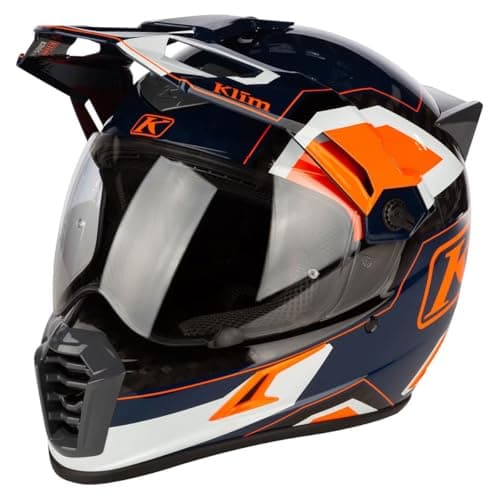
The Krios Pro wins here for a different reason than it wins our touring roundup. There, its argument is that it is the lightest way to hold ECE 22.06 on a long paved day. Here, the argument is that it is the only helmet on the page that strips down to a bare peaked goggle shell at around 1,450 g in size L — full carbon, Koroyd, and genuine US DOT + ECE 22.06that Klim publishes itself. Standing up on a rocky section with your head on a swivel, the difference between this and the polycarbonate helmets below is not subtle, and it is the closest thing to a motocross helmet's weight you can get while keeping a shield for the ride home.
The honest cons: it is priced like the flagship it is, and it is noticeably noisier in full peak-and-goggles configuration than it is buttoned up with the visor — which matters because the highway leg is exactly when you will have it buttoned up. It also has no drop-down internal sunshade, so bright-sun management is the goggle lens or a tinted shield. Full detail in the Krios Pro review and its safety rating.
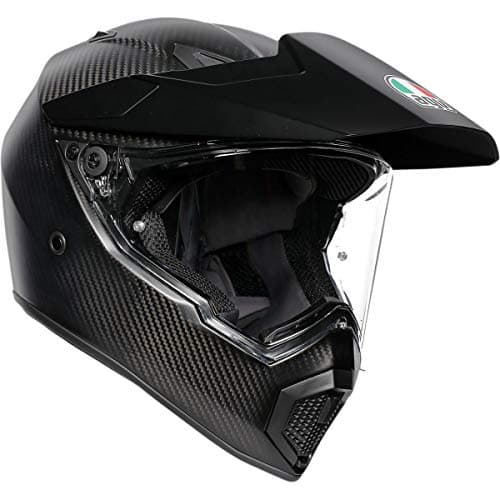
AGV AX9 — the widest aperture, and the better helmet for goggles
Sixty grams heavier than the Klim at around 1,510 g in a carbon, aramid and glass-fiber blend, with the same genuine US DOT + ECE 22.06, and one specific advantage over our top pick: the eye port is one of the widest in the category. With goggles on, that aperture is the whole experience. A narrow port turns a pair of goggles into a letterbox, and it also decides whether the goggle frame sits cleanly against the foam or fights the shell edge. If you expect to run goggles more often than the shield, this is arguably the better helmet of the two despite sitting second, and it converts through the same three configurations — full ADV, street visor, or peak and goggles.
The honest cons: AGV's internal shape is firmly intermediate oval, so round-oval heads should try one on before spending, and it produces the same peak buffeting at very high speeds that afflicts almost every helmet in this class. It is also a flagship price for a helmet with no sunshade. See the AGV AX9 review, and how to measure helmet size if you are not sure which shape you are.
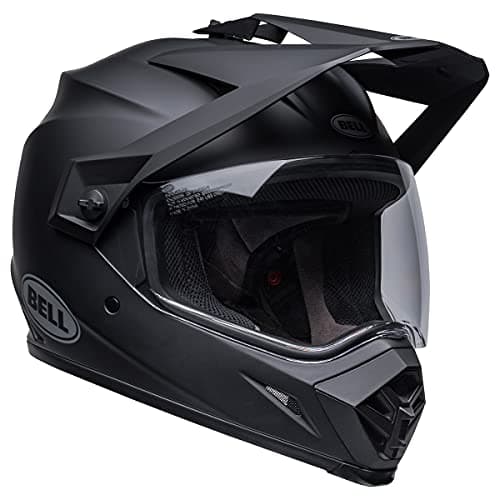
Bell MX-9 Adventure MIPS — the one most riders should actually buy
This is the value pick, and for a genuine dual-sport rider it is more than that. The MX-9 Adventure descends from Bell's motocross line rather than from a street helmet, which shows in how it treats goggles: Bell says it is "designed to work with any dirt goggle out there," and when the trail turns dusty you "simply flip up the shield and throw 'em on." The peak is a two-point removable design. And it is the only helmet on this page with independent crash-test data behind it — genuine DOT + ECE 22.06, a MIPS rotational-management layer, and a SHARP 4/5 result, in a helmet that costs a fraction of the carbon lids above. Three shell sizes cover XS-3XL.
The honest cons are the ones you buy at this price. It is a polycarbonate shell at around 1,696 g, roughly 250 g heavier than the Krios Pro, and you will feel that standing up. It is louder and less refined than the flagships at speed, and the finish is workmanlike. None of that changes the arithmetic: if you are going to drop this helmet on rocks, it is the one we would buy. Full write-up in the MX-9 Adventure review, with the independent numbers in its safety rating.
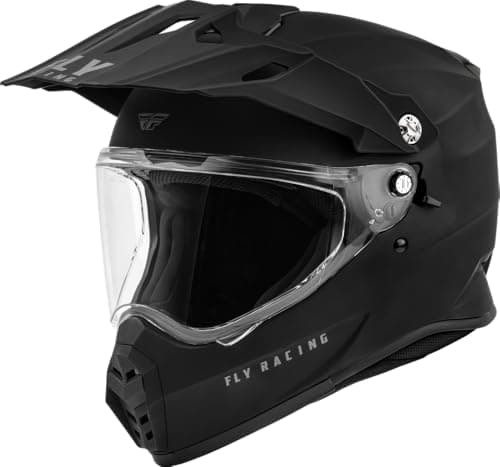
Fly Racing Trekker — the dual-sport lid that kept the sun visor
The Trekker is here because it solves a problem the four helmets above simply ignore. Almost no dual-sport helmet has a drop-down internal sunshade — the category assumes you are running tinted goggles — and the Trekker has one, with an anti-fog coating, at a mid-range price. Fly also took the first of the two goggle approaches rather than the second: the shield is designed "specifically to accommodate goggles and goggle straps when in the closed position," so you are not hunting for somewhere to put a removed shield. Add switchable on/off vents in the chin bar, brow and rear, a removable washable antimicrobial liner, a chin curtain, and a size run of XS-3XL across 53-66 cm in a round-oval shape, and it is a lot of helmet for the money.
The honest cons, and one of them is the reason it is not higher. Fly does not publish the ECE revision.Its own product page says "ECE / DOT Approved (FMVSS218 Approved)," and Cycle Gear and RevZilla both list it as nothing more specific than "ECE / DOT approved." Fly names the revision explicitly on other models — its Sentinel line is sold as an ECE 22.06 helmet — so we read the silence here as meaningful and we do not assert 22.06 on your behalf. Buy it as a DOT helmet and read the label on the one that arrives. It is also a 3.5 lb polymer shell, heavy for this use, and there is no published Pinlock provision.
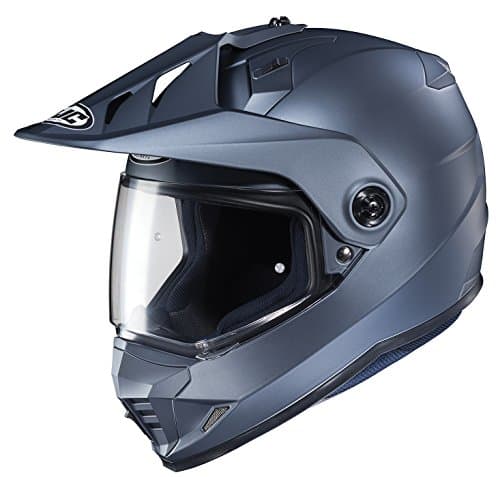
HJC DS-X1 — the cheapest one we can stand behind
Every category needs an entry point that is not junk, and in dual-sport this is it. The DS-X1 does the thing the class is supposed to do: HJC's "easy converting system" takes it from shield-and-visor to visor-only, turning it into a peaked goggle shell in a couple of minutes. It ships with a Pinlock-prepared HJ-27 shield, which is anti-fog provision the budget competition leaves out entirely — our Pinlock guide explains why that matters more than any coating. HJC builds it on three EPS sizes (XS/S, M/L, XL/2XL) rather than padding out one shell, with published weights from 1,575 g at XS to 1,673 g at LG-2XL, a double D-ring strap and molded speaker pockets.
The honest cons are real and there are three of them. It is DOT only— no ECE, no Snell — which makes it the weakest certification on this page and the reason it sits fifth rather than third on price. webBikeWorld found the shield will not raise high enough to mount goggles comfortably without removing it first, so the "flip up and go" workflow that works on the Bell does not work here. And the consistent reviewer criticism is the upper ventilation: shallow EPS channels that can be partly blocked by head pressure, which is the wrong weakness for a helmet you wear while working hard at low speed. Buy it knowing all three.
Scorpion EXO-AT960 — the flip-up outlier, for the commute at either end
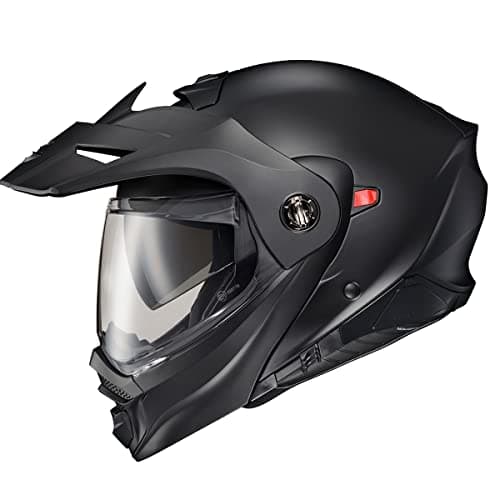
The AT960 is the odd one here and it earns its place by being useful in a way none of the others are. It is a modular: the chin bar lifts, so you can talk at a gate, drink at a fuel stop or cool off on a fire road without unstrapping. It runs three configurations — peak-and-visor, street, or goggles — carries genuine DOT + ECE 22.06, and uniquely on this page it has a drop-down internal sun visor as well as everything else. For a rider whose dual-sport bike is also the commuter, it does more jobs per dollar than anything else listed.
The honest cons are exactly what you would expect from putting a hinge in a dirt helmet. At around 1,860 g it is the heaviest helmet on this page by a wide margin — more than 400 g above the Krios Pro — and it is a polycarbonate shell, so that weight is not buying you shell technology. The mechanism is another thing to fill with dust and another thing to break in a fall. It is not quiet, and the peak adds drag at highway speed. If your split genuinely leans dirt, this is the wrong end of the list; if it leans road with trail days, it may be the right one. See the EXO-AT960 review and the sub-$300 alternatives in best budget adventure helmets.
Goggles or the shield? Both — and here is when to switch
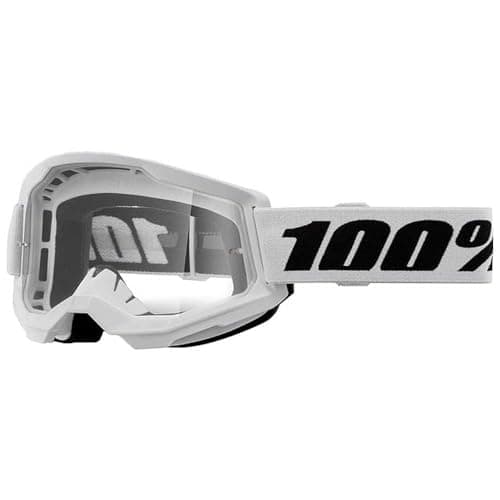
The shield wins on the road and the goggles win in the dirt, and the reason is the same in both cases: the sealed environment. A closed shield keeps wind off your eyeballs, keeps insects out of your face and cuts the roar, and it fogs less than goggles do because you are not breathing hard behind it. Goggles win the moment you are working: they seal to your face so dust and sand cannot get around them, and they cope with heavy breathing far better than a shield resting a centimeter from your nose. That is the whole decision. Shield for the transit, goggles for the terrain.
Which means the practical question is how fast your helmet lets you switch. On the MX-9 Adventure you flip the shield up and pull the goggles down. On the Krios Pro, AX9 and DS-X1 the shield comes off, which is cleaner to ride with but leaves you carrying a shield in a tank bag. On the Trekker the shield stays closed over the goggles. None is wrong; they just suit different days. If you routinely do both in one ride, weight the fast-switch designs higher than we have.
Fog is a bigger problem here than on any other helmet
Dual-sport riding is the worst case for fogging: high exertion, low airflow, cool air, frequent stops. The single best answer remains a genuine Pinlock insert in a Pinlock-prepared shield, which is why the DS-X1's HJ-27 shield is worth more than its price bracket suggests — see the Pinlock roundup. When your helmet has no Pinlock pins, the options get worse and more effortful, and we run through all of them in how to stop your visor fogging. Goggles have the same problem in miniature: a dual-pane lens and untouched anti-fog coating are what keep them clear, and wiping the inside of a goggle lens with a glove is the fastest way to destroy it permanently.
Three EPS sizes is not the same as three shells
Two of the helmets here advertise multiple sizes in a way that is easy to misread. HJC publishes three "EPS shell sizes" on the DS-X1 (XS/S, M/L, XL/2XL) — that refers to the internal impact-absorbing liner, not to three different outer shells. Bell lists three shell sizes covering XS-3XL on the MX-9 Adventure. Either arrangement is better than one shell padded out with thicker cheek pads across the whole range, because the further a helmet gets from its designed size the more it balloons above your head and the worse the weight distribution gets. It is one of the quiet reasons a small rider often finds a mid-price helmet more comfortable than a flagship built on fewer shells. Our sizing guide covers measuring and head shape, and riders at the top of the range should also read best helmets for big heads.
The ride home is where dual-sport helmets get judged
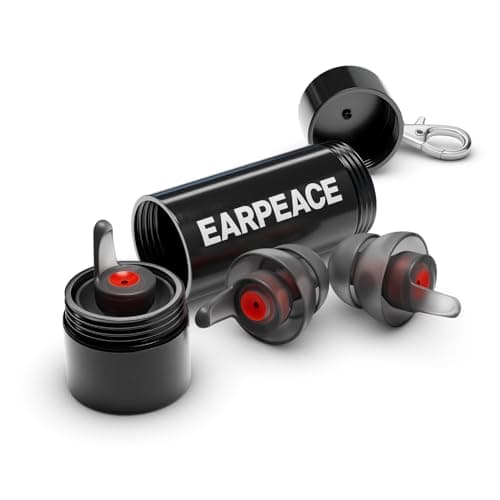
Almost every complaint riders have about this category comes from the paved leg, not the trail. The big eye port and the aggressive vents that make a dual-sport helmet pleasant at 15 mph also make it loud at 70, and the peak that shades your eyes under trees pulls at your head in clean air. You can mitigate the noise — earplugs move perceived helmet noise more than any helmet upgrade at this price, and how to make your helmet quieter runs the fixes in cost order. You cannot mitigate the peak except by taking it off, which is why quick peak removal is a genuine feature rather than a spec-sheet line.
What we left off, and why
We left off the Arai XD-5 and the Shoei Hornet X2. Both are excellent helmets and both are on our adventure touring roundup, where they belong — they are road-biased lids with peaks, they are heavier than the carbon convertibles here, and Shoei's own positioning of the Hornet X2 is a helmet that starts to struggle once your riding is genuinely 50/50 or dirtier. Putting them on a dirt-first page because they carry peaks would have been the kind of padding this site tries not to do.
We also left off pure motocross helmets. A true MX shell is lighter and vents better than anything above, and for a rider who never does more than a mile of pavement it is the right answer — but it has no shield, no seal, no chin curtain and no provision for any of them, so it turns every road transit into an endurance event. That is a different category with different rules, and it is covered in types of motorcycle helmets rather than ranked against helmets it is not competing with. Finally, we did not list any helmet whose certification we could only find on a marketplace listing. Dual-sport is a category with a lot of cheap peaked lids and very little published homologation behind them, and absence here means we could not check, not that we tested and rejected.