HUB 01 · Adventure & Dual-Sport Helmets
Fly Racing Trekker Review
The dual-sport helmet that solves the problem the rest of the class ignores - sun - at a mid-range price, in a documented round-oval shell. The catch is a certification Fly will not pin down in writing.
We earn a commission when you buy through our Amazon links, at no extra cost to you. It never changes a ranking, and we tell you when the cheaper helmet is the better buy. How this works.
Dual-sport riders who want a sun visor
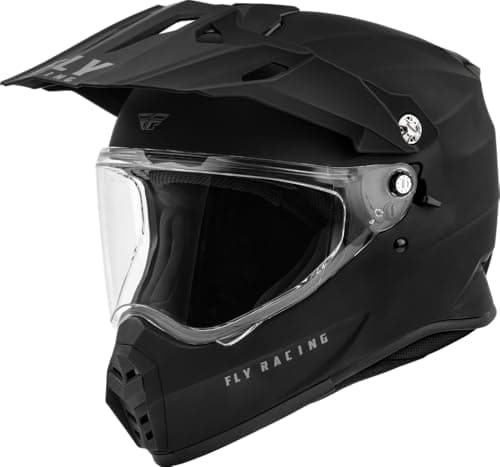
The mid-price dual-sport that keeps a drop-down sun visor and still takes goggles — but Fly never publishes which ECE revision it holds.
Price as of October 21, 2026. Prices change — Amazon's at checkout is the one that counts.
#ad · we may earn a commission from this link to Fly Racing Trekker
Buy the Trekker for one specific reason: it is a dual-sport helmet with a drop-down anti-fog sunshade and a shield Fly designs to stay closed over goggles and goggle straps, in a documented round-oval shell offered XS-3XL. Who it is for: the round-oval rider splitting time between pavement and dirt who is tired of squinting, and who is not prepared to spend flagship money.
The honest caveat, up front and unresolved: Fly Racing states "ECE / DOT Approved (FMVSS218 Approved)"on its own product page and never names the ECE revision. Neither do Cycle Gear or RevZilla, which both list it as simply "ECE / DOT approved." So we rate this helmet as a confirmed DOT (FMVSS 218) build with an unverifiedECE status - not as ECE 22.06. More on why that silence matters below. We have not crash-tested this helmet and we do not run a lab; everything here comes from Fly's published specification and the retail listing data, cited at the foot of the page.
The sunshade is the reason this helmet exists
Dual-sport helmets are built around a peak and a goggle aperture, and the usual consequence is that nothing shades your eyes except a tinted shield or tinted goggles. On a long gravel road into low sun that is a real problem, and swapping a shield at the roadside is a poor answer. The Trekker puts a drop-down internal sunshade with an anti-fog coating into a mid-price dirt-biased helmet, which almost nothing else in the class does. The Scorpion EXO-AT960 also has one, but it is a heavier, pricier adventure-touring modular rather than a dual-sport lid - and outside those two, our sun-visor roundup is dominated by street helmets for exactly this reason.
Goggles without taking the shield off
There are three ways a dual-sport helmet handles goggles, and they are not interchangeable. Some helmets expect you to remove the shield entirely (the Klim Krios Pro and AGV AX9 convert that way). Some expect you to flip the shield upand wear goggles under it, which does not always clear - webBikeWorld found the HJC DS-X1's shield does not raise high enough to mount goggles comfortably without removing it first. And some are designed so the shield stays closed over the goggles, which is what Fly publishes for the Trekker: the shield accommodates goggles and goggle straps in the closed position.
That third route is the most convenient of the three in practice - nothing to carry, nothing to unbolt at a trailhead - and it is the one to look for if you switch surfaces mid-ride. Our dual-sport roundup compares all three approaches across the field, and if you need goggles to go with it, a clear anti-fog pair is the cheap half of this setup.
The certification silence, stated exactly
Here is why we will not write "ECE 22.06" on this page. The marks on a helmet are the one thing we refuse to infer: DOT (FMVSS 218) is self-certified by the manufacturer, while ECE 22.06 is independently lab-tested before sale and adds the oblique (rotational) impact test that 22.05 lacked. Those are materially different claims, and "ECE approved" without a revision could mean either series.
What makes the silence meaningful rather than accidental: Fly doesname the revision explicitly on other models - its Sentinel line is sold as "ECE 22.06" - so the company clearly knows the distinction matters to buyers and prints it when it applies. We treat an unnamed revision as unverified, which is how it appears on the certification row of the table on this page: DOT yes, ECE unverified, no SHARP data (the Trekker has not been SHARP tested). Check the label sewn to the chin strap of the unit you receive - an approval code beginning 06 is the current series, 05 the previous one.
If confirmed ECE 22.06 is your deciding factor, buy the Bell MX-9 Adventure MIPS instead. It carries published DOT + ECE 22.06, adds a MIPS rotational-management layer, and has an independent SHARP 4/5 score, for similar money - it just has no sunshade. That is the trade this page comes down to: documented certification, or sun management. Our certification explainer is the page to read before you decide which you value more.
Fit: a documented round-oval shell, XS to 3XL
Two things here are genuinely unusual at this price. First, the internal shape is documented as round oval - and almost no manufacturer publishes an internal shape at all, which is the central frustration of our head-shape guide. If helmets normally crush your temples while leaving space front to back, your head is rounder than the average shell and this is one of the few budget lids you can shop for on purpose rather than by trial and error.
Second, the size range runs XS-3XL (53-66 cm), where plenty of premium helmets stop at 2XL. If you are at the large end, that reach is worth real money - see our big-heads guide for how rare it is. Fly also fits a removable, washable antimicrobial liner, which matters more on a helmet you will sweat into off-road than on a touring lid.
Weight and ventilation
Fly publishes 3.5 lb (about 1,588 g) for the polymer shell. In context: that is lighter than the heavyweight convertible adventure modulars and meaningfully heavier than a carbon dual-sport, and weight is felt most exactly where a dual-sport helmet is used - standing on the pegs, head up, working. If you spend most of your time off-road, carbon is the upgrade that changes the day, and our weight explainer covers what you pay for it.
Ventilation is switchable on/off vents in the chin bar, brow and rear, which is the right design philosophy: vents that genuinely close give you a summer helmet and a usable cold-weather one. Dirt-biased helmets vent harder than street helmets by design, because low-speed, high-effort riding generates heat with no airflow to clear it - the reason ADV and dual-sport shells appear in our hot-weather picks.
Fog is the one thing to plan for
There is no published Pinlock provisionon the Trekker, so the best fog fix in motorcycling is off the table. What you have instead is the sunshade's anti-fog coating, the chin vent and airflow, and - if you ride cold and damp - a wipe-on anti-fog treatment or goggles under the closed shield. Our fogging guide ranks the options honestly and says plainly that a Pinlock-equipped shield beats every one of them, which is a point against this helmet if your riding is November commuting rather than summer trails.
Running comms on it
Fly publishes no comms channel or speaker-pocket claim for the Trekker, so we will not assert one - check the liner for depth before you buy an intercom to go with it. If you do want comms on a budget dual-sport, a two-rider bolt-on that ships with both a hybrid/boom mic and a wired mic, like the Cardo Spirit HD, is the most forgiving choice because it does not assume a particular chin-bar shape. If you ride in a group of three or more you need Mesh rather than Bluetooth, which our group-riding guide explains.
Who should skip it
Skip the Trekker if a confirmed current certification is the thing you are buying - the Bell MX-9 Adventure MIPS gives you published ECE 22.06, MIPS and a SHARP score for similar money. Skip it if you are mostly off-road and weight matters, since 3.5 lb of polymer is the wrong end of the scale for standing riding. Skip it if you need a Pinlock-ready shield for cold, damp commuting. And skip it if your head is long-oval, because this is a round-oval shell. What is left - a round-oval rider who wants sun management and goggle compatibility on a mid-price dual-sport, and who will check the ECE label themselves - is who this helmet genuinely suits. For the category question behind that, see dual-sport vs adventure helmets.
The other budget dual-sport worth a look is HJC's convertible DS-X1, which ships a Pinlock-prepared shield. The two go head to head in HJC DS-X1 vs Fly Racing Trekker.
The scorecard
How it scores, and who should skip it
- Value
- 9
- Features
- 8.5
- Fit range
- 8.5
- Certification
- 6.5
- Weight
- 6.5
Pros
- A drop-down anti-fog sunshade, which almost no dual-sport helmet at this price offers
- Shield is designed to accommodate goggles and goggle straps with the shield closed, so you aren't forced to remove it
- Switchable on/off vents in the chin bar, brow and rear, plus a removable washable antimicrobial liner
- XS-3XL across 53-66 cm in a round-oval shape — a wide range for the money
Cons
- Fly doesn't publish the ECE revision, so we can't confirm the current 22.06 rotational standard
- 3.5 lb in a polymer shell — heavier than the carbon convertibles and heavy for standing on the pegs
- No published Pinlock provision, so fog management is the sunshade coating and airflow
Don't buy this if…
…confirmed ECE 22.06 is your deciding factor — the Bell MX-9 Adventure MIPS carries it, plus MIPS and a SHARP 4/5 score, for similar money.
Price as of October 21, 2026. Prices change — Amazon's at checkout is the one that counts.
#ad · we may earn a commission from this link to Fly Racing Trekker
How we picked
We do not crash-test helmets
We compiled published specifications, cited each helmet's certification (DOT, ECE 22.06, Snell, SHARP) from the standards body or manufacturer homologation, and aggregated owner reports, then scored against a published method. The scores are judgments from documented research — not measurements we took. We do not run a crash lab. Certifications reflect the US-market build; where it differs from the European version, we say so and cite it.
Questions
Frequently asked
Is the Fly Racing Trekker ECE 22.06?
Can you wear goggles with the Fly Racing Trekker?
What head shape and sizes does the Trekker come in?
Does the Trekker take a Pinlock insert?
Keep reading
Related
- Best dual-sport helmetsWhere the Trekker ranks against the dirt-biased field.
- Bell MX-9 Adventure reviewThe published-22.06 alternative, with MIPS and a SHARP score.
- Head shapes explainedThis is a documented round-oval shell - check that is you.
- Best helmets with a sun visorThe feature that puts this helmet on the list, across formats.
- DOT vs ECE vs Snell vs SHARPWhy an unnamed ECE revision is not good enough for us.
- Best helmets for big headsXS-3XL is a rare reach at this price.
Receipts
Sources
- Fly Racing - Trekker Solid Helmet ("ECE / DOT Approved (FMVSS218 Approved)"; drop-down sunshade; shield accommodates goggles closed; switchable on/off vents; removable washable antimicrobial liner)
- Cycle Gear - Fly Racing Trekker Helmet ("ECE / DOT approved" with no revision named; 3.5 lb; XS-3XL, 53-66 cm; round oval)
- SHARP - ECE R22.06: what you need to know (what the current revision adds over 22.05)
- SHARP - Bell MX-9 Adventure MIPS (4/5)
- NHTSA - Choose the Right Motorcycle Helmet (FMVSS 218 self-certification)
We do not run a crash lab, and we do not pretend to. Certifications are cited to the standards body or the manufacturer's stated homologation; where a US model's certification differs from its European namesake, we say so. Where we could not verify something, we say so on the page rather than quietly leaving it out. Read our full method.