HUB 01 · Adventure & Dual-Sport Helmets
HJC DS-X1 Review
The cheapest dual-sport lid we can stand behind: a shield that genuinely comes off for goggles, three real EPS shell sizes, and a Pinlock-prepared visor - with a DOT-only certification we will not dress up as anything more.
We earn a commission when you buy through our Amazon links, at no extra cost to you. It never changes a ranking, and we tell you when the cheaper helmet is the better buy. How this works.
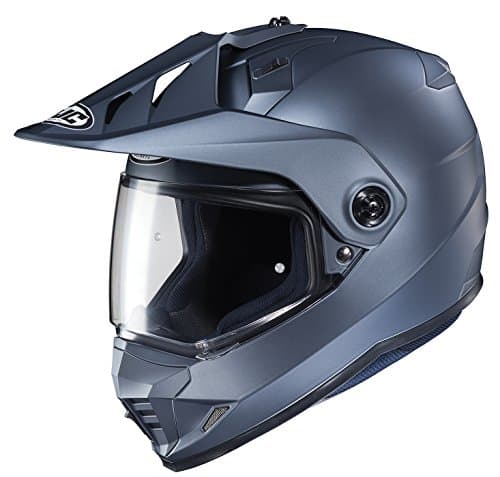
The lowest-cost convertible dual-sport
The cheapest genuinely convertible dual-sport lid we can stand behind — a Pinlock-prepared shield that comes off for goggles, on a DOT-only certification.
Price as of October 21, 2026. Prices change — Amazon's at checkout is the one that counts.
#ad · we may earn a commission from this link to HJC DS-X1
The HJC DS-X1 is the entry point to the dual-sport class, and it is an honest one. For the money you get a helmet that genuinely converts - the shield comes off and you ride in goggles behind the peak - plus a Pinlock-prepared visor and three separate EPS shell sizes, which are features budget rivals usually skip. Who it is for: the rider mixing pavement and dirt roads who needs a real convertible lid and cannot spend adventure-flagship money. The one thing you must read before buying is the certification, and we have put it first rather than last.
We have not crash-tested this helmet and we have no lab. The specifications below come from HJC and from the US retail listing, the owner-experience notes are aggregated from published reviews and buyer feedback, and everything is sourced at the foot of the page.
The certification, stated plainly
On the US market the DS-X1 is a DOT (FMVSS 218) helmet and nothing more. webBikeWorld's review states that "the DS-X1 meets the DOT standard in the U.S.A.", and the RevZilla listing shows DOT approval with no ECE and no Snell. It has never been SHARP-tested. That is the weakest certification of any helmet in our adventure category, and it is the single biggest reason this helmet is cheap.
What DOT actually means is worth being precise about, because "DOT only" is not the same as "unsafe". DOT is the US legal minimum, and a DOT-labeled helmet from a real manufacturer like HJC is a real helmet that has been built to a real standard. But DOT is self-certified - the manufacturer applies the label and NHTSA spot-checks afterward - and it does not include the oblique rotational-impact test, the extra impact points or the visor testing that ECE 22.06 added. If you want an independently type-approved shell, this is not the helmet; our DOT vs ECE vs Snell vs SHARP explainer lays out exactly what each mark buys you. The Bell MX-9 Adventure MIPS gets you genuine DOT + ECE 22.06, a MIPS layer and an independent SHARP 4/5 result for not a great deal more, and that is the upgrade we would push most riders toward.
We say this plainly because the alternative is worse. A brand that publishes "DOT only" and means it is giving you more usable information than one that prints "DOT/ECE" with no revision attached - a gap we walk through in are Simpson helmets good?. HJC's disclosure here is clear. It is simply a low floor.
The converting system is the whole point
A dual-sport helmet has to do two jobs: behave like a street helmet with a shield down on the highway, and work with goggles behind a peak when the pavement ends. HJC's easy converting system takes the DS-X1 from shield-and-visor to visor-only, which is the real version of that promise rather than the marketing version. You remove the face shield, keep the peak, and ride in goggles - and because the peak stays, you keep the roost and low-sun protection that is the reason peaks exist.
The honest limitation is the halfway position. webBikeWorld found the shield will not raise high enough to mount goggles comfortably without taking it off first. Some dual-sport helmets let you flip the shield up and wear goggles beneath it; this is not one of them. If you want to switch between shield and goggles repeatedly in a single ride, that matters - it is a tool-free swap but it is still a swap, not a flip. We compare the three different approaches to this problem in the best dual-sport helmets.
A Pinlock-prepared shield at this price
The DS-X1 ships with a Pinlock-prepared HJ-27 shield, with the insert sold separately. That provision is genuinely unusual this far down the price list and it is worth more than the spec sheet suggests: a Pinlock insert is the difference between a helmet you can ride in cold, wet weather and one whose visor fogs the moment you stop at lights. Budget it in as a small extra purchase rather than treating it as optional - our Pinlock insert guide covers how to pick one, and how to stop your visor fogging explains why the insert works where sprays mostly do not.
Three EPS shell sizes, and who it fits
HJC publishes three EPS shell sizesfor the DS-X1 - XS/S, M/L and XL/2XL - rather than padding one shell out across the whole range. That is the right way to build a size range: the shell scales with your head, so a small head is not carrying a large helmet's profile and a large head is not relying on thin padding. The published weights run from about 1,575 g at XS to 1,673 g at the LG-2XL shell; RevZilla lists 3.74 lb for its sample, which is the same ballpark.
The shell is HJC's advanced polycarbonate composite, and the retention is a double D-ring - the fastener every certification body prefers. The interior liner and cheek pads are removable and washable, there are molded speaker pockets for a comms unit, and there are glasses grooves in the cheek pads, which is a real convenience if you ride in prescription lenses; we cover that fit problem in detail in best motorcycle helmets for glasses. Buyer feedback does repeatedly flag inconsistent sizing, so measure your head properly with our head-measuring guide and buy where you can return it.
Ventilation: the consensus weak point
HJC fits its ACS Advanced Channeling Ventilation System, which is designed to pull air front-to-back and flush heat and humidity out of the top of the helmet. On paper that is the same architecture HJC uses further up its range. In practice the upper ventilation is the most consistent criticism of this helmet in published reviews and buyer feedback - airflow is reported as limited at low speed and in hot weather, which is precisely when a dual-sport rider needs it, because slow technical sections generate heat and no wind.
That is the trade a budget shell makes. Vent engineering - intake shape, channel volume, exhaust pressure - is expensive to develop, and it is one of the first things cut to hit a price. If you mostly ride at road speeds, you will probably find it adequate. If your riding is slow, hot and technical, this is the specification that will annoy you first, and it is worth stepping up to a helmet with a better-developed vent path.
The peak
The peak does its job - roost deflection, low-sun shading - but its adjustment range is narrow, so you have less scope to tune it for your riding position than on pricier dual-sport lids, and some owners report wobble at speed. On any peaked helmet, a peak catches wind at highway speeds and adds head-turn drag; that is physics rather than a defect, and it is one of the main reasons some riders choose a smooth adventure-touring shell instead. If you are not sure which class you want, read dual-sport vs adventure helmets before you spend anything.
Who should skip it
Skip the DS-X1 if you want more than the US legal minimum on the shell. That is the honest summary: the certification is the cost of the low price, and the Bell MX-9 Adventure MIPS solves it with genuine DOT + ECE 22.06, MIPS and an independent SHARP 4/5 for a modest step up - both helmets appear in our best budget adventure helmets roundup. Skip it too if your riding is slow and hot, where the ventilation will frustrate you, or if you need to switch between shield and goggles without stopping.
Where the DS-X1 sits
Buy it if the budget is the constraint and you need a helmet that genuinely converts. On that narrow brief it is good value: a real converting system, a Pinlock-prepared shield, three EPS shell sizes, a double D-ring and glasses grooves, from a manufacturer that states its certification clearly. It is the cheapest dual-sport helmet we are willing to recommend, and the reasons we rank it last in the class are written on its own spec sheet rather than hidden. If your riding has drifted onto pavement and you no longer need the peak at all, the same money buys considerably more certification in a road helmet - see our best budget full-face helmets.
Its closest rival at this money is the Fly Racing Trekker, which adds a drop-down sunshade and saves weight. We compare them directly in HJC DS-X1 vs Fly Racing Trekker.
The scorecard
How it scores, and who should skip it
- Value
- 9
- Versatility
- 8
- Fit range
- 8
- Certification
- 6
- Weight
- 6.5
Pros
- HJC's "easy converting system" takes it from shield-and-visor to visor-only for goggles, which is the whole point of a dual-sport lid
- Ships with a Pinlock-prepared HJ-27 shield — anti-fog provision the cheaper rivals leave out
- Three EPS sizes rather than one padded-out shell, plus a double D-ring and molded speaker pockets
Cons
- DOT only — no ECE and no Snell on the US build, so it's the weakest certification on this page
- webBikeWorld found the shield won't raise high enough to mount goggles comfortably without taking it off first
- Upper ventilation is the review consensus weak point, and the peak's adjustment range is narrow
Don't buy this if…
…you want more than the US legal minimum on the shell — spend a little more on the Bell MX-9 Adventure MIPS for ECE 22.06, MIPS and an independent SHARP score.
Price as of October 21, 2026. Prices change — Amazon's at checkout is the one that counts.
#ad · we may earn a commission from this link to HJC DS-X1
How we picked
We do not crash-test helmets
We compiled published specifications, cited each helmet's certification (DOT, ECE 22.06, Snell, SHARP) from the standards body or manufacturer homologation, and aggregated owner reports, then scored against a published method. The scores are judgments from documented research — not measurements we took. We do not run a crash lab. Certifications reflect the US-market build; where it differs from the European version, we say so and cite it.
Questions
Frequently asked
Is the HJC DS-X1 ECE certified?
Can you wear goggles with the HJC DS-X1?
How much does the HJC DS-X1 weigh?
Does the HJC DS-X1 come with a Pinlock insert?
Is the HJC DS-X1 good for glasses?
Keep reading
Related
- Best dual-sport helmetsWhere the DS-X1 ranks against the rest of the class.
- Bell MX-9 Adventure MIPS reviewThe modest step up that adds ECE 22.06, MIPS and a SHARP score.
- Best budget adventure helmetsCertified ADV lids under $300.
- DOT vs ECE vs Snell vs SHARPWhat a DOT-only label does and does not tell you.
- Best Pinlock anti-fog insertsThe insert this helmet is prepared for, and how to pick one.
- Dual-sport vs adventure helmetsWhether you need the peak at all.
Receipts
Sources
- RevZilla - HJC DS-X1 (DOT approved; advanced polycarbonate composite shell; easy converting system; Pinlock-prepared HJ-27 shield, insert sold separately; ACS ventilation; double D-ring; glasses grooves; 3.74 lb)
- webBikeWorld - HJC DS-X1 review ("the DS-X1 meets the DOT standard in the U.S.A."; three EPS shell sizes; weights 1,575-1,673 g; shield will not raise high enough for goggles; weak upper ventilation)
- SHARP - ECE R22.06 and what the approval number means
We do not run a crash lab, and we do not pretend to. Certifications are cited to the standards body or the manufacturer's stated homologation; where a US model's certification differs from its European namesake, we say so. Where we could not verify something, we say so on the page rather than quietly leaving it out. Read our full method.