Skip to content
VISOR & VENT

HUB 01 · Adventure & Dual-Sport Helmets

Dual-Sport vs Adventure Helmets

Both have a peak and a shield, and they are not the same helmet. One is built for highway speed and long days; the other for slow, hot, standing-on-the-pegs riding. Picking the wrong one is the most common mistake in this category.

By Stephen V.Updated How we rate
#ad

We earn a commission when you buy through our Amazon links, at no extra cost to you. It never changes a ranking, and we tell you when the cheaper helmet is the better buy. How this works.

If most of your riding is pavement with dirt sections, buy an adventure helmet. If most of it is dirt with pavement to get there, buy a dual-sport helmet. If it genuinely splits both ways, buy the helmet that converts: the Klim Krios Pro is our pick of the category, a full-carbon convertible at about 1,450 g that runs as ADV, street or dirt and holds genuine US DOT + ECE 22.06 in every configuration. Who it is for: the rider whose one helmet has to do everything. For road-biased adventure touring the Arai XD-5 is the reference, and at the dirt-biased end the Fly Racing Trekker and HJC DS-X1 are the value answers - with a certification caveat we will not bury.

The confusion is understandable, because from ten feet away the two categories are the same silhouette: a peak, a shield, and a bigger chin bar than a road helmet. The differences are all in what the designer optimized for, and the clearest way to read a helmet is to look at three things - the peak, the shield, and whether the aperture was cut around goggles.

The peak tells you the design speed

A peak exists to shade your eyes and keep roost out of your face on the dirt, and it comes with a price: it catches air at road speed. That is the single most important fact in this comparison. A dirt-biased peak is wide and aggressive because the helmet is expected to be used at 25 mph standing on the pegs; an adventure-biased peak is shaped, vented or slotted to shed wind so it does not try to lift your head at 75 mph.

You can see the design intent in the product itself. Arai's peak on the XD-5 is engineered specifically to shed wind rather than lift at highway speed, which is why it is our adventure-touring reference. Most convertibles - the Krios Pro, the AGV AX9 - let you remove the peak entirely and run a street configuration, which is the honest admission that a peak is a liability on a motorway. If you never leave the pavement, our hot-weather picks and the full-face range will be quieter and better behaved than any peaked helmet.

The shield and the goggle aperture tell you the rest

A dual-sport helmet is designed around goggles. The eye port is cut wide and tall enough to take a goggle frame and strap, and the shield is expected to come off - or at least to stay closed while goggles sit in front of it. An adventure helmet is designed around the shield: it seals, it takes a Pinlock insert, and the goggle option is secondary.

That distinction has a practical edge. The Fly Racing Trekker's shield is designed to accommodate goggles and goggle straps with the shield closed, so you are not forced to remove it - genuinely useful on a day that mixes both. The HJC DS-X1 has an easy-converting system that takes it from shield-and-visor to visor-only for goggles, but webBikeWorld found its shield will not raise high enough to mount goggles comfortably without taking it off first. Those are the kinds of details that decide whether a helmet is pleasant on a mixed ride or a roadside wrestling match. If you are going the goggle route, our dual-sport picks cover the whole field.

Ventilation and weight: the dirt end wins one, loses the other

Dirt-focused helmets get large vents and deep EPS air channels because slow, high-effort riding generates a lot of heat and the bike gives you almost no airflow. That is why ADV and dual-sport lids look like cheese graters, and it is a real advantage in heat.

Weight cuts the other way, and the spread across this category is enormous. The Krios Pro is about 1,450 g in full carbon; the Arai XD-5 is about 1,683 g; the HJC DS-X1 about 1,673 g in polycarbonate composite; and the heaviest modular ADV lids we rate run past 1,850 g. On pavement that difference is fatigue by mid-afternoon. Standing on the pegs on a technical trail it is worse, because your neck is doing the work your seat normally does. Our helmet weight explainer covers what each shell material buys you.

The certification pattern nobody mentions

Here is the finding that should change how you shop this category: as helmets get more dirt-biased and cheaper, the certification gets weaker, and the listings do not make that obvious.

The adventure-touring end is well covered. The Klim Krios Pro and AGV AX9 publish genuine US DOT + ECE 22.06; the Bell MX-9 Adventure MIPS carries 22.06, MIPS and an independent 4/5 SHARP score at a budget price; the Arai XD-5 takes the Snell route with Snell M2025Don the US build. At the dirt-biased end it thins out fast: Fly Racing states "ECE / DOT Approved" on the Trekker but never names the ECE revision, so we do not assert 22.06 on it - and Fly does name the revision on other lines, which is why we treat the silence as meaningful. The HJC DS-X1 is sold in the US as a DOT-only helmet. Both are honest products at honest prices; neither is the safety equal of the 22.06 helmets above them, and if certification is your priority the Bell MX-9 Adventure MIPS is the budget answer that does not compromise it. Our certifications explainer covers what each mark tests.

Klim Krios Pro - buy this if your riding genuinely splits

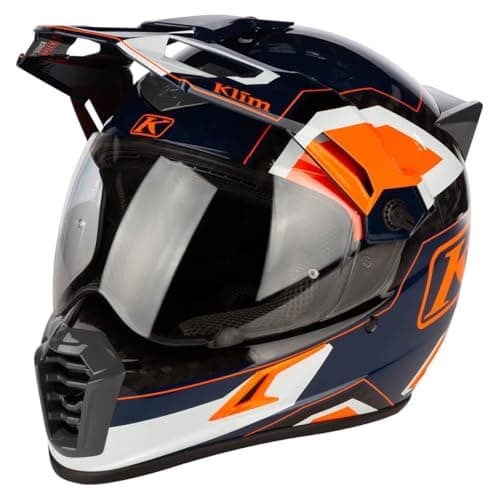
The Krios Pro is the most complete answer in the category: peak, visor and goggle configurations in one helmet, a full-carbon shell with Koroyd at about 1,450 g - class-leading light for a convertible - and genuine DOT + ECE 22.06, which Klim publishes. Who it is for: the weight-conscious ADV rider who wants one helmet for everything. The honest cons: flagship money, and it is quieter with the visor than in full peak-and-goggles mode. See the Krios Pro review and Krios Pro vs Arai XD-5.

Arai XD-5 - the road-biased adventure reference

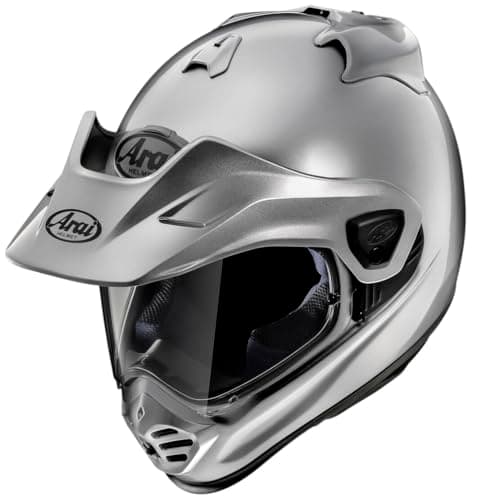
If your "adventure" is mostly long highway days with gravel at the end, the XD-5 is the helmet: a super-fiber composite shell at about 1,683 g carrying DOT + Snell M2025Din the US, with Arai's rounder internal shape and a peak engineered to behave at speed. Who it is for: long-haul ADV touring, and round-oval heads most rivals pinch. The honest cons: premium price, heavier than a carbon lid, and the US version is a Snell build rather than the ECE 22.06 of the European Tour-X5. See the XD-5 review and its safety rating page.

Fly Racing Trekker - the dual-sport with a sun visor

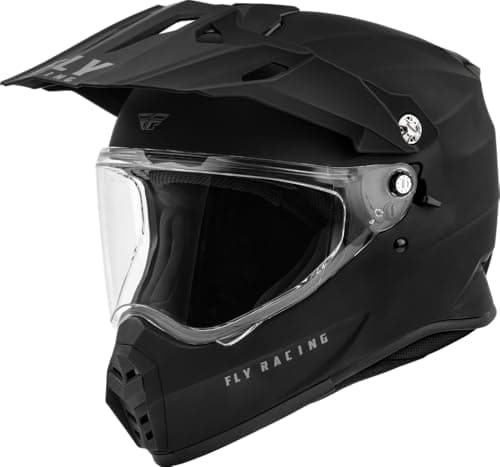
The Trekker is the mid-price dual-sport that keeps features its rivals delete: a drop-down anti-fog sunshade, almost unheard of at this price in this category, plus a shield designed to work with goggles closed and switchable vents in the chin bar, brow and rear - across XS-3XL in a round-oval shape. Who it is for: dual-sport riders who want a sun visor and a wide size range. The honest cons: the unnamed ECE revision, 3.5 lb in a polymer shell, and no published Pinlock provision. See the Trekker review.

HJC DS-X1 - the cheapest genuine convertible

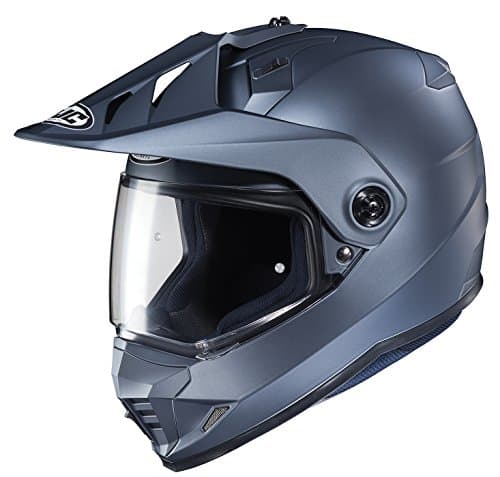
The DS-X1 is the entry point: HJC's easy-converting system takes it from shield-and-visor to visor-only for goggles, it ships with a Pinlock-prepared HJ-27 shield that cheaper rivals omit, and it uses three EPS sizes rather than one shell padded out. Who it is for: the rider who wants a convertible dual-sport for the least money - the DS-X1 review has the full breakdown. The honest cons: DOT only on the US build, upper ventilation is the review consensus weak point, and the shield does not raise far enough to mount goggles without removing it. See our dual-sport picks for how it ranks against the field.

So which one?

Mostly pavement? An adventure helmet, or a full-face. Mostly dirt? A dual-sport, and plan on goggles. Genuinely both? The Klim Krios Pro, which converts rather than compromising. On a budget and unwilling to give up certification, the Bell MX-9 Adventure MIPS is the outlier that carries ECE 22.06, MIPS and a SHARP score for dual-sport money - and if you want a modular you can also flip open, the Scorpion EXO-AT960 holds genuine 22.06 in a three-configuration shell.

The short answer

Quick picks, by the mark on the shell

#HelmetCertificationScorePrice
01
Klim Klim Krios Pro
Klim Krios Pro

The lightest way to hold genuine US DOT + ECE 22.06 — a full-carbon convertible that goes from ADV to street to dirt.

DOT certifiedECE 22.06 certified
8.6
$599.74Amazon
02
Arai Arai XD-5 (Tour-X5)
Arai XD-5 (Tour-X5)

The reference ADV lid for round-oval heads and long days — a Snell build in the US, with a peak that actually behaves at speed.

DOT certifiedECE 22.06not heldSnell M2025D certified
8.2
$799.00Amazon
03
Fly Racing Fly Racing Trekker
Fly Racing Trekker

The mid-price dual-sport that keeps a drop-down sun visor and still takes goggles — but Fly never publishes which ECE revision it holds.

DOT certifiedECE 22.06 unverified
7.8
$229.95Amazon
04
HJC HJC DS-X1
HJC DS-X1

The cheapest genuinely convertible dual-sport lid we can stand behind — a Pinlock-prepared shield that comes off for goggles, on a DOT-only certification.

DOT certifiedECE 22.06not held
7.5
$189.99Amazon

#ad · Live prices from the Amazon Product API, as of October 21, 2026. Certifications reflect the US-market build and are cited in Sources. Where a live price has rotted, we show none.

In detail

The picks, in full

01
Klim Klim Krios Pro

Weight-obsessed ADV riders who want ECE 22.06

Klim Krios Pro

DOT certifiedECE 22.06 certified
Full carbon fiber~1,450 g (L)DOT + ECE 22.06Koroyd + convertible
8.6/10

The lightest way to hold genuine US DOT + ECE 22.06 — a full-carbon convertible that goes from ADV to street to dirt.

Certification
9.5
Weight
9.5
Versatility
9
Quiet
7.5
Value
7.5

Pros

  • Genuine US DOT + ECE 22.06 — the rotational-impact standard, on the US build
  • ~1,450 g in a full-carbon shell is class-leading light for a convertible ADV lid
  • Peak, visor and goggle configuration all in one helmet

Cons

  • Carbon and Koroyd cost money — this is a flagship price
  • Quieter with the visor than in full peak-and-goggles ADV mode

Don't buy this if…

…you want the deepest sun-visor sunshade and plushest touring quiet — a road-first modular does that better.

$599.74View on Amazon

Price as of October 21, 2026. Prices change — Amazon's at checkout is the one that counts.

#ad · we may earn a commission from this link to Klim Krios Pro

02
Arai Arai XD-5 (Tour-X5)

Long-haul ADV touring

Arai XD-5 (Tour-X5)

DOT certifiedECE 22.06not heldSnell M2025D certified
Super-fiber composite~1,683 gSnell M2025D (US)Removable peak
8.2/10

The reference ADV lid for round-oval heads and long days — a Snell build in the US, with a peak that actually behaves at speed.

Certification
8.5
Fit range
9
Wind/peak
8.5
Weight
7.5
Value
7.5

Pros

  • Snell M2025D in the US market — a stricter add-on to DOT, not just the legal floor
  • Arai's rounder internal shape fits round-oval heads most rivals pinch
  • Peak is engineered to shed wind rather than lift your head at highway speed

Cons

  • Premium price, and the US version is not the ECE 22.06 you may have read about abroad
  • Heavier than a carbon ADV lid like the Krios Pro

Don't buy this if…

…you specifically want ECE 22.06 rotational-test homologation in the US — the US XD-5 is a Snell build; buy the European Tour-X5 direct for 22.06.

$799.00View on Amazon

Price as of October 21, 2026. Prices change — Amazon's at checkout is the one that counts.

#ad · we may earn a commission from this link to Arai XD-5 (Tour-X5)

03
Fly Racing Fly Racing Trekker

Dual-sport riders who want a sun visor

Fly Racing Trekker

DOT certifiedECE 22.06 unverified
Polymer shell~1,588 g (3.5 lb)DOT (FMVSS 218)Drop-down sunshade
7.8/10

The mid-price dual-sport that keeps a drop-down sun visor and still takes goggles — but Fly never publishes which ECE revision it holds.

Value
9
Features
8.5
Fit range
8.5
Certification
6.5
Weight
6.5

Pros

  • A drop-down anti-fog sunshade, which almost no dual-sport helmet at this price offers
  • Shield is designed to accommodate goggles and goggle straps with the shield closed, so you aren't forced to remove it
  • Switchable on/off vents in the chin bar, brow and rear, plus a removable washable antimicrobial liner
  • XS-3XL across 53-66 cm in a round-oval shape — a wide range for the money

Cons

  • Fly doesn't publish the ECE revision, so we can't confirm the current 22.06 rotational standard
  • 3.5 lb in a polymer shell — heavier than the carbon convertibles and heavy for standing on the pegs
  • No published Pinlock provision, so fog management is the sunshade coating and airflow

Don't buy this if…

…confirmed ECE 22.06 is your deciding factor — the Bell MX-9 Adventure MIPS carries it, plus MIPS and a SHARP 4/5 score, for similar money.

$229.95View on Amazon

Price as of October 21, 2026. Prices change — Amazon's at checkout is the one that counts.

#ad · we may earn a commission from this link to Fly Racing Trekker

04
HJC HJC DS-X1

The lowest-cost convertible dual-sport

HJC DS-X1

DOT certifiedECE 22.06not held
Polycarbonate composite~1,673 g (LG-2XL)DOT (FMVSS 218)Pinlock-prepared HJ-27 shield
7.5/10

The cheapest genuinely convertible dual-sport lid we can stand behind — a Pinlock-prepared shield that comes off for goggles, on a DOT-only certification.

Value
9
Versatility
8
Fit range
8
Certification
6
Weight
6.5

Pros

  • HJC's "easy converting system" takes it from shield-and-visor to visor-only for goggles, which is the whole point of a dual-sport lid
  • Ships with a Pinlock-prepared HJ-27 shield — anti-fog provision the cheaper rivals leave out
  • Three EPS sizes rather than one padded-out shell, plus a double D-ring and molded speaker pockets

Cons

  • DOT only — no ECE and no Snell on the US build, so it's the weakest certification on this page
  • webBikeWorld found the shield won't raise high enough to mount goggles comfortably without taking it off first
  • Upper ventilation is the review consensus weak point, and the peak's adjustment range is narrow

Don't buy this if…

…you want more than the US legal minimum on the shell — spend a little more on the Bell MX-9 Adventure MIPS for ECE 22.06, MIPS and an independent SHARP score.

$189.99View on Amazon

Price as of October 21, 2026. Prices change — Amazon's at checkout is the one that counts.

#ad · we may earn a commission from this link to HJC DS-X1

How to pick between the two

Count your actual miles, not your intended ones. Most riders who buy a dirt-biased helmet spend eighty percent of their time on tarmac, where the wide peak and open vents cost them noise and neck fatigue every single ride. Buy for the riding you do.

Decide on goggles before you decide on a helmet. If goggles are part of your kit, the eye port has to be cut for them and the shield has to get out of the way - check whether the shield can stay on with goggles fitted, because some can and some cannot. If you never wear goggles, you are paying for an aperture you do not use.

Read the ECE revision, or treat it as absent."ECE approved" without a revision number is not a claim to the current 22.06 standard, and it is common at the dirt-biased end. A genuine 22.06 approval tag inside the helmet carries a number beginning with 06. Check the label on the helmet you actually receive.

Weigh it, and then plan for the noise. The spread in this category is over 400 g between a carbon convertible and a polycarbonate modular ADV lid, and every peaked helmet is louder than an equivalent full-face. Earplugs are not optional kit on a peaked helmet - our noise guide explains why.
How we picked

We do not crash-test helmets

We compiled published specifications, cited each helmet's certification (DOT, ECE 22.06, Snell, SHARP) from the standards body or manufacturer homologation, and aggregated owner reports, then scored against a published method. The scores are judgments from documented research — not measurements we took. We do not run a crash lab. Certifications reflect the US-market build; where it differs from the European version, we say so and cite it.

Questions

Frequently asked

What is the difference between a dual-sport and an adventure helmet?
Design speed. An adventure helmet is optimized for highway riding with dirt sections: the peak is shaped to shed wind rather than lift at speed, and the helmet is built around a sealed shield that takes a Pinlock insert. A dual-sport helmet is optimized for slow, hot, off-road riding: a wider peak, larger vents with deep EPS air channels, and an eye port cut around goggles with a shield that is expected to come off. They look similar and behave very differently at 75 mph.
Can I use a dual-sport helmet on the highway?
Yes, but you will notice it. The wide peak catches air at road speed and the big open vents are loud, so a long motorway day in a dirt-biased helmet is tiring in a way an adventure-biased one is not. If your riding is mostly pavement, buy an adventure helmet or a convertible you can run with the peak removed - and wear earplugs either way.
Which is safer, a dual-sport or an adventure helmet?
Neither category is inherently safer, but in practice the certifications differ. The adventure-touring end is well covered - the Klim Krios Pro and AGV AX9 publish genuine US DOT + ECE 22.06, the Bell MX-9 Adventure MIPS adds MIPS and an independent 4/5 SHARP score, and the Arai XD-5 is a DOT + Snell M2025D build. The cheaper dirt-biased helmets are weaker on paper: Fly Racing does not name the ECE revision on the Trekker, and the HJC DS-X1 is DOT only in the US. Judge the model's published homologation rather than the category.
Do I need the peak on an adventure helmet?
Only if you ride off-road. The peak shades your eyes and keeps roost off your face in the dirt, and it costs you wind noise and lift on the highway. That trade is why most convertible helmets - the Klim Krios Pro and AGV AX9 among them - let you remove the peak entirely and run a street configuration. If you never leave the pavement, a full-face will be quieter and better behaved than any peaked helmet.

Keep reading

Receipts

Sources

We do not run a crash lab, and we do not pretend to. Certifications are cited to the standards body or the manufacturer's stated homologation; where a US model's certification differs from its European namesake, we say so. Where we could not verify something, we say so on the page rather than quietly leaving it out. Read our full method.