Skip to content
VISOR & VENT

HUB 04 · Bluetooth & Comms Helmets

The Best Mesh Motorcycle Intercoms

Bluetooth chains riders in a line and drops the chain when one rider stops. Mesh rebuilds the network around whoever is still there. Here are the five mesh units we rate, and the protocol decision you make before you pick one.

By Stephen V.Updated How we rate
#ad

We earn a commission when you buy through our Amazon links, at no extra cost to you. It never changes a ranking, and we tell you when the cheaper helmet is the better buy. How this works.

The best mesh motorcycle intercom is the Cardo Packtalk Pro: second-generation DMC mesh for up to 13 riders, JBL 45 mm speakers, IP67 weather sealing and a crash-detection feature no rival offers. The budget pick is the Sena 50S, the cheapest unit we rate that carries genuine mesh rather than Bluetooth alone. Who this page is for: a rider who has had a Bluetooth group chain collapse at a junction and wants to understand what mesh actually fixes before spending three or four hundred dollars on it.

Start with what the word means, because it is the whole reason these units cost what they do. Bluetooth intercom works as a chain. Rider one pairs to rider two, two to three, three to four. If rider two pulls into a gas station, the chain breaks and riders three and four lose the conversation until somebody re-pairs. It is fine for two people and increasingly fragile beyond that.

Mesh works as a self-healing network. Every unit talks to every other unit in range and relays for the ones that are not, so the group reorganises itself automatically when somebody drops out, falls behind or rejoins. Nobody re-pairs anything. On a six-bike ride with fuel stops and traffic lights, that is the difference between an intercom you use and one you turn off.

On prices: we do not print dollar figures in prose, because they go stale and a stale number is worse than none. Each pick's buy module carries the live price pulled from the Amazon product API with the date it was checked, and that card is the authoritative figure. Qualitatively, mesh is the premium shelf - the cheapest genuine mesh unit here costs more than the best Bluetooth-only intercom we rate, which is the trade this page is about.

The decision you make before you pick a unit: DMC or Mesh 3.0

This is the single most important thing on the page and it is not a feature comparison, it is a compatibility one. There are two mesh protocols and they do not talk to each other.

  • Cardo DMC (Dynamic Mesh Communication).Cardo's implementation, supporting large groups - up to 15 riders in a DMC network, with the Packtalk range able to connect to far more over multiple hops depending on the model. Cardo's approach is that the network manages itself and you never touch it.
  • Sena Mesh 3.0.Sena's implementation, with an Open Mesh mode that lets strangers join on a shared channel and a Group Mesh mode for a closed set of riders. Sena also layers its Wave cellular service on top on the newest units, which extends conversation beyond radio range entirely.

A Cardo on DMC cannot join a Sena Mesh network and vice versa. Both brands fall back to standard Bluetooth to bridge across - which works, and which throws away the thing you paid for. So the practical rule is simple and unromantic: buy the protocol your regular riding group already uses. If you ride alone or with one other person, the protocol barely matters and you should be reading best budget intercoms instead, because mesh is largely wasted on a pair. The brand comparison in full is Sena vs Cardo.

How we ranked five mesh intercoms

Protocol generation first - a second-generation mesh radio is a genuine hardware difference, not a firmware label. Then audio hardware, because a mesh network you cannot hear at 75 mph is useless. Then published battery and weather sealing, which are the two specs that decide whether a unit survives a touring week. Then the physical install, since a bolt-on unit and an integrated helmet are different purchases. Every figure below is what the manufacturer publishes; we do not run range tests.

1. Cardo Packtalk Pro - second-generation DMC, and crash detection

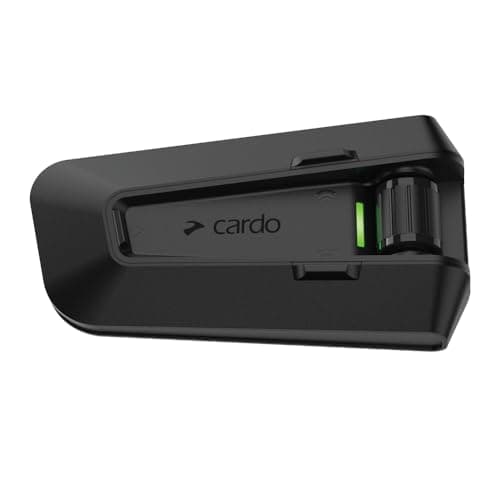
The Packtalk Pro is Cardo's current flagship and the most capable mesh unit we rate: second-generation DMC, Bluetooth 5.2 alongside it, JBL 45 mm speakers (the largest on this page), IP67 sealing and a published 13 hours of talk time. The feature nobody else has is crash detection: the unit senses an impact and, if you do not respond, notifies your emergency contact through the paired phone. Who it is for: a rider who leads groups, tours in weather, or rides alone often enough that an automatic alert is worth paying for.

Full detail in the Cardo Packtalk Pro review, and the upgrade question in Packtalk Pro vs Edge.

The honest cons. It is the most expensive bolt-on here, and the gap over the Edge below buys you crash detection, bigger speakers and a newer radio rather than a fundamentally different experience - for many riders the Edge is the better buy and we say so on its page. Crash detection depends on a paired phone with signal, so it is not a substitute for a satellite beacon in genuinely remote country. And it is DMC, so it will not mesh with a Sena group.

Who should skip it: riders whose group runs Sena, and anyone who rides in a pair - the money is better spent elsewhere.

2. Cardo Packtalk Edge - the best mesh unit for most people

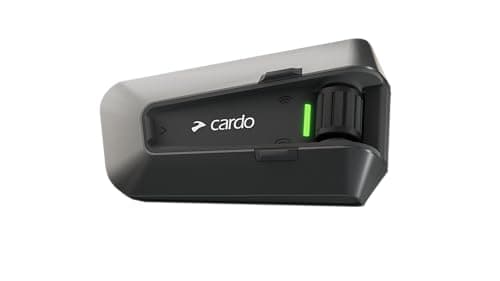
The Edge is the unit we recommend more often than any other in this hub, and it is our standing pick for best bolt-on comms overall: DMC mesh plus Bluetooth 5.2, JBL 40 mm speakers, IP67 sealing, and a 31-rider DMC capability that is far beyond what any normal group needs. Its best quality is the one that does not show up on a spec sheet: the magnetic Air Mount makes it genuinely quick to move between helmets, and the voice control works well enough that you stop reaching for the unit. Who it is for: almost anybody buying their first mesh intercom who rides with a Cardo group or no fixed group at all.

Detail in the Cardo Packtalk Edge review, and the cross-brand pair in Packtalk Edge vs Sena 50S.

The honest cons. It is a previous-generation radio now that the Pro exists, and it has no crash detection. Cardo does not publish a talk time we can quote with the same confidence as the Pro's. The magnetic mount is excellent but it is also one more proprietary part to lose. And like every Cardo, it is DMC only for mesh.

Who should skip it: riders who specifically want crash detection, and anyone already committed to a Sena Mesh group.

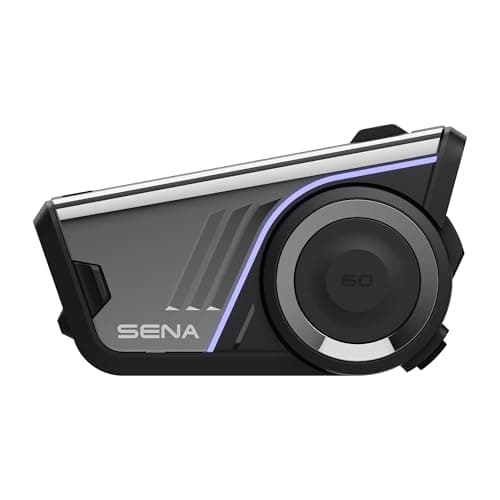
3. Sena 60S - the best Sena mesh unit, and the one with Wave

If your group runs Sena, this is the top of the range: Mesh 3.0 plus Bluetooth 5.3, IPX7 sealing, second-generation Harman Kardon speakers and microphone, and support for Sena Wave - a cellular-backed service that keeps a conversation alive when riders are far beyond radio range of each other. That last feature is genuinely different from anything Cardo offers, and on a trip where two riders take different routes to the same hotel it is the only thing on this page that works. Who it is for: a Sena-ecosystem rider, or anyone who wants beyond-range conversation.

Full write-up in the Sena 60S review, and the in-house comparison in Sena 50S vs 60S.

The honest cons. Wave is a service, not just hardware, so check Sena's current terms and any subscription before you count on it - and it needs cellular coverage, which is exactly what remote routes do not have. It is more expensive than the Cardo Edge above and still, in our assessment, a slightly less polished day-to-day experience. And it is Mesh 3.0, so it will not join a DMC group.

Who should skip it: riders in a Cardo group, and riders who will never use Wave - the 50S below does the core mesh job for meaningfully less.

4. Sena 50S - the budget pick, and the cheapest genuine mesh

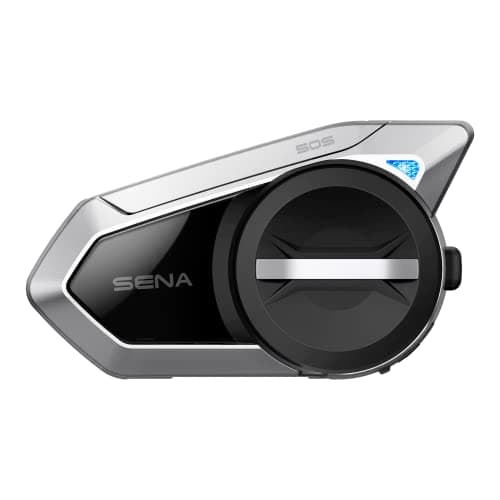
This is the budget pick: the cheapest unit we rate that carries real mesh rather than Bluetooth alone. Bluetooth 5.0 plus Mesh 3.0, Harman Kardonspeakers, and Sena's jog dial - which remains the best physical control on any intercom, because you can find it and use it in thick winter gloves without looking. It is also the unit our group riding page recommends for riders joining an existing Sena network. Who it is for: a rider who wants mesh at the lowest price we can document, or who is slotting into a Sena group.

Detail in the Sena 50S review.

The honest cons. It is the oldest radio on this page - Bluetooth 5.0 and the first generation of Mesh 3.0 - and Sena has released two flagships since. It has no Wave support, no crash detection, and we do not have a published IP rating for it to quote alongside the IP67 and IPX7 units above. Sena's firmware update process is also more involved than Cardo's.

Who should skip it: riders who do not actually need mesh. If you ride in a pair, a good Bluetooth unit at a third of the price does everything you need - the Cardo Spirit HD is the one we point people at.

5. Sena Impulse - mesh with no install at all

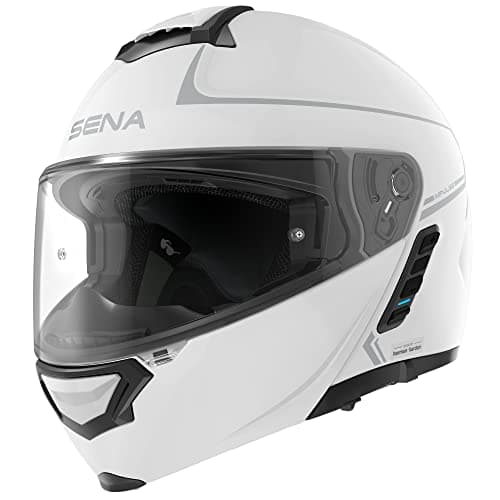
The Impulse is a different kind of purchase: a modular helmet with the comms built in, carrying Mesh 3.0 plus Bluetooth 5.0, Harman Kardon audio, a drop-down sun visor and an integrated taillight. There is no mount, no wiring, no speaker pockets to fight and no unit to transfer - the antenna and speakers were designed into the shell rather than retrofitted into it, which is why integrated units usually sound better than bolt-ons at the same price. Who it is for: a rider buying a new helmet anyway who wants mesh without ever installing anything.

Full write-up in the Sena Impulse review, and the format argument in helmets with Bluetooth built in.

The honest cons. The big one: you cannot separate the electronics from the helmet. A helmet should be replaced around five years from first use, or immediately after any impact, and when you replace it you replace the comms too - whereas a bolt-on moves to the next helmet. Our card records it as a DOT build with no ECE, so on certification it is behind the helmets we rank in the modular hub. It is the most expensive item on this page, and the fit is whatever Sena decided - you do not get to choose the shell that suits your head.

Who should skip it: anyone who already owns a helmet they like, and anyone buying on helmet certification rather than convenience.

Do you actually need mesh?

Honest answer: only if you ride in groups of three or more, regularly. Here is the decision in one paragraph. Two riders: no. Bluetooth handles a pair perfectly and the money is better spent on a helmet or earplugs. Three or four riders who always stay together: borderline - Bluetooth will work, and it will annoy you occasionally. Five or more, or any group that splits at fuel stops and junctions: yes, and the difference is dramatic rather than marginal.

The second half of the answer is that mesh does nothing for the problem most riders actually have, which is wind noise above 65 mph. No intercom out-shouts turbulence. Earplugs plus a correctly positioned speaker does more for intelligibility than any upgrade on this page, and it costs almost nothing - how to make your helmet quieter goes through it.

The verdict

Buy the Cardo Packtalk Pro if you want the most capable mesh unit available and value crash detection. Buy the Cardo Packtalk Edge if you want the best mesh experience for the money - for most riders this is the right answer and the Pro is the upgrade you do not need.

Buy the Sena 60Sif your group runs Sena or you want Wave's beyond-range conversation. Buy the Sena 50S if you want mesh at the lowest price we can document. Buy the Sena Impulse if you are replacing the helmet anyway and never want to install anything.

And the rule that overrides all of the above: match the protocol your group already uses. A technically better unit on the wrong protocol falls back to Bluetooth, which means you paid for mesh and are not using it.
The short answer

Quick picks, by the mark on the shell

#HelmetCertificationScorePrice
01
Cardo Cardo Packtalk Pro
Cardo Packtalk Pro

Cardo's flagship: second-generation Dynamic Mesh for up to 15 riders, 45 mm JBL speakers as standard, automatic crash detection, and a 3-year warranty — the most capable bolt-on you can buy.

Comms device — no helmet cert
8.8
$349.97Amazon
02
Cardo Cardo Packtalk Edge
Cardo Packtalk Edge

The bolt-on to beat: true dynamic Mesh, JBL 40 mm speakers, IP67 weatherproofing, and it fits the helmet you already own.

Comms device — no helmet cert
8.9
$329.96Amazon
03
Sena Sena 60S
Sena 60S

The full-spec Sena bolt-on at the lower price since the 60S EVO succeeded it in May 2026: Mesh 3.0, cellular Wave Intercom, 2nd-generation Harman Kardon audio and a published IPX7 rating.

Comms device — no helmet cert
8.7
$307.30Amazon
04
Sena Sena 50S
Sena 50S

Sena's previous-generation Mesh bolt-on, still the unit most Sena groups run — the natural Cardo rival if you're already in the Sena ecosystem, with the newer 60S above it.

Comms device — no helmet cert
8.4
$265.30Amazon
05
Sena Sena Impulse
Sena Impulse

The most completely equipped integrated modular we rank: Mesh networking, Harman Kardon audio, a drop-down sun visor and an integrated rear taillight built into a DOT flip-up — helmet, comms, audio and visibility in one box.

DOT certifiedECE 22.06not held
8.7
$499.00Amazon

#ad · Live prices from the Amazon Product API, as of November 23, 2026. Certifications reflect the US-market build and are cited in Sources. Where a live price has rotted, we show none.

In detail

The picks, in full

01
Cardo Cardo Packtalk Pro

Flagship Mesh with crash detection

Cardo Packtalk Pro

Bolt-onBT 5.2 + 2nd-gen DMCJBL 45 mmIP67 · 13 h talk
8.8/10

Cardo's flagship: second-generation Dynamic Mesh for up to 15 riders, 45 mm JBL speakers as standard, automatic crash detection, and a 3-year warranty — the most capable bolt-on you can buy.

Audio
9.5
Range/Mesh
9.5
Safety features
9
Weatherproofing
9.5
Value
6.5

Pros

  • Automatic crash detection using the phone's inertia sensors plus an internal IMU, which can alert an emergency contact — no other bolt-on intercom offers it
  • 45 mm JBL speakers fitted as standard, where JBL audio used to be a paid upgrade on the Packtalk line
  • Second-generation DMC for up to 15 riders with a self-healing connection, 1 mile rider-to-rider and up to 5 miles across a group, plus IP67 and a 3-year warranty

Cons

  • Crash detection needs cell service, the Cardo Connect app and a paired smartphone to work at all — it is a connected service, not a standalone sensor, and it is region-limited
  • The most expensive single comms unit on this site, and the Packtalk Edge delivers the same core Mesh experience for noticeably less
  • Cardo publishes 13 hours of talk time, which is shorter than several much cheaper Bluetooth-only units manage

Don't buy this if…

…crash detection is not the reason you are here — the Packtalk Edge gives you the same dynamic Mesh, the same IP67 and JBL speakers for less money.

$349.97View on Amazon

$499.9530% off

Price as of November 23, 2026. Prices change — Amazon's at checkout is the one that counts.

#ad · we may earn a commission from this link to Cardo Packtalk Pro

02
Cardo Cardo Packtalk Edge

Best bolt-on comms overall

Cardo Packtalk Edge

Bolt-onBT 5.2 + DMC MeshJBL 40 mmIP67 · 31-rider DMC
8.9/10

The bolt-on to beat: true dynamic Mesh, JBL 40 mm speakers, IP67 weatherproofing, and it fits the helmet you already own.

Audio
9
Range/Mesh
9.5
Ease of use
8.5
Weatherproofing
9.5
Value
8

Pros

  • Dynamic Mesh (DMC) self-heals as riders drop in and out — and Cardo's free Mesh Boost update raised the group ceiling from 15 riders to 31
  • JBL 40 mm speakers are a real step up in clarity
  • IP67 rated — genuinely weatherproof, not just water-resistant

Cons

  • Premium price for a comms unit
  • The magnetic Air Mount is great but a proprietary part to keep track of
  • The 31-rider ceiling assumes every unit in the group has the Mesh Boost update — mixed groups drop back to 15

Don't buy this if…

…you only ever ride solo or in a fixed pair — you're paying for Mesh you won't use; the Bluetooth-only Outrush R is cheaper.

$329.96View on Amazon

$439.9525% off

Price as of November 23, 2026. Prices change — Amazon's at checkout is the one that counts.

#ad · we may earn a commission from this link to Cardo Packtalk Edge

03
Sena Sena 60S

Sena-ecosystem bolt-on

Sena 60S

Bolt-onBT 5.3 + Mesh 3.0 + WaveIPX72nd-gen Harman Kardon
8.7/10

The full-spec Sena bolt-on at the lower price since the 60S EVO succeeded it in May 2026: Mesh 3.0, cellular Wave Intercom, 2nd-generation Harman Kardon audio and a published IPX7 rating.

Audio
9
Range/Mesh
9.5
Ease of use
8.5
Weatherproofing
9
Value
7.5

Pros

  • A published IPX7 water rating — the one spec the 50S never had on the record
  • 24 h Bluetooth / 17 h Mesh talk time and a 1.5-hour USB-C charge, both well ahead of the 50S
  • Mesh 3.0 with Mesh 2.0 kept for older units, plus cellular Wave Intercom that falls back to Mesh when coverage drops

Cons

  • A clear price step over the 50S, which got Mesh 3.0 and Wave by firmware and still does most of the same job
  • No longer Sena's newest flagship — the 60S EVO (May 2026) and 60X (July 2026) sit above it
  • Wave needs cellular coverage, the app running in the background and your phone's data and battery
  • Sena Mesh still does not bridge to Cardo DMC — cross-brand you drop to plain Bluetooth

Don't buy this if…

…your group runs Cardo, or you already own a 50S that does what you need — the upgrade case is the seal and the battery, not the network.

$307.30View on Amazon

$439.0030% off

Price as of November 23, 2026. Prices change — Amazon's at checkout is the one that counts.

#ad · we may earn a commission from this link to Sena 60S

04
Sena Sena 50S

Sena-ecosystem Mesh

Sena 50S

Bolt-onBT 5.0 + Mesh 3.0Jog dialHarman Kardon speakers
8.4/10

Sena's previous-generation Mesh bolt-on, still the unit most Sena groups run — the natural Cardo rival if you're already in the Sena ecosystem, with the newer 60S above it.

Audio
8.5
Range/Mesh
9
Ease of use
8.5
Weatherproofing
8
Value
8

Pros

  • Mesh 3.0 via firmware for large, self-healing group rides of up to 24, with Mesh 2.0 kept on board to talk to older units
  • Familiar jog-dial control that works well in gloves
  • Pairs cleanly with other Sena units and integrated helmets

Cons

  • Bulkier bolt-on profile than the Cardo Edge
  • Best value only if you're already committed to Sena Mesh
  • No published IP water rating, and a group mixing updated and older units has to drop to Mesh 2.0

Don't buy this if…

…your riding buddies all run Cardo — cross-brand works over Bluetooth but you lose the Mesh magic; match the group.

$265.30View on Amazon

$379.0030% off

Price as of November 23, 2026. Prices change — Amazon's at checkout is the one that counts.

#ad · we may earn a commission from this link to Sena 50S

05
Sena Sena Impulse

The most complete all-in-one modular

Sena Impulse

DOT certifiedECE 22.06not held
Integrated modularMesh 3.0 + BT 5.0Harman Kardon audioSun visor + taillight
8.7/10

The most completely equipped integrated modular we rank: Mesh networking, Harman Kardon audio, a drop-down sun visor and an integrated rear taillight built into a DOT flip-up — helmet, comms, audio and visibility in one box.

Audio
9
Range/Mesh
9
Ease of use
8.5
Features
9
Value
8

Pros

  • Runs both Mesh and Bluetooth — unlike the Bluetooth-only Outrush R, it self-heals big group rides
  • Harman Kardon speakers and mic, a drop-down sun visor, and an integrated rear-facing taillight
  • A genuinely complete one-box modular: helmet, comms, audio and visibility in a single unit

Cons

  • The shell is a DOT-certified helmet — confirm the certification label; comms carry no helmet rating
  • Like any integrated helmet, the comms can't be upgraded independently — you replace the whole thing
  • No longer the top of Sena's own range: the Specter modular is listed with ECE 22.06 for Europe alongside DOT, Mesh 3.0 and Wave, and Sena showed a Specter KV with active noise cancellation at EICMA 2026

Don't buy this if…

…you already own a helmet you love (a bolt-on Cardo or Sena keeps it) or you want the lightest possible dedicated helmet.

$499.00View on Amazon

$599.0017% off

Price as of November 23, 2026. Prices change — Amazon's at checkout is the one that counts.

#ad · we may earn a commission from this link to Sena Impulse

How we picked

We do not crash-test helmets

We compiled published specifications, cited each helmet's certification (DOT, ECE 22.06, Snell, SHARP) from the standards body or manufacturer homologation, and aggregated owner reports, then scored against a published method. The scores are judgments from documented research — not measurements we took. We do not run a crash lab. Certifications reflect the US-market build; where it differs from the European version, we say so and cite it.

Questions

Frequently asked

What is the best mesh motorcycle intercom?
The Cardo Packtalk Pro. It carries second-generation DMC mesh, Bluetooth 5.2, JBL 45 mm speakers, IP67 sealing and a published 13 hours of talk time, plus crash detection that notifies an emergency contact through your paired phone - a feature no rival offers. For most riders the cheaper Cardo Packtalk Edge delivers the same core mesh experience and is the better buy.
What is the difference between mesh and Bluetooth intercom?
Bluetooth intercom works as a chain: each rider pairs to the next, and if a middle rider drops out the chain breaks until somebody re-pairs. Mesh works as a self-healing network where every unit relays for the others, so the group reorganises itself automatically when riders stop, fall behind or rejoin. For two riders the difference is negligible. For five or more with fuel stops it is the whole experience.
Can Cardo and Sena mesh together?
Not on mesh. Cardo DMC and Sena Mesh 3.0 are separate, incompatible protocols - a Cardo cannot join a Sena Mesh network and vice versa. Both brands will fall back to standard Bluetooth to bridge the gap, which works but throws away the mesh behaviour you paid for. The practical rule is to buy whichever protocol your regular riding group already runs.
What is the cheapest mesh intercom?
The Sena 50S is the cheapest unit we rate carrying genuine mesh - Bluetooth 5.0 plus Mesh 3.0, with Harman Kardon speakers and Sena's jog dial, which remains the best physical control on any intercom for gloved use. Everything below it in price is Bluetooth-only. If you ride in a pair rather than a group, a Bluetooth unit at a third of the price does everything you need.
How many riders can a mesh intercom connect?
More than any normal group needs. Cardo publishes a 15-rider DMC network, with the Packtalk range able to reach far more over multiple relay hops depending on the model - the Packtalk Edge is specified for 31 riders in DMC. Sena's Mesh 3.0 offers an Open Mesh mode on shared channels that strangers can join plus a closed Group Mesh mode. In practice terrain and line of sight limit a real group long before the rider count does.
Do I need mesh if I ride with one other person?
No. A two-rider conversation is exactly what Bluetooth does well, and the chain-break problem mesh solves does not exist with two units. You would be paying two to four times as much for a feature you cannot use. Our budget intercom roundup covers the Bluetooth-only shelf, where the Cardo Spirit HD is the unit we point most pairs at.
Is Sena Wave the same as mesh?
No - they solve different problems. Mesh is a radio network between units within range of each other. Wave is a cellular-backed service on Sena's newest units that keeps a conversation alive when riders are far beyond radio range, which no mesh protocol can do. It needs cellular coverage to work, so it helps on a multi-route touring day and not at all in genuinely remote country. Check Sena's current terms and any subscription before relying on it.

Keep reading

Receipts

Sources

We do not run a crash lab, and we do not pretend to. Certifications are cited to the standards body or the manufacturer's stated homologation; where a US model's certification differs from its European namesake, we say so. Where we could not verify something, we say so on the page rather than quietly leaving it out. Read our full method.