HUB 03 · Full-Face Helmets
Bell Custom 500 Review
The default three-quarter lid, and an honest one. Five genuine shell sizes and a fiberglass composite shell at a fair price - bought at the cost of the single most-struck part of a helmet.
We earn a commission when you buy through our Amazon links, at no extra cost to you. It never changes a ranking, and we tell you when the cheaper helmet is the better buy. How this works.
A certified open-face classic
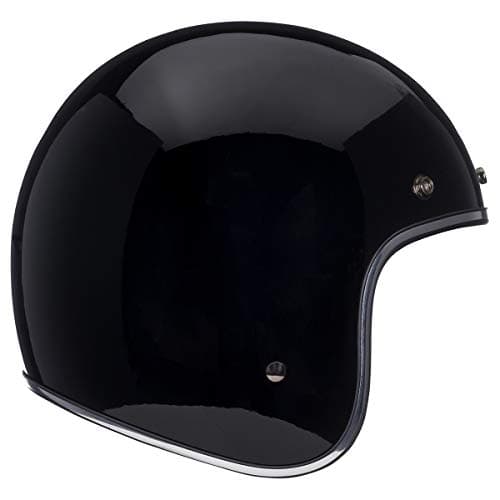
The default classic three-quarter lid, and an honest one: five real shell sizes, a DOT label, and no chin bar at all — which is the entire trade you are making.
Price as of October 21, 2026. Prices change — Amazon's at checkout is the one that counts.
#ad · we may earn a commission from this link to Bell Custom 500
The Bell Custom 500 is the helmet most people picture when they picture a three-quarter lid, and the reason it has survived this long is that the engineering underneath the styling is real: five separate shell and EPS liner sizes, a fiberglass composite shell, and an integrated 5-snap pattern that opens the entire aftermarket of bubble shields, flat shields and peaks. Who it is for: the rider doing short, slow, around-town miles on a bike where a full-face would look and feel wrong. The trade, stated once and plainly: there is no chin bar, and the chin bar is the part of a helmet that gets hit most.
We have not crash-tested this helmet and we have no lab. Everything below comes from Bell, from US retail listings and from published independent reviews, all cited at the foot of the page. Where sources disagree - and on this helmet's certification they genuinely do - we say so rather than pick the flattering answer.
The certification, stated plainly
In the US the Custom 500 is sold as a DOT (FMVSS 218)helmet. That is the number you can rely on. Beyond it, the record is messy: Motolegends' editorial says the helmet is "both DOT and CE approved" without naming a revision, Visordown's review states it "boasts ECE and DOT certification", and US retail listings disagree with one another - some print 22.05, some 22.06, and the two biggest US retailers print no certification field at all. Bell sells this helmet into several markets with different homologations, so an ECE claim that is true in Europe is not automatically true of the box that arrives at your door.
So we do not assert ECE on this helmet. Read the label inside the shell of the one you receive, and if an ECE 22.06 mark is what you are buying, buy somewhere that will take a return. Our DOT vs ECE vs Snell vs SHARP explainer sets out what each mark actually tests, and ECE 22.06 explained covers the oblique rotational test that 22.06 added and DOT still does not include.
One thing no label can fix: no open-face helmet carries Snell, and SHARP does not star-rate this class, so there is no independent lab score for the Custom 500 and there never will be. Visordown puts the underlying point better than we could - "massive question marks hang over the crash performance credentials of an open-face helmet" - and that is true of every helmet in this category, not a Bell failing.
Five shell sizes is the spec that justifies the price
This is the part worth paying for. Bell builds the Custom 500 in five shell and EPS liner sizes- shell 1 covers XS and SM, shell 2 is MD, shell 3 LG, shell 4 XL and shell 5 2XL. Almost everything else at this money is one or two shells padded out across the whole size range, which means a small head wears a large helmet's silhouette and a large head relies on thinner padding to make up the difference.
Scaling the shell matters for two reasons. Cosmetically, it is why the Custom 500 sits low and close rather than ballooning above your ears - the look people buy it for is a consequence of the engineering, not a paint job. Functionally, the EPS liner is the part that manages a crash, and an EPS liner sized to your head does that job better than a thick pad compensating for a shell two sizes too big. We go into why shell count is the single most under-read spec on a helmet listing in helmet shell materials explained.
The shell itself is a fiberglass compositein Bell's own description and in Visordown's key-features list. Be aware that some marketplace listings for this helmet state polycarbonate instead; they are either describing a different variant or they are wrong, and it is one more reason to buy from a seller who publishes the spec. US retailers list the helmet at 2.41 lb (roughly 1,093 g), which is light - though lightness is cheap when there is no chin bar to carry.
Sizing: it runs small, and the retailers say so
Both major US retail listings carry the same warning in the same words: "Customers have found this helmet to run small and recommend sizing up one size from what size chart suggests." When a retailer prints that against its own size chart, take it seriously.
Bell lists the Custom 500 as an intermediate oval fit, and Visordown found it suits round and intermediate heads with long-oval riders likely needing to size up. There are no optional cheek-pad thicknesses published for this helmet, so unlike a modern full-face you cannot tune the fit after purchase - what comes in the box is what you get. Measure properly before you order using our helmet measuring guide, check your head shape against motorcycle helmet head shapes explained, and buy where you can send it back.
No shield, no vents: what is not in the box
The Custom 500 ships bare. There is no face shield - the bubble shield in every photograph is sold separately - and there are no vents. What you get instead is the integrated 5-snap pattern, which is the de facto standard for three-quarter helmet accessories and means you can fit a bubble shield, a flat shield, a peak, or nothing at all, and change your mind later for the price of a part rather than a helmet. That flexibility is a genuine feature, not a cop-out, and it is the main practical reason the Custom 500 outsells better-specified rivals.
You still have to solve eye protection, though. Below about 30 mph you can ride in sunglasses. Above it you need a shield or goggles, because an unprotected eye at road speed finds every insect in the county. Budget for the shield as part of the purchase price, not as an optional extra.
Ventilation is the cost of the clean shell line. Visordown's review is blunt about it - "cooling comes entirely from the front", with "not much in the way of innovation to assist". In practice an open-face with a shield up is extremely well ventilated and an open-face with a shield down has no vent path at all, which is an odd combination to live with on a warm day in traffic. If hot-weather airflow is the problem you are solving, a vented full-face does it better; see best motorcycle helmets for hot weather.
Noise: the thing buyers underestimate
There is no chin bar, no seal and no chin curtain, so there is nothing between your ears and the air. Visordown found "wind noise at anything but inner-city speeds is pretty intense", and that matches the consistent owner feedback on this class of helmet.
This is not a reason to avoid the helmet, but it is a reason to buy earplugs at the same time and to be honest with yourself about your mileage. Sustained exposure above roughly 85 dB causes hearing damage over time, and an open-face at highway speed is comfortably past that. Our how to make your helmet quieter guide covers what actually helps on an open shell - which is plugs and a neck tube, not foam stuck inside the lid - and if quiet is genuinely a priority you are shopping in the wrong category entirely: start with the quietest motorcycle helmets.
Comms, glasses and the small practicalities
An open-face is the easiest helmet in the world to fit an intercom to - the speaker pockets are unobstructed, a boom mic has somewhere to go, and you are not fighting a chin curtain. A Cardo Spirit or Spirit HD ships with both a hybrid/boom mic and a wired mic, which makes either a straightforward pairing with this helmet. Glasses are similarly easy; there is no cheek pad to thread the arms through.
The retention is a padded chin strap with a stainless steel double D-ring closure and a leather pull tab - the fastener every certification body prefers, and the right choice here. Bell backs the helmet with a five-year warranty, which is longer than most and worth something on a helmet you will keep for a while. On that, note that warranty length is not service life: the standing advice is to replace a helmet about five years from first use regardless of condition, and we explain why in when to replace a helmet.
Who should skip it
Skip the Custom 500 if you ride highway miles. It is loud, it offers no chin protection at the speeds where that matters most, and you will find yourself not wearing it.
Skip it if you want the classic look and a chin bar - that helmet exists, and it is the Biltwell Gringo SV, which keeps the retro silhouette while carrying DOT FMVSS 218 and ECE 22.06 with a shield included. For most riders drawn to this category on styling alone, that is the better purchase and we say so in full-face vs open-face helmets.
And skip it if you need a specific certification on the record before you buy, because the sources on this helmet's ECE status conflict and we will not resolve them for you with a guess.
Where the Custom 500 lands
Buy it if you have made the open-face trade consciously and want the best-built version of the classic shape at a sane price. On that narrow brief it is very good: five real shell sizes, a fiberglass composite shell, a double D-ring, a five-year warranty and the accessory ecosystem that comes with the 5-snap pattern. It is honest about what it is - a styling-led helmet with no vents, no shield and no chin bar - and it does not pretend the missing parts are a design philosophy.
Visordown calls it "more style than substance" and also "arguably one of the coolest and most recognisable open-face helmets on sale". Both are true at once, and between them they are the whole review. If you want to see where it ranks against the rest of the class, our best open-face motorcycle helmets roundup sets it beside the alternatives, and are Bell motorcycle helmets good? puts the brand in context.
The scorecard
How it scores, and who should skip it
- Weight
- 9
- Fit range
- 8.5
- Value
- 8.5
- Certification
- 5
- Coverage
- 3.5
Pros
- Five separate shell and EPS sizes — the shell genuinely scales, which is rare at any price
- Thin-profile shell sits low on the head rather than ballooning above it
- Integrated 5-snap pattern accepts the whole aftermarket of bubble shields, flat shields and peaks
Cons
- No chin bar, so the most-struck part of a helmet is simply not covered — no open-face can fix that
- No published cheek-pad thickness options, so the fit is what it is, and it is widely reported to run small
- No shield, no seal and no sun visor in the box — eye protection and wind noise are on you
Don't buy this if…
…you ride highway miles, or you want the certification a chin bar makes possible — the Biltwell Gringo SV keeps the classic look and keeps the chin bar.
Price as of October 21, 2026. Prices change — Amazon's at checkout is the one that counts.
#ad · we may earn a commission from this link to Bell Custom 500
How we picked
We do not crash-test helmets
We compiled published specifications, cited each helmet's certification (DOT, ECE 22.06, Snell, SHARP) from the standards body or manufacturer homologation, and aggregated owner reports, then scored against a published method. The scores are judgments from documented research — not measurements we took. We do not run a crash lab. Certifications reflect the US-market build; where it differs from the European version, we say so and cite it.
Questions
Frequently asked
Is the Bell Custom 500 DOT approved?
Does the Bell Custom 500 come with a visor?
Does the Bell Custom 500 run small?
How many shell sizes does the Bell Custom 500 have?
Is the Bell Custom 500 noisy?
Bell Custom 500 or Biltwell Gringo SV?
Keep reading
Related
- Best open-face motorcycle helmetsWhere the Custom 500 ranks against the rest of the class.
- Biltwell Gringo SV reviewThe retro look with a chin bar and ECE 22.06.
- Full-face vs open-face helmetsThe coverage trade, with the crash data behind it.
- Are Bell motorcycle helmets good?The brand in context, model by model.
- How to make your helmet quieterWhat actually works on an open shell.
- DOT vs ECE vs Snell vs SHARPWhat a DOT-only label does and does not tell you.
Receipts
Sources
- RevZilla - Bell Custom 500 (5 shell and EPS liner sizes; multi-density EPS liner; 2.41 lb; intermediate oval; integrated 5-snap pattern; stainless D-ring closure; five year warranty; runs small per customers)
- Cycle Gear - Bell Custom 500 (shell 1 XS/SM through shell 5 2XL; bubble face shield sold separately; size chart 53-54 cm XS to 65-66 cm 3XL)
- Visordown - Bell Custom 500 review (fiberglass composite shell; "wind noise at anything but inner-city speeds is pretty intense"; "cooling comes entirely from the front"; suits round and intermediate head shapes; "more style than substance")
- Motolegends - Bell Custom 500 editorial (five shell sizes; "both DOT and CE approved"; 5-snap visor pattern)
- SHARP - ECE R22.06 and what the approval number means
We do not run a crash lab, and we do not pretend to. Certifications are cited to the standards body or the manufacturer's stated homologation; where a US model's certification differs from its European namesake, we say so. Where we could not verify something, we say so on the page rather than quietly leaving it out. Read our full method.