Skip to content
VISOR & VENT

HUB 06 · Buying Guides & How-To

The Best ECE 22.06 Motorcycle Helmets

ECE 22.06 is the only certification on a US-market helmet that was independently lab-tested, sampled from production and subjected to an oblique rotational impact. Here are the six we can document, across five formats, and the cheapest way to get it.

By Stephen V.Updated How we rate
#ad

We earn a commission when you buy through our Amazon links, at no extra cost to you. It never changes a ranking, and we tell you when the cheaper helmet is the better buy. How this works.

The best ECE 22.06 motorcycle helmet is the AGV K6 S: genuine 22.06 homologation, a published ~1,255 g carbon-aramid shell - the lightest helmet in our catalog with a face shield - and the only helmet we rate that holds a perfect 5-out-of-5 SHARP rating. The budget pick is the HJC RPHA 12, the cheapest helmet in our catalog carrying real ECE 22.06, and the single most useful fact on this page is that it costs under two hundred dollars. Who this page is for: a rider who has worked out that 22.06 is the certification worth having and wants a documented list rather than a label hunt.

Here is the framing. DOT (FMVSS 218) is self-certified - the manufacturer declares compliance and nobody independent tests the helmet before it goes on sale. Snell is independently tested but voluntary, and in the US it almost always arrives instead of ECE rather than alongside it. ECE 22.06 is the one approval on a US-market helmet that is independently lab-tested with production sampling and includes an oblique rotational-impact test. That is why this site sorts helmets by the mark on the shell, and it is why this page exists as the counterpart to the best Snell-certified helmets.

On prices: we do not print dollar figures in prose, because they go stale and a stale number is worse than none. Each pick's buy module carries the live price pulled from the Amazon product API, stamped with the date it was checked - that card is the authoritative figure. Qualitatively, 22.06 spans the whole price range below: the cheapest pick here is a sub-$200 sport-touring helmet and the most expensive is a carbon adventure lid at roughly three times that. We have not worn or crash-tested any of these helmets. What we have done is read the homologation each maker publishes and the independent test data where it exists.

What ECE 22.06 actually tests that 22.05 did not

Both are UNECE type approvals, and both are independently tested - but 22.06 is a substantially harder test, and the revision number is the whole story:

  • An oblique (rotational) impact test. 22.05 measured straight-line deceleration. 22.06 added angled impacts that load the head rotationally, which is the injury mechanism MIPS and similar systems were built to address. This is the single biggest change.
  • More impact points and more speeds. 22.06 tests additional locations on the shell, including points a maker previously knew would never be struck, and at multiple velocities rather than one.
  • Accessory and visor testing. Sun visors, Pinlock inserts and comms mounts are assessed as part of the helmet rather than ignored.
  • Production conformity. Helmets are sampled off the line over the life of the approval, so the approval reflects what is being built now, not one golden sample.

A helmet that says only "ECE 22.05" has passed the older, easier version. It is not a bad helmet - the Scorpion EXO-GT930 and the Simpson Speed Bandit in our catalog are both 22.05 and both legal - but it has not been through the rotational test. Full mechanism in ECE 22.06 explained, and the side-by-side in DOT vs ECE vs Snell vs SHARP.

How to read a real 22.06 label - and the US trap

The approval lives on a white or yellow label stitched to the chin strap. Read it in two parts. The number after the letter E is the country that issued the approval. The digits that follow are the regulation and revision: a string beginning "06" is 22.06; one beginning "05" is 22.05. A P means the helmet is homologated as a full-face, a J as an open-face, and P/J on a flip-front means it is legal and tested both open and closed - the detail that matters most on a modular.

The trap: a US-market helmet and its European twin are frequently different helmets. Several flagships sold on Amazon.com are DOT or DOT-plus-Snell builds whose European versions are 22.06, sometimes under a different model name - the Shoei RF-1400 and NXR2, the Arai Contour-X and Quantic, the Arai XD-5 and Tour-X5. We record the US answer on every card, because that is the helmet you are buying. Three of our highest-rated helmets are not on this page for exactly that reason.

How we ranked six 22.06 helmets

The criteria, in this order:

  1. Documented ECE 22.06, with the revision named by the maker. Every helmet below clears this; where we could not source the revision, the helmet is not here.
  2. Independent test data on top of the approval. SHARP buys helmets anonymously from retailers and runs 32 impacts across seven samples for a 1-to-5 star rating. Two picks below have been through it.
  3. Extra homologation. FIM racing homologation and a P/J dual approval are both additional tested claims, not marketing.
  4. Published weight in a stated size, then format breadth, then price for the certification.

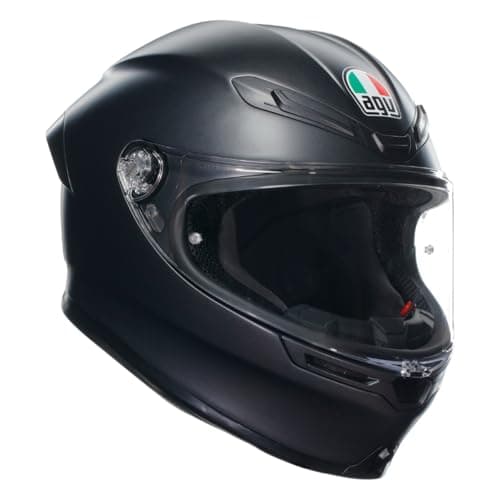
1. AGV K6 S - the best ECE 22.06 helmet, full stop

The K6 S is the only helmet in our catalog that pairs genuine ECE 22.06 with a 5-out-of-5 SHARP rating, the top score SHARP awards, and it does it at a published ~1,255 g in a carbon-aramid shell. That combination - the current independent type approval plus the best available independent crash data plus the lowest weight - is not matched anywhere else here, and the helmet is nowhere near flagship-touring money. Who it is for: a road rider who wants the strongest documented safety case on the site and will accept a race-derived fit.

Detail in the AGV K6 S review and the certification breakdown in the K6 S safety rating.

The honest cons. The interior is intermediate-oval and cut close to the cheeks, so it is the wrong helmet for a round-oval head. There is no drop-down sun visor. And the five-shell construction that keeps the weight down also means fewer size steps per shell than some rivals.

Who should skip it: commuters who need a sun visor, and anyone whose head AGV pinches - start with head shapes explained.

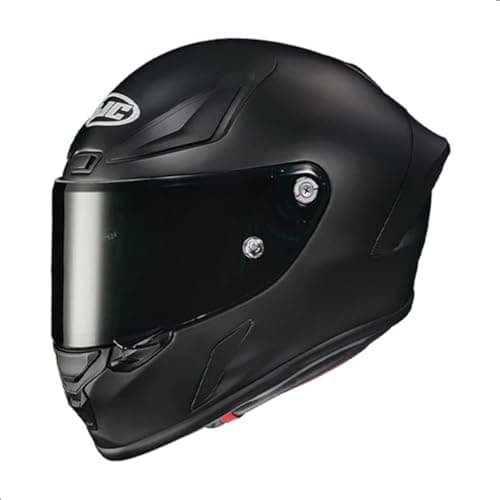
2. HJC RPHA 1N - 22.06 plus FIM, at mid-range money

The RPHA 1N is the only helmet on this page carrying FIM racing homologation on top of DOT and ECE 22.06. FIM is the approval required to race internationally and it is a separate tested standard, not a sticker - which makes this the most heavily certified helmet in the catalog under roughly twice its own price. PIM+ carbon shell, published ~1,510 g, and an ACS ventilation layout with five intakes and four exhausts. Who it is for: a sport rider who wants track-legal paperwork without paying flagship race-helmet money.

More in the HJC RPHA 1N review.

The honest cons. It has never been SHARP-tested, so unlike the AGV there is no independent star rating to point at. It is a race-biased helmet: the ventilation that works at 100 mph is loud at 40, and there is no sun visor. It is also heavier than the K6 S by a quarter of a kilo.

Who should skip it: commuters and tourers. The noise is the price of the airflow, and the quietest helmets page is the better starting point.

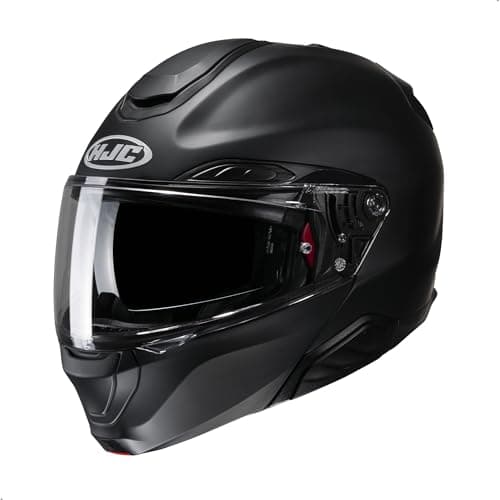
3. HJC RPHA 91 - the best-certified modular, and the only one with stars

Flip-fronts are where certification claims get slippery, because a modular has to be tested twice to be trusted twice. The RPHA 91 holds ECE 22.06 with a P/J dual homologation - tested and legal both closed and open - and it is the only modular in our catalog with an independent SHARP rating (4 out of 5). Published ~1,740 g in a PIM EVO composite shell, with a sun visor. Who it is for: a tourer or commuter who wants the convenience of a chin bar that lifts without giving up the current standard.

Read the commuter modular comparison, or are modular helmets safe for the mechanism behind P/J.

The honest cons. It is the heaviest helmet on this page by a clear margin - a flip-front mechanism costs grams and there is no way around it. Our catalog records ECE 22.06 P/J but not a DOT claim alongside it on the same build, so check the label on the unit you receive if DOT matters to you legally. And the sun visor eats internal space for glasses.

Who should skip it: riders who want the lightest thing they can buy - the AGV above is nearly 500 g lighter.

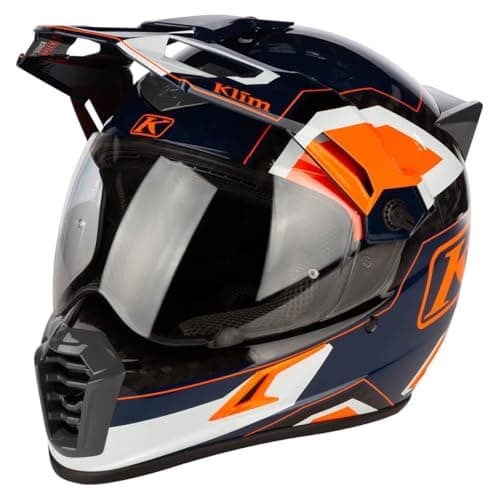
4. Klim Krios Pro - the 22.06 adventure helmet

Adventure helmets are the hardest format to find 22.06 in, because a peak and a goggle channel both have to survive the new accessory testing. The Krios Pro does it: DOT plus ECE 22.06 in a full carbon shell at a published ~1,450 g, with a Koroyd energy-absorbing layer and a shell that converts between full-face, peaked ADV and goggle-and-peak configurations. It is also the lightest adventure helmet we rate, by a long way. Who it is for: an ADV rider who covers real highway distance and refuses to carry an extra 300 g on their neck for it.

Full write-up in the Klim Krios Pro review, and the certification detail in the Krios Pro safety rating.

The honest cons. It is the most expensive pick on this page and it has never been SHARP-tested. Carbon does not make a helmet quiet, and a peak at highway speed is noisier than no peak. The convertible hardware is fiddly the first few times.

Who should skip it: riders who never leave pavement. You are paying for off-road capability you will not use - a road full-face gives you more helmet per dollar.

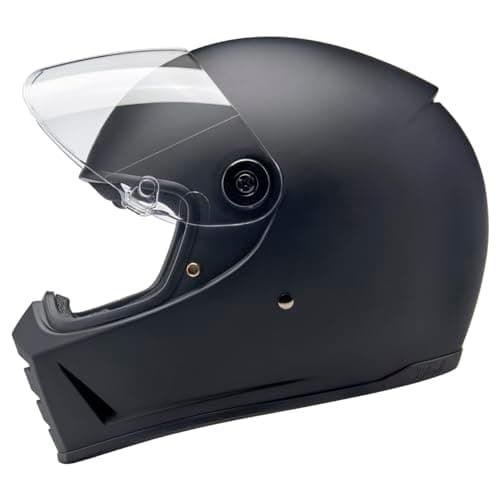
5. Biltwell Lane Splitter - 22.06 in a retro shell

This is the pick that surprises people. Classic-looking helmets are usually a certification desert - DOT-only shells with no revision named and no independent data anywhere. The Lane Splitter is DOT plus genuine ECE 22.06 in an injection-molded ABS shell with a published 3.45 lb weight, at a price that sits under a third of the AGV above. It is the cheapest way we know of to have a helmet that looks like 1974 and holds a 2026 approval. Who it is for: a rider who wants the retro silhouette and is not willing to trade the rotational test for it.

It leads our retro helmets comparison on exactly this basis.

The honest cons. Only two shell sizes, which means the largest and smallest sizes are padded rather than properly shelled, and fit is the thing every certification on this page assumes. It is heavy for what it is, there is no sun visor and no Pinlock pin fitting, and ABS is the cheapest shell material here. Never SHARP-tested.

Who should skip it: anyone doing long highway days. A two-shell ABS retro helmet is a city helmet.

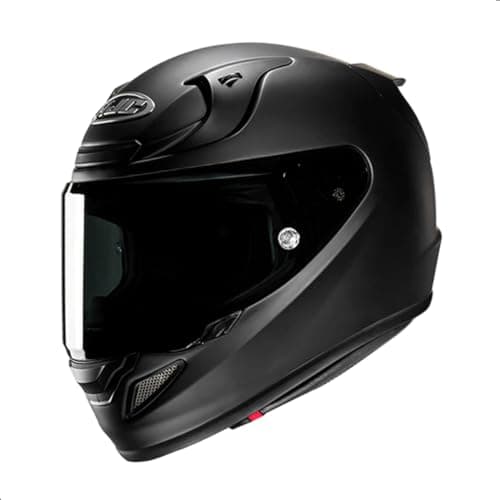
6. HJC RPHA 12 - the budget pick, and the proof 22.06 is not expensive

This is the budget pick: the cheapest helmet in our catalog that carries genuine ECE 22.06, and it does it without feeling like a compromise. PIM EVO composite shell, published ~1,474 g- lighter than helmets at three times the money - DOT plus ECE 22.06, and a Pinlock-ready HJ-42 shield. If the only question you came with was "what is the cheapest ECE 22.06 helmet", this is the answer. Who it is for: a rider on a real budget who has decided the certification is non-negotiable.

More in the HJC RPHA 12 review and the RPHA 12 safety rating. It also leads our under-$200 roundup.

The honest cons. Never SHARP-tested. No drop-down sun visor. The shield mechanism is the cheapest-feeling part of the helmet, and the liner is not as plush as a premium composite at twice the price. It also sits close enough to the $200 line that a modest price move puts it over - treat the card price as authoritative.

Who should skip it: nobody on a budget, honestly. If you can spend more, spend it on the AGV; if you cannot, this is not a consolation prize.

The verdict

Buy the AGV K6 S. ECE 22.06 plus a SHARP 5/5 at 1,255 g is the strongest documented safety case on this site, in a helmet that costs well under flagship money.

Buy the HJC RPHA 12 if budget is the binding constraint - it holds the same approval for a fraction of the price, which is the whole point of this page. Buy the HJC RPHA 1N for FIM homologation and track days. Buy the HJC RPHA 91 if you want a flip-front and will not give up the standard. Buy the Klim Krios Pro for adventure riding, and the Biltwell Lane Splitter if the helmet has to look the part.

And if your shortlist is full of US flagships that are not on this page - the RF-1400, the Contour-X, the Neotec 3 - that is not an oversight. Those are DOT or DOT-plus-Snell builds in this market, and the trade is laid out in best Snell-certified helmets. Decide which standard you are buying before you decide how much to spend.
The short answer

Quick picks, by the mark on the shell

#HelmetCertificationScorePrice
01
AGV AGV K6 S
AGV K6 S

Featherweight carbon-aramid, genuine ECE 22.06, and a perfect 5/5 SHARP score — the safety data leader of this list.

DOT certifiedECE 22.06 certifiedSHARP ★★★★★
9.1
$639.00Amazon
02
HJC HJC RPHA 1N
HJC RPHA 1N

HJC's MotoGP-derived flagship: the same PIM+ carbon shell HJC races, carrying DOT + ECE 22.06 and FIM racing homologation, for a fraction of an Arai or Shoei race lid.

DOT certifiedECE 22.06 certified
8.9
$428.80Amazon
03
HJC HJC RPHA 91
HJC RPHA 91

The value-flagship modular that quietly out-certifies the big names: ECE 22.06 P/J, a 4/5 SHARP score, at half a Neotec's price.

DOT certifiedECE 22.06 certifiedSHARP ★★★★☆
8.6
$545.00Amazon
04
Klim Klim Krios Pro
Klim Krios Pro

The lightest way to hold genuine US DOT + ECE 22.06 — a full-carbon convertible that goes from ADV to street to dirt.

DOT certifiedECE 22.06 certified
8.6
$599.74Amazon
05
Biltwell Biltwell Lane Splitter
Biltwell Lane Splitter

The cheapest route to genuine ECE 22.06 in a retro shell — the 1970s moto silhouette with a full face shield, a steel D-ring and the current certificate on the box.

DOT certifiedECE 22.06 certified
7.9
$299.95Amazon
06
HJC HJC RPHA 12
HJC RPHA 12

HJC's value sport-touring flagship: a genuinely light PIM EVO composite shell with ECE 22.06, a Pinlock-ready HJ-42 shield and wind-tunnel aero, for well under premium money.

DOT certifiedECE 22.06 certified
8.6
$194.81Amazon

#ad · Live prices from the Amazon Product API, as of November 23, 2026. Certifications reflect the US-market build and are cited in Sources. Where a live price has rotted, we show none.

In detail

The picks, in full

01
AGV AGV K6 S

Lightest full-face with top safety data

AGV K6 S

DOT certifiedECE 22.06 certifiedSHARP ★★★★★
Carbon-aramid~1,255 gDOT + ECE 22.06SHARP 5/5
9.1/10

Featherweight carbon-aramid, genuine ECE 22.06, and a perfect 5/5 SHARP score — the safety data leader of this list.

Certification
9.5
Safety data
9.5
Weight
9.5
Field of view
9
Value
8

Pros

  • ~1,255 g — one of the lightest full-face helmets on the market
  • Genuine DOT + ECE 22.06 and a perfect 5/5 SHARP score
  • Huge field of view derived from AGV's racing helmets

Cons

  • No internal sun visor
  • Sport-oriented fit is snug for round heads

Don't buy this if…

…you tour long days and want a sun visor and maximum quiet — a touring full-face or modular fits better.

$639.00View on Amazon

Price as of November 23, 2026. Prices change — Amazon's at checkout is the one that counts.

#ad · we may earn a commission from this link to AGV K6 S

02
HJC HJC RPHA 1N

Track-grade certification for the money

HJC RPHA 1N

DOT certifiedECE 22.06 certified
PIM+ carbon shell~1,510 gDOT + ECE 22.06 + FIMACS 5-in / 4-out vents
8.9/10

HJC's MotoGP-derived flagship: the same PIM+ carbon shell HJC races, carrying DOT + ECE 22.06 and FIM racing homologation, for a fraction of an Arai or Shoei race lid.

Certification
9.5
Ventilation
9
Weight
8.5
Value
9
Finish
8.5

Pros

  • Carries FIM racing homologation on top of DOT + ECE 22.06 — a track-grade cert most street lids can't show
  • PIM+ carbon shell keeps it light (~1,510 g) for a full race helmet
  • ACS ventilation (5 intakes, 4 exhausts) flushes heat and reduces visor fog

Cons

  • A hard, track-focused shell and fit — less plush than a touring lid
  • No sun visor, and premium-priced for an HJC (though far under Arai/Shoei race helmets)

Don't buy this if…

…you want a comfortable touring or commuting helmet — this is a race-derived lid; a sport-touring RPHA 12 or a touring full-face suits daily riding better.

$428.80View on Amazon

Price as of November 23, 2026. Prices change — Amazon's at checkout is the one that counts.

#ad · we may earn a commission from this link to HJC RPHA 1N

03
HJC HJC RPHA 91

Best-certified modular for the money

HJC RPHA 91

DOT certifiedECE 22.06 certifiedSHARP ★★★★☆
PIM EVO composite~1,740 g (M)ECE 22.06 P/JSHARP 4/5
8.6/10

The value-flagship modular that quietly out-certifies the big names: ECE 22.06 P/J, a 4/5 SHARP score, at half a Neotec's price.

Certification
9.5
Value
9.5
Quiet
8
Weight
8
Finish
8

Pros

  • ECE 22.06 with P/J dual-homologation — legally approved to ride with the chin bar up
  • Independently SHARP-tested at 4/5, a real safety data point
  • Composite shell keeps weight and price down together

Cons

  • Not as whisper-quiet as a Neotec 3
  • Interior plushness is a notch below the premium Japanese brands

Don't buy this if…

…outright touring silence matters more to you than certification and price — the Neotec 3 is quieter.

$545.00View on Amazon

Price as of November 23, 2026. Prices change — Amazon's at checkout is the one that counts.

#ad · we may earn a commission from this link to HJC RPHA 91

04
Klim Klim Krios Pro

Weight-obsessed ADV riders who want ECE 22.06

Klim Krios Pro

DOT certifiedECE 22.06 certified
Full carbon fiber~1,450 g (L)DOT + ECE 22.06Koroyd + convertible
8.6/10

The lightest way to hold genuine US DOT + ECE 22.06 — a full-carbon convertible that goes from ADV to street to dirt.

Certification
9.5
Weight
9.5
Versatility
9
Quiet
7.5
Value
7.5

Pros

  • Genuine US DOT + ECE 22.06 — the rotational-impact standard, on the US build
  • ~1,450 g in a full-carbon shell is class-leading light for a convertible ADV lid
  • Peak, visor and goggle configuration all in one helmet

Cons

  • Carbon and Koroyd cost money — this is a flagship price
  • Quieter with the visor than in full peak-and-goggles ADV mode
  • No longer Klim's newest ADV platform — the pricier X1 Alpha (Koroyd plus EPS, also DOT + ECE 22.06) sits above it, and Klim showed an X1 Gamma adventure helmet in its 2027 collection

Don't buy this if…

…you want the deepest sun-visor sunshade and plushest touring quiet — a road-first modular does that better.

$599.74View on Amazon

Price as of November 23, 2026. Prices change — Amazon's at checkout is the one that counts.

#ad · we may earn a commission from this link to Klim Krios Pro

05
Biltwell Biltwell Lane Splitter

Certification per dollar in the retro class

Biltwell Lane Splitter

DOT certifiedECE 22.06 certified
Injection-molded ABS3.45 lb publishedDOT + ECE 22.062 shell sizes
7.9/10

The cheapest route to genuine ECE 22.06 in a retro shell — the 1970s moto silhouette with a full face shield, a steel D-ring and the current certificate on the box.

Certification
9.5
Value
9.5
Styling
8.5
Fit range
6.5
Weight
5.5

Pros

  • Genuine ECE 22.06 plus DOT at the bottom of the retro price bracket — the same certification pair as helmets costing substantially more here
  • Plated steel double D-ring strap, a hand-sewn brushed Lycra liner with removable cheek pads, and a UV-rated anti-fog clear shield with a revised locking mechanism
  • Large chin vents and a rear outlet, and a full XS-2XL size run with published head-circumference ranges for every size

Cons

  • Injection-molded ABS over EPS, which is the cheapest full-face construction — the certificate is current, the shell is not exotic
  • Only 2 shell sizes across six helmet sizes, so the smallest and largest riders are padding out a shell rather than getting one sized to them
  • Published at 3.45 lb, the heaviest helmet in this group, and the retro eyeport is not a touring seal

Don't buy this if…

…weight is what you notice on a long ride — this is the heaviest lid in the retro class here, and a composite-shell full-face will be noticeably lighter for similar money.

$299.95View on Amazon

Price as of November 23, 2026. Prices change — Amazon's at checkout is the one that counts.

#ad · we may earn a commission from this link to Biltwell Lane Splitter

06
HJC HJC RPHA 12

Lightweight ECE 22.06 sport-touring value

HJC RPHA 12

DOT certifiedECE 22.06 certified
PIM EVO composite~1,474 gDOT + ECE 22.06HJ-42 Pinlock-ready
8.6/10

HJC's value sport-touring flagship: a genuinely light PIM EVO composite shell with ECE 22.06, a Pinlock-ready HJ-42 shield and wind-tunnel aero, for well under premium money.

Certification
9
Weight
9
Value
9
Aero / quiet
8
Finish
8

Pros

  • Genuinely light at ~1,474 g in a PIM EVO composite shell — lighter than most sport lids
  • Genuine ECE 22.06 with a Pinlock-ready HJ-42 shield for anti-fog
  • Wind-tunnel shell and rear spoiler cut lift, drag and noise at speed

Cons

  • Not SHARP-tested, so no independent star score like an AGV K6 S
  • No sun visor — a sport lid, so you run a tinted shield or sunglasses

Don't buy this if…

…you want independent SHARP data or a sun visor — the K6 S has the SHARP score, the GT-Air 3 has the sun visor.

$194.81View on Amazon

Price as of November 23, 2026. Prices change — Amazon's at checkout is the one that counts.

#ad · we may earn a commission from this link to HJC RPHA 12

How we picked

We do not crash-test helmets

We compiled published specifications, cited each helmet's certification (DOT, ECE 22.06, Snell, SHARP) from the standards body or manufacturer homologation, and aggregated owner reports, then scored against a published method. The scores are judgments from documented research — not measurements we took. We do not run a crash lab. Certifications reflect the US-market build; where it differs from the European version, we say so and cite it.

Questions

Frequently asked

Which motorcycle helmets are ECE 22.06 certified?
In our catalog, fifteen helmets hold documented ECE 22.06, and the six on this page are the ones we rank: the AGV K6 S, HJC RPHA 1N, HJC RPHA 91, Klim Krios Pro, Biltwell Lane Splitter and HJC RPHA 12. Others include the Bell MX-9 Adventure MIPS, the AGV AX9, the AGV K1 S, the LS2 Advant X, the Scorpion EXO-AT960, the Biltwell Gringo SV, the Bell Bullitt GT and the two ECE builds of the Alpinestars Supertech range. Every one of those carries the revision on its card, cited to the maker or the standards body.
What is the cheapest ECE 22.06 helmet?
The HJC RPHA 12 is the cheapest helmet in our catalog with documented ECE 22.06 - under $200 at the time this page was built, in a PIM EVO composite shell at a published ~1,474 g. The next step up the price ladder is the AGV K1 S. The useful conclusion is that 22.06 is not a premium feature: it is available at the bottom of the market, and a DOT-only helmet at $280 is now a choice rather than a limit.
Is ECE 22.06 better than DOT?
Yes, on the specific question of how much independent testing stands behind the label. DOT (FMVSS 218) is self-certified: the manufacturer declares compliance and no independent lab tests the helmet before sale, though NHTSA can test after the fact. ECE 22.06 is an independently lab-tested type approval with production sampling, more impact points, multiple speeds and an oblique rotational-impact test DOT does not include. A 22.06 helmet has cleared a harder bar that somebody else checked.
Is ECE 22.06 better than Snell?
They are different test philosophies, not a strict ranking, and Snell says so itself - it split its current standard into M2025D and M2025R precisely because ECE 22.06 is incompatible with its previous approach. Snell emphasizes stiffer shells and repeated high-energy impacts; 22.06 emphasizes rotational injury across more points and speeds. Both are independently tested. In the US you are usually choosing one or the other, because the Snell flagships sold here are not 22.06 builds.
How do I tell if a helmet is ECE 22.06 or 22.05?
Read the label stitched to the chin strap. After the circled E and the country number, the approval string begins with the regulation revision: a string starting 06 is 22.06, one starting 05 is 22.05. The letter alongside tells you the homologation type - P for full-face, J for open-face, P/J on a flip-front that is tested both ways. Do not rely on the box or the product page; the strap label is the document.
Why is my helmet ECE 22.06 in Europe but not in the US?
Because they are often not the same helmet. Manufacturers build market-specific versions, and the US unit is frequently a DOT or DOT-plus-Snell build, sometimes under a different model name - the Shoei NXR2 is sold here as the RF-1400, the Arai Quantic as the Contour-X, the Arai Tour-X5 as the XD-5. The European model's 22.06 approval and any SHARP score belong to that build, not to the one shipping from a US warehouse. Every card on this site records the US-market answer.
Does ECE 22.06 replace MIPS?
No, but it overlaps with what MIPS is for. MIPS is a low-friction layer inside the helmet designed to reduce rotational force; ECE 22.06 is a test regime that now measures rotational loading. A 22.06 helmet has been tested against the mechanism MIPS addresses, whether or not it uses MIPS to pass. Two helmets in our catalog carry both. The distinction is worked through in our MIPS explainer.

Keep reading

Receipts

Sources

We do not run a crash lab, and we do not pretend to. Certifications are cited to the standards body or the manufacturer's stated homologation; where a US model's certification differs from its European namesake, we say so. Where we could not verify something, we say so on the page rather than quietly leaving it out. Read our full method.