Skip to content
VISOR & VENT

HUB 06 · Buying Guides & How-To

The Best Open-Face Motorcycle Helmets

An open face is the most pleasant way to ride in traffic and the least protected. Here is the honest version of this category: the one true 3/4 helmet we would buy, and the P/J-homologated flip-ups that let you ride open legally without giving up a chin bar.

By Stephen V.Updated How we rate
#ad

We earn a commission when you buy through our Amazon links, at no extra cost to you. It never changes a ranking, and we tell you when the cheaper helmet is the better buy. How this works.

If you want the open-face experience and you want the best-certified way to get it, buy the HJC RPHA 91 - a flip-up carrying ECE 22.06 with P/J dual homologation, which means it was impact-tested with the chin bar both closed and open and is approved to be ridden either way. It is for the rider who likes air on their face in town but wants a chin bar on the highway. If what you actually want is a true 3/4 shell for classic style, the Bell Custom 500 is the one we would buy - and the rest of this page is about what that choice costs you.

We have not crash-tested any of these helmets and we do not run a lab. Certifications below come from the standards bodies and each maker's published homologation, and they describe the US-market build, which is frequently not the European one. Everything is cited at the foot of the page.

What "open face" means, and the three things it costs you

An open-face (or "jet" or 3/4) helmet covers the top, back and sides of your head and leaves your face and jaw exposed. Our helmet types explainer covers the whole format landscape; here is the part that matters when you are about to spend money. First, there is no chin bar, so your jaw, teeth and chin are unprotected in exactly the impact a full-face is designed around. Second, the testing picture is thinner: no open-face helmet carries Snell, and SHARP - the UK government scheme whose star ratings we cite all over this site - does not rate this class at all, so you cannot comparison-shop open-face helmets on independent impact data the way you can a full-face. Third, an open face is loud, and it leaves your eyes exposed to wind, grit and bugs unless you add a shield, a snap-on visor or glasses.

None of that makes an open face a bad choice. It makes it a choice you should make deliberately - for low-speed town riding, for heat, or because you genuinely prefer it - and not because a page like this one glossed over the trade. If any of those three costs bother you, the next section is the fix.

The P/J mark: an open face when you want one, a full face when you need one

Under the ECE standard a flip-up can be homologated three ways and they are not interchangeable. P (protective) means the helmet is approved only as a full-face, so the chin guard must stay down while you are moving. J (jet) means it is approved only as an open-face. P/J means it passed both, so the same helmet is simultaneously an approved full-face and an approved open-face and you can legitimately ride with the bar up or down. That mark is the single most useful thing on this page: it is how you get the open-face experience without permanently giving up a chin bar. Our modular safety guide goes deeper on the latch data behind it.

HJC RPHA 91 - the best-certified way to ride with your face open

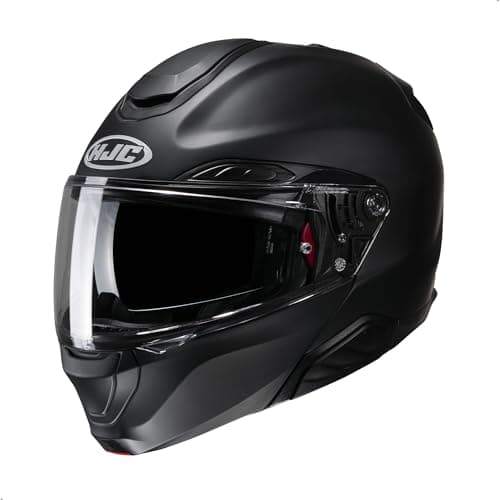
This is the pick for most riders who want an open face. The RPHA 91 carries genuine ECE 22.06 with P/J homologation and an independent SHARP 4/5 score, in a PIM EVO composite shell at about 1,740 g, with a drop-down sun visor. Nothing else on this page combines a current standard, independent testing and approval to ride open. Who it is for: the commuter or tourer who wants air at the lights and a chin bar at 70 mph. The honest cons: it is a flip-up, so it is heavier and has more mechanism than a true 3/4, and it is not cheap - see the full RPHA 91 review.

LS2 Advant X - the lightest P/J we cover

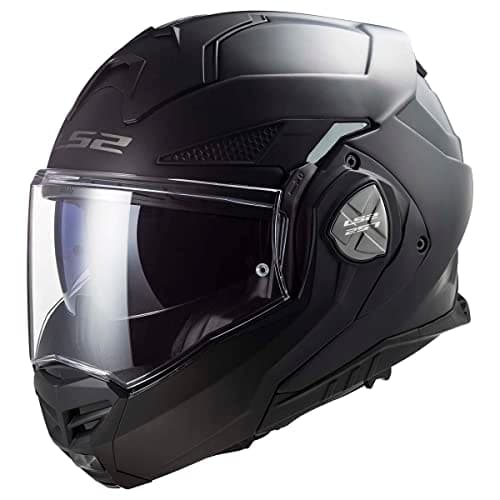
If the weight of a flip-up is what puts you off, the Advant X answers it: DOT + ECE 22.06 with P/J homologation in a forged-carbon shell at about 1,550 g, with a drop-down sun visor and Cardo-ready comms channels. That is close to full-face weight with open-face approval. Who it is for: the rider who wants P/J but refuses to carry 1,800 g. The honest con is noise - it is louder than a premium touring modular, as the Advant X review says plainly.

Scorpion EXO-GT930 Transformer - the one that becomes a genuine open face

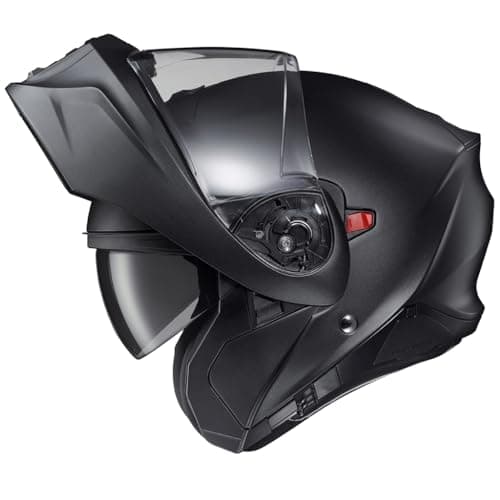
Every other flip-up here keeps the chin bar attached when you raise it. The GT930's chin bar comes off entirely, so the helmet converts into a real open-face with a drop-down sun visor, and its P/J homologation means that open configuration is a tested, approved one rather than an improvisation. Who it is for: the rider who wants one helmet to be a full-face on the highway and a true 3/4 around town. The honest cons: it is certified DOT + ECE 22.05, not the newer 22.06, so it lacks the rotational (oblique) impact test, and at roughly 1,890 g it is the heaviest helmet on this page. Full detail in the EXO-GT930 review.

Bell Custom 500 - the classic 3/4, honestly described

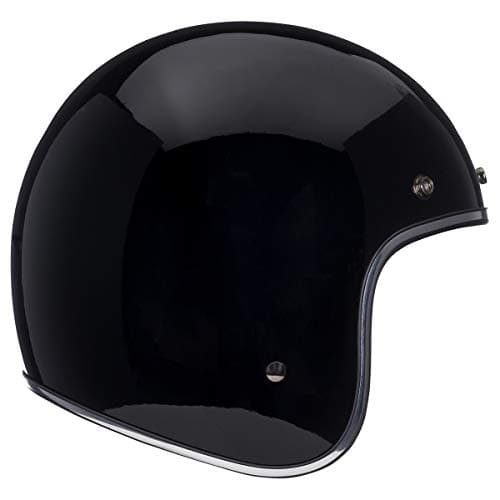
If you want the low-profile vintage silhouette, this is the one we would buy, and the reason is fit engineering rather than styling: Bell builds the Custom 500 in five shell and EPS liner sizes, where cheap open-faces stretch two shells across a whole size range and pad out the difference. It is DOT (FMVSS 218), with a stainless double-D ring and the industry-standard five-snap visor pattern. Who it is for: the cruiser or cafe rider who wants a genuinely well-made 3/4 and accepts the protection trade. The honest cons: ECE is not something we will assert on this model - retail listings disagree with each other and Bell does not publish a revision for the US unit, so check the label on the helmet you receive - and you get no chin bar, no shield in the box and no independent impact data, because none exists for this class.

So which one?

Want the open-face experience with the best certification available? The HJC RPHA 91. Want that, lighter? The LS2 Advant X. Want a helmet that is genuinely a full-face some days and a genuine 3/4 on others? The Scorpion EXO-GT930. Want the classic shape and nothing else? The Bell Custom 500. And whichever way you go, get the size right first with our head-measuring guide - fit is what makes any certification real.

The short answer

Quick picks, by the mark on the shell

#HelmetCertificationScorePrice
01
HJC HJC RPHA 91
HJC RPHA 91

The value-flagship modular that quietly out-certifies the big names: ECE 22.06 P/J, a 4/5 SHARP score, at half a Neotec's price.

DOT certifiedECE 22.06 certifiedSHARP ★★★★☆
8.6
$559.99Amazon
02
LS2 LS2 Advant X
LS2 Advant X

The featherweight certification bargain: a genuine ECE 22.06 P/J flip-up in a ~1,550 g forged-carbon shell, for a fraction of a premium modular's price.

DOT certifiedECE 22.06 certified
8.3
$499.98Amazon
03
Scorpion Scorpion EXO-GT930 Transformer
Scorpion EXO-GT930 Transformer

A genuinely clever three-in-one that converts full-face to open-face — but read the certification: it's ECE 22.05, not 22.06.

DOT certifiedECE 22.05 certified
7.7
$279.95Amazon
04
Bell Bell Custom 500
Bell Custom 500

The default classic three-quarter lid, and an honest one: five real shell sizes, a DOT label, and no chin bar at all — which is the entire trade you are making.

DOT certifiedECE 22.06 unverified
6.9
$179.95Amazon

#ad · Live prices from the Amazon Product API, as of October 6, 2026. Certifications reflect the US-market build and are cited in Sources. Where a live price has rotted, we show none.

In detail

The picks, in full

01
HJC HJC RPHA 91

Best-certified modular for the money

HJC RPHA 91

DOT certifiedECE 22.06 certifiedSHARP ★★★★☆
PIM EVO composite~1,740 g (M)ECE 22.06 P/JSHARP 4/5
8.6/10

The value-flagship modular that quietly out-certifies the big names: ECE 22.06 P/J, a 4/5 SHARP score, at half a Neotec's price.

Certification
9.5
Value
9.5
Quiet
8
Weight
8
Finish
8

Pros

  • ECE 22.06 with P/J dual-homologation — legally approved to ride with the chin bar up
  • Independently SHARP-tested at 4/5, a real safety data point
  • Composite shell keeps weight and price down together

Cons

  • Not as whisper-quiet as a Neotec 3
  • Interior plushness is a notch below the premium Japanese brands

Don't buy this if…

…outright touring silence matters more to you than certification and price — the Neotec 3 is quieter.

$559.99View on Amazon

Price as of October 6, 2026. Prices change — Amazon's at checkout is the one that counts.

#ad · we may earn a commission from this link to HJC RPHA 91

02
LS2 LS2 Advant X

Lightest ECE 22.06 P/J modular for the money

LS2 Advant X

DOT certifiedECE 22.06 certified
Forged carbon fiber~1,550 gDOT + ECE 22.06 P/JSun visor + Cardo-ready
8.3/10

The featherweight certification bargain: a genuine ECE 22.06 P/J flip-up in a ~1,550 g forged-carbon shell, for a fraction of a premium modular's price.

Certification
9
Weight
9
Value
8.5
Features
8
Quiet
7

Pros

  • Genuine ECE 22.06 with P/J homologation in a full forged-carbon shell
  • About 1,550 g makes it one of the lightest modulars you can buy — real neck-fatigue relief on long days
  • Drop-down sun visor and a channel for LS2's Cardo-based 4X comms

Cons

  • The 180-degree flip mechanism and modular seams make it louder at highway speed than a one-piece carbon full-face
  • Uses a micrometric ratchet strap rather than a Double-D ring, and only two shell sizes cover the whole range

Don't buy this if…

…outright touring silence is your first priority — a sealed premium modular like the Shoei Neotec 3 is quieter, if heavier and far pricier.

$499.98View on Amazon

Price as of October 6, 2026. Prices change — Amazon's at checkout is the one that counts.

#ad · we may earn a commission from this link to LS2 Advant X

03
Scorpion Scorpion EXO-GT930 Transformer

Budget convertible commuting

Scorpion EXO-GT930 Transformer

DOT certifiedECE 22.05 certified
Polycarbonate~1,890 g (XL)DOT + ECE 22.05 P/JFull-face ↔ open-face
7.7/10

A genuinely clever three-in-one that converts full-face to open-face — but read the certification: it's ECE 22.05, not 22.06.

Certification
7.5
Versatility
9
Value
8.5
Weight
6.5
Quiet
7

Pros

  • Converts fully to an open-face — rare and genuinely useful for hot commutes
  • P/J homologation, so riding open is approved
  • Drop-down sun visor and a friendly price

Cons

  • ECE 22.05, not the newer 22.06 with its rotational-impact test
  • Heavy polycarbonate shell

Don't buy this if…

…you want the current 22.06 rotational standard — step up to the ECE 22.06 EXO-AT960 or the HJC RPHA 91.

$279.95View on Amazon

Price as of October 6, 2026. Prices change — Amazon's at checkout is the one that counts.

#ad · we may earn a commission from this link to Scorpion EXO-GT930 Transformer

04
Bell Bell Custom 500

A certified open-face classic

Bell Custom 500

DOT certifiedECE 22.06 unverified
Composite shell5 shell + EPS sizesDOT (FMVSS 218)5-snap visor pattern
6.9/10

The default classic three-quarter lid, and an honest one: five real shell sizes, a DOT label, and no chin bar at all — which is the entire trade you are making.

Weight
9
Fit range
8.5
Value
8.5
Certification
5
Coverage
3.5

Pros

  • Five separate shell and EPS sizes — the shell genuinely scales, which is rare at any price
  • Thin-profile shell sits low on the head rather than ballooning above it
  • Integrated 5-snap pattern accepts the whole aftermarket of bubble shields, flat shields and peaks

Cons

  • No chin bar, so the most-struck part of a helmet is simply not covered — no open-face can fix that
  • No published cheek-pad thickness options, so the fit is what it is, and it is widely reported to run small
  • No shield, no seal and no sun visor in the box — eye protection and wind noise are on you

Don't buy this if…

…you ride highway miles, or you want the certification a chin bar makes possible — the Biltwell Gringo SV keeps the classic look and keeps the chin bar.

$179.95View on Amazon

Price as of October 6, 2026. Prices change — Amazon's at checkout is the one that counts.

#ad · we may earn a commission from this link to Bell Custom 500

What to check before you buy an open-face helmet

Eye protection is not optional. An open face with no shield leaves you at the mercy of grit, rain and insects at speed. Either buy a model with a face shield fitted, add a snap-on visor (the five-snap pattern on the Custom 500 is the standard), or commit to goggles or wrap-around glasses every ride. Decide this before you buy, not after your first highway mile.

Count the shells, not the sizes. A helmet offered in six sizes across two shells is mostly padding changes - the outer shell on a small head is the same object that sits on a large one. More shell and EPS sizes means the shell sits closer to your actual head, which is both more comfortable and, because the EPS is the part that manages an impact, better engineering. This is the main reason we rate the Custom 500 over cheaper 3/4 helmets.

Expect noise, and plan for it. Open-face helmets are the loudest class there is, and wind noise above about 40 mph is dominated by air rather than the engine. Earplugs are the single most effective fix - see how to make your helmet quieter - and they matter more here than in any other format.

If you are buying open-face for heat, read the alternative first. A P/J modular you are approved to ride open gives you most of the airflow with the option of a chin bar, and a well-vented full-face gives up less than riders expect. Our hot-weather helmet picks cover that route, and ventilation explained covers why vent design beats vent count.
How we picked

We do not crash-test helmets

We compiled published specifications, cited each helmet's certification (DOT, ECE 22.06, Snell, SHARP) from the standards body or manufacturer homologation, and aggregated owner reports, then scored against a published method. The scores are judgments from documented research — not measurements we took. We do not run a crash lab. Certifications reflect the US-market build; where it differs from the European version, we say so and cite it.

Questions

Frequently asked

Are open-face motorcycle helmets safe?
They are legal and certified, but they protect less than a full-face: there is no chin bar, so your jaw and face are exposed. No open-face helmet carries Snell, and SHARP does not rate the class, so independent impact data for open-face models does not exist. If you want the open-face experience with full protection available, buy a P/J-homologated modular like the HJC RPHA 91 - it is approved to be ridden both open and closed.
What does P/J mean, and why does it matter for open-face riding?
Under the ECE standard, P means the flip-up was approved as a full-face only (bar down while moving), J means approved as an open-face only, and P/J means it passed both tests - so the helmet is simultaneously an approved full-face and an approved jet and you can ride with the chin bar up legally. A modular without the P/J mark is not approved to be ridden open, whatever the marketing photo shows.
What is the best open-face helmet for a cruiser?
If you want a true 3/4, the Bell Custom 500 - five shell and EPS sizes is unusually good fit engineering for the class, and it carries DOT with a stainless double-D ring. If you would accept a flip-up that converts to a genuine open-face, the Scorpion EXO-GT930 Transformer gives you both plus a drop-down sun visor, with DOT + ECE 22.05 P/J on the shell.

Keep reading

Receipts

Sources

We do not run a crash lab, and we do not pretend to. Certifications are cited to the standards body or the manufacturer's stated homologation; where a US model's certification differs from its European namesake, we say so. Where we could not verify something, we say so on the page rather than quietly leaving it out. Read our full method.