HUB 03 · Full-Face Helmets
Biltwell Gringo SV Review
Almost every classic-looking helmet asks you to trade certification for styling. The Gringo SV is the one that does not - Biltwell publishes ECE R22.06 on it, the current rotational-impact revision, on a shell that looks like 1974.
We earn a commission when you buy through our Amazon links, at no extra cost to you. It never changes a ranking, and we tell you when the cheaper helmet is the better buy. How this works.
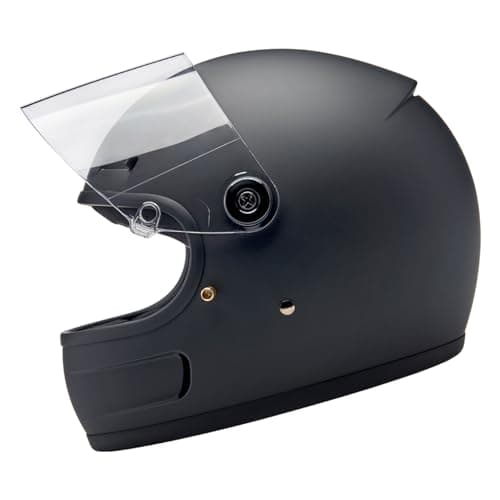
Classic looks without losing the chin bar
The classic-looking lid that doesn't trade the chin bar for the look — and one of the very few retro full-faces carrying genuine ECE 22.06 on the US box.
Price as of October 21, 2026. Prices change — Amazon's at checkout is the one that counts.
#ad · we may earn a commission from this link to Biltwell Gringo SV
Buy the Gringo SV if you want a helmet that looks like a vintage lid and still carries the current European standard. Biltwell states it is "US DOT FMVSS No. 218 compliant / ECE R22.06 certified" on its own product page, and the US Amazon listing carries R22.06 in the title - which puts it in a very small group of classic-styled full-faces holding the 22.06 revision rather than an older 22.05 carry-over. Who it is for: the rider whose other shortlist is all open-face cruiser helmets, who wants the look without giving up a chin bar or a current mark. If the rest of that shortlist is Simpson, read are Simpson helmets good? first - the Bandit line mostly does not publish the revision this helmet states outright. It is also the styling entry in our best budget full-face roundup.
We have not crash-tested this helmet and we do not run a lab. Everything below comes from Biltwell's published specification, the standard it states it is homologated to, and the retail listing data for the US unit, all cited at the foot of the page. Where a figure is Biltwell's own claim, we say so.
The certification is the whole story
Retro helmets are where certification quietly goes to die. The styling market is full of shells sold on looks with a DOT sticker and nothing else, because DOT (FMVSS 218) is self-certified - the manufacturer asserts compliance, and nobody independently type-tests the helmet before it reaches a shelf. ECE 22.06 is the opposite: independently lab-tested before sale, with batch checks afterwards.
Three things 22.06 tests that the older 22.05 series did not. It adds an oblique (rotational) impact test, which is the injury mechanism modern helmet engineering is built around. It tests more impact points at more speeds. And it tests the visor and any pre-fitted accessories as part of the helmet rather than as bolt-ons. That last one matters on a helmet like this, where the shield is a flat retro-profile item rather than a modern wrapped one. Our certification explainer sets all four marks against each other if you want the full picture.
What the Gringo SV does not have: independent star ratings
Being straight about the gap: the Gringo SV has not been tested by SHARP, the UK government scheme whose 1-5 star results we cite across this site. That is not a mark against the helmet - SHARP buys and tests a limited set of models, and most of the helmets on sale have never been through it - but it does mean you are relying on the 22.06 type approval rather than on comparative impact data. If independent star data is your deciding factor, the AGV K6 S (ECE 22.06 and a 5/5 SHARP score) is the helmet to look at instead, and it is a completely different object to wear.
Three shells, five EPS sizes - the part you cannot see
This is the engineering decision that separates the Gringo SV from cheaper retro shells. Biltwell builds it in three shell sizes with five EPS liner options across XS-2XL (53-64 cm), over a dual-density EPS liner. A helmet sold in six sizes on two shells is mostly padding changes: the outer shell on a small head is the same object that sits on a large one, with more foam between. Because the EPS is the part that manages an impact, having it sized closer to your actual head is both more comfortable and better engineering.
The internal shape is documented as intermediate oval, which is the most common head shape and the default for most manufacturers - so most riders will find it fits. If helmets usually pinch your temples while leaving room front to back, you are rounder than this shell and should read our head-shape guide before ordering, because no amount of break-in fixes a shape mismatch.
What you give up for the styling
Two real omissions, and they are the reason this is not a touring helmet.
No drop-down sun visor. You manage glare with the shield you have, which means either a tinted shield and a clear one in the bag, or a photochromic shield if a compatible one exists for your shield fitment. Our visor tint guide covers the trade-offs, and if an internal sun visor turns out to matter more to you than the silhouette, our sun-visor helmet picks are the honest alternative.
No published Pinlock provision. The shield is a CE-certified polycarbonate item with anti-fog and anti-scratch treatments, but Biltwell does not publish pin posts for a Pinlock insert, so you cannot plan on the best fog fix in motorcycling. What you can do is work the vents and use a wipe-on anti-fog treatment - our fogging guide ranks the options and is honest that a Pinlock-equipped shield beats all of them.
Weight, noise and ventilation, honestly
At a published 3.69 lb (about 1,674 g) this is a heavy full-face by 2026 standards - it is injection-molded ABS, not a composite or carbon shell, and you are carrying roughly 400 g more than a mid-tier composite sport-touring lid. On short rides it is a non-issue; on a six-hour day you will notice it. Our helmet weight explainer covers what each shell material buys.
Ventilation is front, side and rear vent ports - a classic shell with vents added, not an aerodynamics project - and the same goes for noise. A smooth retro shell with a flat shield profile and no deep neck roll is not built for quiet, and we have no measured decibel figure for this helmet, so we will not rank it against the lids that do have one. What we will say is that wind noise is mostly fixable at the rider end: filtered earplugs beat any helmet swap, as our noise guide explains.
It takes a comms unit, which retro helmets often do not
A detail worth more than it sounds: the Gringo SV has molded EPS ear pockets and a removable, washable liner. That means a bolt-on intercom's speakers have somewhere to sit instead of pressing on your ears, and you can get the liner out to run the wiring. On a budget that makes it a workable pairing with a two-rider unit like the Cardo Spirit HD, which ships with both a hybrid/boom mic and a wired mic so helmet shape is not a constraint. Worth remembering that a comms unit carries no helmet certification of its own - the shell does.
Gringo SV versus the obvious alternatives
Against a true open-face (the Bell Custom 500 and friends): you keep the chin bar and you gain a current ECE mark, and you give up nothing but airflow on your face. If you are choosing between a 3/4 and this, read our open-face guide - the protection difference is the single biggest variable on that page, and the Gringo SV is the way to keep the look without taking it.
Against a touring full-face (the Shoei GT-Air 3 or similar): you give up the sun visor, the quiet, roughly 100 g, and the comms integration, and you get the styling plus - this is the twist - a better published certification than several premium touring helmets sold in the US, which are DOT builds. That is a genuine point in the Gringo SV's favor, and it is the kind of thing price alone never tells you, as our price-versus-certification page works through.
Who should skip it
Skip the Gringo SV if you ride long sunny highway days - the missing sun visor and the basic sealing will annoy you more than the styling pleases you, and a premium touring helmet is the right tool. Skip it if low weight is a priority, because ABS at 3.69 lb is the wrong end of the scale. Skip it if you need a Pinlock-ready shield for cold, damp commuting. And skip it if your head is strongly round-oval or long-oval, since this is an intermediate-oval shell in three sizes. What is left - a rider who wants the classic look, the chin bar and the current standard, in that order - is exactly who this helmet is for.
For the certification on its own, including what the absent SHARP and Snell results do and do not tell you, see Biltwell Gringo SV safety rating.
The scorecard
How it scores, and who should skip it
- Certification
- 9.5
- Value
- 8
- Finish
- 8
- Quiet
- 6.5
- Weight
- 6
Pros
- Genuine ECE 22.06 on a retro-styled helmet — the rotational-impact revision, not a 22.05 carry-over
- Three shell sizes with five EPS options, so the shell scales with your head instead of padding out one size
- Molded EPS ear pockets and a removable, washable liner — it takes a comms unit and a wash
Cons
- No drop-down sun visor and no published Pinlock provision — you manage sun and fog with the shield you have
- Heavy for a full-face at a published 3.69 lb, and ABS rather than a composite shell
- Ventilation is basic by touring standards — a classic shell with vent ports added, not an aero project
Don't buy this if…
…you ride long sunny highway days — a drop-down sun visor and a better-sealed touring shell like the GT-Air 3 will do more for you than the styling does.
Price as of October 21, 2026. Prices change — Amazon's at checkout is the one that counts.
#ad · we may earn a commission from this link to Biltwell Gringo SV
How we picked
We do not crash-test helmets
We compiled published specifications, cited each helmet's certification (DOT, ECE 22.06, Snell, SHARP) from the standards body or manufacturer homologation, and aggregated owner reports, then scored against a published method. The scores are judgments from documented research — not measurements we took. We do not run a crash lab. Certifications reflect the US-market build; where it differs from the European version, we say so and cite it.
Questions
Frequently asked
Is the Biltwell Gringo SV ECE 22.06 certified?
Does the Gringo SV take a Pinlock insert?
What head shape does the Gringo SV suit?
Is the Gringo SV heavy?
Keep reading
Related
- Best open-face helmetsThe alternative this helmet is the answer to - with the chin bar kept.
- Best helmets for cruisersWhere the Gringo SV sits against five other cruiser-friendly lids.
- Head shapes explainedThis is an intermediate-oval shell - check that is you.
- ECE 22.06 explainedWhat the standard on this retro shell actually tested.
- Best helmets with a sun visorIf the missing internal visor is a dealbreaker.
- Cardo Spirit HD reviewThe cheap way to get comms into those molded ear pockets.
Receipts
Sources
- Biltwell - Gringo SV ECE helmet ("US DOT FMVSS No. 218 compliant / ECE R22.06 certified"; injection-molded ABS; dual-density EPS; molded EPS ear pockets; anti-fog, anti-scratch shield)
- RevZilla - Biltwell Gringo SV (3 shell sizes, 5 EPS options, XS-2XL 53-64 cm, 3.69 lb, intermediate oval)
- SHARP - ECE R22.06: what you need to know (oblique impact test; visors and pre-fitted accessories tested)
- NHTSA - Choose the Right Motorcycle Helmet (FMVSS 218 self-certification)
We do not run a crash lab, and we do not pretend to. Certifications are cited to the standards body or the manufacturer's stated homologation; where a US model's certification differs from its European namesake, we say so. Where we could not verify something, we say so on the page rather than quietly leaving it out. Read our full method.