Skip to content
VISOR & VENT

HUB 01 · Adventure & Dual-Sport Helmets

The Best Adventure Helmets Under $500

Five hundred dollars buys an adventure helmet with the current European approval, a rotational-impact layer and an independent crash rating - or a convertible dual-sport lid for under two hundred. Here is the whole shelf, and the step-by-step of what each increment buys.

By Stephen V.Updated How we rate
#ad

We earn a commission when you buy through our Amazon links, at no extra cost to you. It never changes a ranking, and we tell you when the cheaper helmet is the better buy. How this works.

The best adventure helmet under $500 is the Bell MX-9 Adventure MIPS, because it is the only helmet in the bracket that carries DOT, ECE 22.06, a MIPS layer and an independent SHARP rating of 4 out of 5 stars. Nothing else here has been independently crash-tested at all. The budget pick is the HJC DS-X1, the cheapest convertible dual-sport helmet we can document, at roughly a third less than the winner. Who this page is for: a rider shopping the whole adventure shelf with a hard $500 ceiling, who wants to know what each step up the ladder actually buys and where it stops being worth it.

Adventure is the format where price and capability diverge most sharply. A peak, a goggle channel, a drop-down sun visor and a flip-up chin bar are four separate mechanisms, and makers under $500 pick two of them. Above the cap the answers get lighter and more expensive - the carbon ADV helmets we rate start around $600 and run past $900 - but nothing above $500 in our catalog beats the certification you can buy at $250, and that is the single most useful thing to know before you shop.

How to read the prices here. We do not print dollar figures in prose, because they go stale and a stale number is worse than no number - the buy module on each pick carries the live price pulled from the Amazon product API, stamped with the date it was checked, and that card is the authoritative figure. All four were under $500 when this page was built, with the most expensive sitting well clear of the line, so this bracket is more stable than our road brackets. We have not worn or crash-tested any of these helmets. What we have done is read what each maker publishes and check whether anybody independent has tested it.

How this differs from our budget page. Two of the four helmets below also appear in best budget adventure helmets, and the top pick is the same - because the evidence is the same and we are not going to reshuffle a ranking to look original. What this page adds is the complete shelf under a hard ceiling, including the two convertible dual-sport helmets the budget page leaves out, and the increment-by-increment account of what each extra sixty dollars buys. If you only want the cheapest certified ADV lid, the budget page is the shorter read.

How we ranked four adventure helmets under $500

The criteria, in this order:

  1. Independent test data first, where any exists. SHARP buys helmets anonymously from retailers and runs 32 impacts across seven samples for a 1-to-5 star rating. Exactly one helmet below has been through it, and that is why it wins.
  2. A named certification, and its revision. DOT (FMVSS 218) is self-certified. ECE 22.06 is independently lab-tested with production sampling and includes an oblique rotational-impact test - detail in ECE 22.06 explained.
  3. Peak behaviour at highway speed. This is the spec nobody lists and every ADV rider feels. A badly shaped peak lifts your head at 70 mph; a good one sheds air. We describe it where owner reports and published aerodynamic claims agree.
  4. Configuration count, then published weight. Sun visor, goggle channel, removable peak and flip-up chin bar are capabilities, not luxuries, on a helmet that has to do two jobs - but every one of them costs grams.

1. Bell MX-9 Adventure MIPS - the only independently tested helmet in the bracket

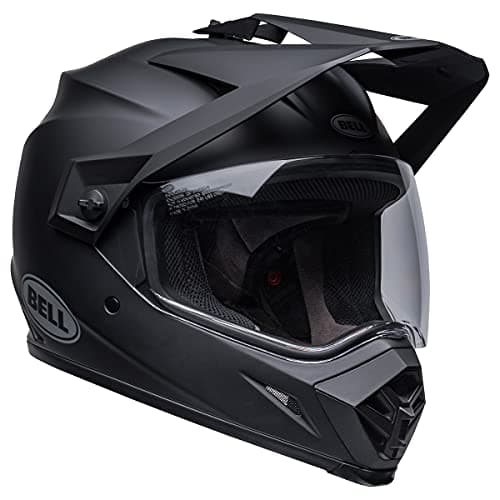
The MX-9 Adventure wins on evidence rather than on feel. It holds DOT, ECE 22.06 and a MIPS rotational-management layer, and it is the only adventure helmet under $500 we can find with an independent SHARP rating - 4 out of 5 stars. MIPS is a low-friction slip plane designed to reduce rotational force, and ECE 22.06 is the standard that added a rotational test, so this helmet addresses the same injury mechanism twice, from two directions. Polycarbonate shell, published ~1,696 g. Who it is for: a rider who wants proof rather than paperwork, and would rather spend the difference on tires.

Detail in the Bell MX-9 Adventure review, the certification breakdown in its safety rating, and the head-to-head most buyers in this bracket need in MX-9 Adventure vs EXO-AT960.

The honest cons. Polycarbonate makes it heavy for the format at ~1,696 g, and it will not feel premium in the hand. There is no drop-down sun visor, so you carry a tinted shield or goggles. The peak generates more lift at highway speed than the engineered peaks on helmets costing twice as much, and the ventilation is adequate rather than good.

Who should skip it: riders who do long highway transit stages every weekend. Peak lift and noise get old fast, and best adventure touring helmets goes after that problem specifically.

2. Scorpion EXO-AT960 - the most helmet the bracket can buy

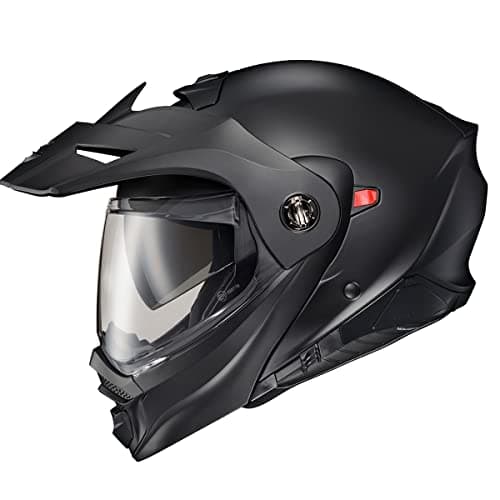
On capability per dollar nothing here competes. The EXO-AT960 is a three-in-one: adventure helmet with a removable peak, drop-down internal sun visor, and a flip-up chin bar, holding DOT plus ECE 22.06 (P/J)in an LG polycarbonate shell at a published ~1,860 g. Peak on for dirt, peak off and chin bar down for a highway day, chin bar up at a gas station - one helmet, three bikes' worth of duty. It is also the helmet we recommend most often to riders buying their first ADV lid, because it does not force a configuration decision before you know your own riding. Who it is for: a one-helmet rider, or a new ADV rider who has not settled yet.

Full write-up in the Scorpion EXO-AT960 review, and the brand question in which Scorpion helmet should you buy.

The honest cons. It is the heaviest helmet on this page at a published ~1,860 g - three mechanisms cost grams and there is no way around it. It has never been SHARP-tested, so unlike the Bell there is no independent data. A helmet that does four jobs does none of them as well as a specialist: it is noisier than a sealed road helmet and heavier than every carbon ADV lid above this bracket. And the sun visor eats internal space for glasses.

Who should skip it: anyone who already owns a road helmet, and anyone weight-sensitive. Read best lightweight helmets if grams are the constraint.

3. Fly Racing Trekker - the cheapest dual-sport with a sun visor

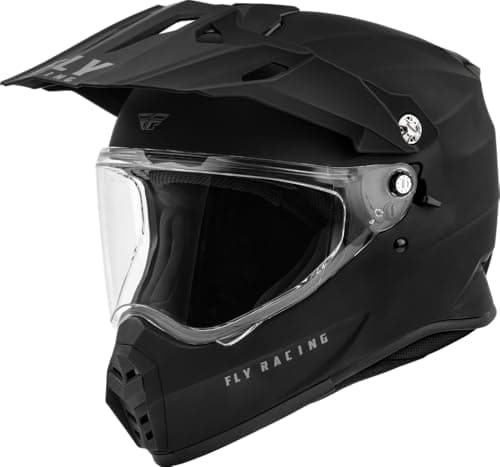
The Trekker is the sensible middle of this shelf: a polymer-shell dual-sport helmet at a published ~1,588 g (3.5 lb) - the lightest helmet on this page - with DOT homologation and, unusually at this price, a drop-down sunshade. For a rider who commutes on a dual-sport through low morning sun and does not want to carry a second shield, that single feature is worth more than the spec sheet suggests. Who it is for: a dual-sport commuter who wants a sun visor and a light shell on a real budget.

Detail in the Fly Racing Trekker review, and the pair comparison in DS-X1 vs Trekker.

The honest cons. Our card records ECE as unverified - Fly does not publish a European revision for the US build, and we will not assert a homologation we cannot source, so you are buying DOT alone. Never SHARP-tested. The polymer shell is the cheapest construction here. And a fitted sunshade plus a peak is a lot of plastic in the airflow: it is not a quiet helmet at highway speed.

Who should skip it: anyone who wants the independently tested standard. The Bell above has ECE 22.06 and SHARP stars for about sixty dollars more, and that is the single best-value step on this page.

4. HJC DS-X1 - the budget pick, and the cheapest way into a convertible

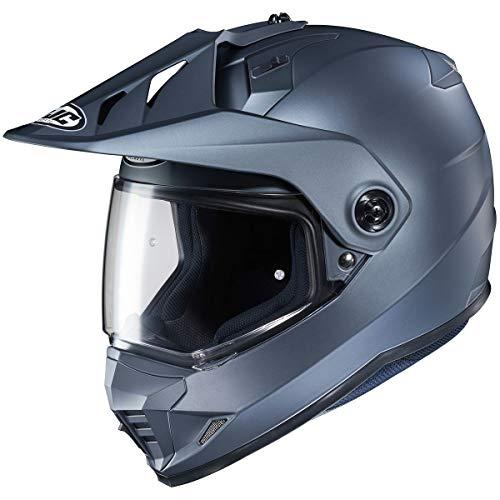
This is the budget pick: the cheapest convertible dual-sport helmet we can document. Polycarbonate composite shell at a published ~1,673 g (LG-2XL), with DOT homologation and a Pinlock-prepared HJ-27 shield - which means you can fit an anti-fog insert rather than fight condensation, and that is rare at this price. Peak and shield both come off, so it runs as a road helmet, a peaked ADV lid or a goggle setup. Who it is for: a rider buying their first dual-sport helmet, or a second lid for a bike they ride occasionally.

Full write-up in the HJC DS-X1 review, and the format question in dual-sport vs adventure helmets.

The honest cons. It is DOT only - no ECE at all, which our card records as a flat no rather than unverified, so it is the least certified helmet on this page. Never SHARP-tested. No sun visor. It is heavy for its price class at ~1,673 g, the vents are basic, and the published weight is quoted for the larger shell, so a small size will differ.

Who should skip it: anyone whose budget can stretch another sixty dollars. The gap between this helmet and the Bell is the biggest single jump in certification anywhere on this page.

What each step up this shelf actually buys

Laid out plainly, because the increments are small and the differences are not:

  • From the DS-X1 to the Trekker you buy a drop-down sunshade and about 85 grams off the weight. You do not buy any additional certification.
  • From the Trekker to the MX-9 Adventure you buy ECE 22.06, a MIPS layer and an independent SHARP 4/5 - the biggest safety-evidence jump on the page, for roughly the price of a tank of fuel and a coffee. You give up the sunshade and gain about 110 grams.
  • From the MX-9 Adventure to the EXO-AT960 you buy a sun visor, a flip-up chin bar and P/J dual homologation. You give up the independent SHARP rating and gain another 165 grams.

Read that list twice if you are deciding between the bottom two. The middle step is where the money goes furthest, and it is the only step on this shelf that buys you evidence rather than convenience.

What $500 does not buy in adventure helmets

Weight, mostly. Every helmet here is between 1,588 and 1,860 g, and the carbon ADV lids sitting just above the cap are 200 to 400 grams lighter - the Klim Krios Pro is a published ~1,450 g and holds ECE 22.06 as well. On an adventure helmet that weight sits further from your head's centre of gravity than it would on a road lid, so the grams matter more here than anywhere else. If your riding is long days in the saddle, the honest advice is to save up rather than to buy twice - start with best adventure touring helmets.

What $500 also does not buy is a quieter helmet. Peaks are noisy, and no helmet in this bracket is sealed the way a dedicated touring lid is. If you ride mostly pavement and the peak is a styling choice rather than a need, dual-sport vs adventure helmets is the page that will save you money.

The verdict

Buy the Bell MX-9 Adventure MIPS. DOT, ECE 22.06, MIPS and an independent SHARP 4 out of 5 is more tested proof than anything else under $500 - and more than any adventure helmet above $500 in our catalog, which is worth sitting with for a moment.

Buy the Scorpion EXO-AT960 if one helmet has to cover commuting, touring and dirt - it is the most capable thing in the bracket and the sun visor alone justifies it for a daily rider. Buy the Fly Racing Trekker if you want a sunshade and the lightest shell here and DOT is enough for you. Buy the HJC DS-X1 if the budget is genuinely fixed - it is a real convertible with a Pinlock-ready shield, which is more than most helmets at that money offer.
The short answer

Quick picks, by the mark on the shell

#HelmetCertificationScorePrice
01
Bell Bell MX-9 Adventure MIPS
Bell MX-9 Adventure MIPS

The rare sub-$300 ADV helmet with DOT + ECE 22.06, MIPS, and an independent 4/5 SHARP score to back it.

DOT certifiedECE 22.06 certifiedSHARP ★★★★☆
8.4
$249.95Amazon
02
Scorpion Scorpion EXO-AT960
Scorpion EXO-AT960

The value ADV pick that still clears the bar that matters: genuine DOT + ECE 22.06, in a modular you can flip open.

DOT certifiedECE 22.06 certified
8.1
$314.95Amazon
03
Fly Racing Fly Racing Trekker
Fly Racing Trekker

The mid-price dual-sport that keeps a drop-down sun visor and still takes goggles — but Fly never publishes which ECE revision it holds.

DOT certifiedECE 22.06 unverified
7.8
$229.95Amazon
04
HJC HJC DS-X1
HJC DS-X1

The cheapest genuinely convertible dual-sport lid we can stand behind — a Pinlock-prepared shield that comes off for goggles, on a DOT-only certification.

DOT certifiedECE 22.06not held
7.5
$189.99Amazon

#ad · Live prices from the Amazon Product API, as of November 23, 2026. Certifications reflect the US-market build and are cited in Sources. Where a live price has rotted, we show none.

In detail

The picks, in full

01
Bell Bell MX-9 Adventure MIPS

Proven safety on a budget

Bell MX-9 Adventure MIPS

DOT certifiedECE 22.06 certifiedSHARP ★★★★☆
Polycarbonate~1,696 gDOT + ECE 22.06 + MIPSSHARP 4/5
8.4/10

The rare sub-$300 ADV helmet with DOT + ECE 22.06, MIPS, and an independent 4/5 SHARP score to back it.

Certification
9.5
Value
9.5
Safety data
9
Weight
7.5
Quiet
6.5

Pros

  • DOT + ECE 22.06 + MIPS at a genuine budget price
  • Independently SHARP-tested at 4 of 5 stars — a rarity in this bracket
  • MIPS adds a rotational-management layer on top of the shell

Cons

  • Polycarbonate build is not the most premium feel
  • Louder and less refined than a Shoei/Arai at speed

Don't buy this if…

…you want a hushed, luxury touring experience — this is a value-and-safety pick, not a plush one.

$249.95View on Amazon

Price as of November 23, 2026. Prices change — Amazon's at checkout is the one that counts.

#ad · we may earn a commission from this link to Bell MX-9 Adventure MIPS

02
Scorpion Scorpion EXO-AT960

Best budget ADV with ECE 22.06

Scorpion EXO-AT960

DOT certifiedECE 22.06 certified
LG polycarbonate~1,860 g (M)DOT + ECE 22.06Modular + peak + visor
8.1/10

The value ADV pick that still clears the bar that matters: genuine DOT + ECE 22.06, in a modular you can flip open.

Certification
9
Value
9.5
Versatility
8.5
Weight
6.5
Quiet
7

Pros

  • Genuine DOT + ECE 22.06 at roughly a third of a carbon flagship's price
  • Three-configuration modular: peak-and-visor, street, or goggles
  • Drop-down internal sun visor most ADV helmets omit

Cons

  • Polycarbonate shell makes it the heaviest here
  • Not the quietest, and the peak adds drag at highway speed

Don't buy this if…

…you ride long highway days and weight or wind noise wear you down — spend up for carbon.

$314.95View on Amazon

Price as of November 23, 2026. Prices change — Amazon's at checkout is the one that counts.

#ad · we may earn a commission from this link to Scorpion EXO-AT960

03
Fly Racing Fly Racing Trekker

Dual-sport riders who want a sun visor

Fly Racing Trekker

DOT certifiedECE 22.06 unverified
Polymer shell~1,588 g (3.5 lb)DOT (FMVSS 218)Drop-down sunshade
7.8/10

The mid-price dual-sport that keeps a drop-down sun visor and still takes goggles — but Fly never publishes which ECE revision it holds.

Value
9
Features
8.5
Fit range
8.5
Certification
6.5
Weight
6.5

Pros

  • A drop-down anti-fog sunshade, which almost no dual-sport helmet at this price offers
  • Shield is designed to accommodate goggles and goggle straps with the shield closed, so you aren't forced to remove it
  • Switchable on/off vents in the chin bar, brow and rear, plus a removable washable antimicrobial liner
  • XS-3XL across 53-66 cm in a round-oval shape — a wide range for the money

Cons

  • Fly doesn't publish the ECE revision, so we can't confirm the current 22.06 rotational standard
  • 3.5 lb in a polymer shell — heavier than the carbon convertibles and heavy for standing on the pegs
  • No published Pinlock provision, so fog management is the sunshade coating and airflow

Don't buy this if…

…confirmed ECE 22.06 is your deciding factor — the Bell MX-9 Adventure MIPS carries it, plus MIPS and a SHARP 4/5 score, for similar money.

$229.95View on Amazon

Price as of November 23, 2026. Prices change — Amazon's at checkout is the one that counts.

#ad · we may earn a commission from this link to Fly Racing Trekker

04
HJC HJC DS-X1

The lowest-cost convertible dual-sport

HJC DS-X1

DOT certifiedECE 22.06not held
Polycarbonate composite~1,673 g (LG-2XL)DOT (FMVSS 218)Pinlock-prepared HJ-27 shield
7.5/10

The cheapest genuinely convertible dual-sport lid we can stand behind — a Pinlock-prepared shield that comes off for goggles, on a DOT-only certification.

Value
9
Versatility
8
Fit range
8
Certification
6
Weight
6.5

Pros

  • HJC's "easy converting system" takes it from shield-and-visor to visor-only for goggles, which is the whole point of a dual-sport lid
  • Ships with a Pinlock-prepared HJ-27 shield — anti-fog provision the cheaper rivals leave out
  • Three EPS sizes rather than one padded-out shell, plus a double D-ring and molded speaker pockets

Cons

  • DOT only — no ECE and no Snell on the US build, so it's the weakest certification on this page
  • webBikeWorld found the shield won't raise high enough to mount goggles comfortably without taking it off first
  • Upper ventilation is the review consensus weak point, and the peak's adjustment range is narrow

Don't buy this if…

…you want more than the US legal minimum on the shell — spend a little more on the Bell MX-9 Adventure MIPS for ECE 22.06, MIPS and an independent SHARP score.

$189.99View on Amazon

Price as of November 23, 2026. Prices change — Amazon's at checkout is the one that counts.

#ad · we may earn a commission from this link to HJC DS-X1

How we picked

We do not crash-test helmets

We compiled published specifications, cited each helmet's certification (DOT, ECE 22.06, Snell, SHARP) from the standards body or manufacturer homologation, and aggregated owner reports, then scored against a published method. The scores are judgments from documented research — not measurements we took. We do not run a crash lab. Certifications reflect the US-market build; where it differs from the European version, we say so and cite it.

Questions

Frequently asked

What is the best adventure helmet under $500?
The Bell MX-9 Adventure MIPS. It is the only adventure helmet we can find under $500 with an independent crash rating - SHARP 4 out of 5 - and it adds DOT, ECE 22.06 and a MIPS rotational-management layer on top. Nothing else in the bracket has been independently tested at all. If you need a sun visor and a flip-up chin bar, the Scorpion EXO-AT960 is the more capable helmet, but it has no independent test data.
What is the cheapest adventure helmet worth buying?
The HJC DS-X1, which is the cheapest convertible dual-sport helmet we can document - polycarbonate composite, DOT, a Pinlock-prepared HJ-27 shield and a removable peak. The honest caveat is that it is DOT only, with no ECE at all. The best-value step on the whole shelf is the one above it: for roughly sixty dollars more the Bell MX-9 Adventure adds ECE 22.06, MIPS and an independent SHARP rating.
Do I need to spend more than $500 on an adventure helmet?
Not for certification. Nothing above $500 in our catalog beats the DOT plus ECE 22.06 plus MIPS plus SHARP 4/5 you can buy at around $250. What more money does buy is weight and noise: the carbon adventure helmets just above this bracket are 200 to 400 grams lighter, and on a peaked helmet that weight levers against your neck all day. If you ride long distances regularly, saving up is better advice than buying twice.
Which adventure helmets under $500 have a sun visor?
Two of the four: the Scorpion EXO-AT960 has a drop-down internal sun visor alongside a removable peak and a flip-up chin bar, and the Fly Racing Trekker has a drop-down sunshade at a much lower price. The Bell MX-9 Adventure and the HJC DS-X1 do not, so with either of those you carry a tinted shield or wear goggles. A sun visor reliably costs 150 to 250 grams, which is why the two helmets that have one are the heavier pair here.
Is a dual-sport helmet the same as an adventure helmet?
No, though the shelf below $500 blurs them. A dual-sport helmet is dirt-biased: bigger peak, longer chin bar, goggle-first, noisier at road speed. An adventure helmet is road-biased with off-road capability: shorter peak shaped to shed air, a face shield as standard, and usually convertible. The HJC DS-X1 and Fly Trekker here are dual-sport; the Bell and Scorpion are adventure. Our dual-sport vs adventure page works the trade through properly.
Does ECE 22.06 matter more than MIPS on an adventure helmet?
They are different kinds of claim and the Bell on this page has both. ECE 22.06 is an independently lab-tested type approval with production sampling that now includes an oblique rotational-impact test. MIPS is a specific low-friction layer inside the helmet designed to reduce rotational force. A 22.06 helmet has been tested against the mechanism MIPS addresses, whether or not it uses MIPS to pass - so 22.06 is the stronger signal, and MIPS on top of it is a bonus rather than a substitute.
Are all four of these actually under $500?
All four were under $500 when this page was built, with the most expensive sitting comfortably clear of the line rather than within a few dollars of it - so this bracket is more stable than our road-helmet brackets. The live price on each card carries the date it was checked, and that card is the authoritative figure, not the headline.

Keep reading

Receipts

Sources

We do not run a crash lab, and we do not pretend to. Certifications are cited to the standards body or the manufacturer's stated homologation; where a US model's certification differs from its European namesake, we say so. Where we could not verify something, we say so on the page rather than quietly leaving it out. Read our full method.