The best modular helmet under $500 is the LS2 Advant X: a forged carbon shell at a published ~1,550 g holding DOT plus ECE 22.06 with a P/J dual homologation - tested and legal both closed and open - with a drop-down sun visor and a Cardo-ready channel. It is roughly 190 grams lighter than any other modular we rate, at any price. The budget pick is the HJC i91, which is half the price and still gives you a sun visor and a Pinlock-ready shield. Who this page is for: a commuter or tourer who wants a chin bar that lifts, a hard $500 ceiling, and a straight answer about which flip-fronts have actually been tested in both positions.
Here is the thing that makes modulars different from every other format. A flip-front has two configurations, and a certification earned closed does not automatically cover open. The European system handles this with a letter on the strap label: P means homologated as a full-face, J means homologated as an open-face, and P/J means the helmet was tested and approved both ways - which is the only honest basis for riding with the chin bar up. Two of the four helmets below carry P/J. The mechanism, and what it does and does not prove, is in are modular helmets safe.
How to read the prices here. We do not print dollar figures in prose, because they go stale and a stale number is worse than no number - the buy module on each pick carries the live price pulled from the Amazon product API, stamped with the date it was checked, and that card is the authoritative figure. All four were under $500 when this page was built, and the winner sits within a couple of dollars of the line, so treat the headline as the bracket we shopped in. We have not worn or crash-tested any of these helmets. What we have done is read what each maker publishes and check whether anybody independent has tested it.
How we ranked four modulars under $500
The criteria, in this order:
- P/J dual homologation, and the ECE revision behind it. ECE 22.06 is independently lab-tested with production sampling and added an oblique rotational-impact test; 22.05 is the older, easier version of the same system. A modular with 22.06 P/J is the strongest claim available in this bracket. Detail in ECE 22.06 explained.
- Published weight in a stated size. This matters more on a modular than anywhere else, because the hinge, the lock, the second seal and usually a sun visor all add grams - and the spread below is over 300 g.
- Shell material, then the mechanism itself. A latch you can work in winter gloves, with one hand, is the difference between a helmet you flip and a helmet you stop flipping.
- Sun visor and comms readiness. Nobody buys a flip-front for track days. These are commuting and touring helmets, and these are the commuting and touring features.
1. LS2 Advant X - carbon, 1,550 g, and 22.06 P/J
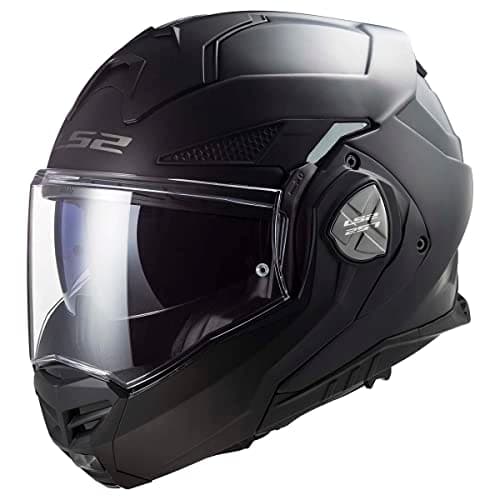
This helmet should not exist at this price. Forged carbon fiber shell, published ~1,550 g, DOT plus ECE 22.06 with P/J dual homologation, a drop-down sun visor and a channel designed around Cardo units. For context: the nearest comparable certification in our catalog is the HJC RPHA 91, which costs substantially more and is about 190 grams heavier, and the premium Shoei flip-front is a US DOT-only build at nearly double this money. Who it is for: a tourer or commuter who wants the lightest flip-front available and the current European approval with it.
Full detail in the LS2 Advant X review, the flagship comparison in Advant X vs Shoei Neotec 3, and the in-bracket pair in Advant X vs EXO-GT930.
The honest cons. Never SHARP-tested - the only modular we rate with an independent star rating is the pricier HJC RPHA 91, and it is heavier. LS2 does not have the dealer network or parts-availability record of Shoei or HJC, which matters more on a helmet with a mechanism than on a plain full-face. It sits within a dollar or two of the $500 line. And the sun visor eats internal space, so check it with glasses.
Who should skip it: riders who want independent crash data on a flip-front, and anyone who wants the quietest modular - that is a different, more expensive helmet.
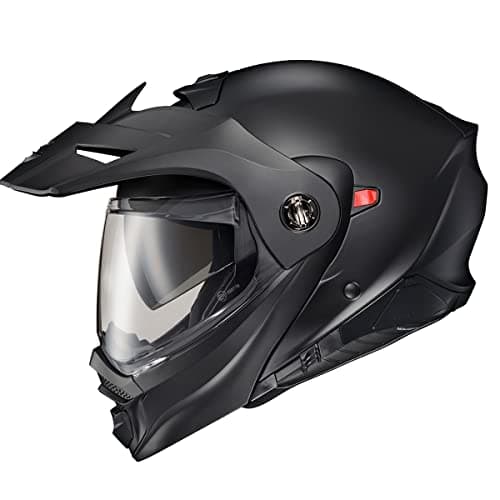
2. Scorpion EXO-AT960 - the modular that is also an adventure helmet
The EXO-AT960 is a flip-front with a removable peak bolted onto the idea, and it is the most versatile helmet in the bracket by a wide margin: DOT plus ECE 22.06 (P/J), an LG polycarbonate shell at a published ~1,860 g, a drop-down internal sun visor and a shell that converts between road modular, peaked adventure lid and goggle setup. If you ride one bike in three different ways - commute, weekend tour, occasional gravel - this is one helmet instead of two. Who it is for: a one-helmet rider, or an adventure rider who also commutes.
Write-up in the EXO-AT960 vs EXO-GT930 comparison and the dedicated Scorpion EXO-AT960 review.
The honest cons. It is the heaviest helmet on this page at a published ~1,860 g - three mechanisms, and polycarbonate is the cheapest shell material here. Never SHARP-tested. The peak is noisy at highway speed even when you leave it on deliberately, and taking it off leaves a shell that is still shaped for a peak. As a pure road modular it is beaten on every axis by the LS2 above.
Who should skip it: riders who never leave pavement. Buy the road modular and save 300 grams.
3. Scorpion EXO-GT930 Transformer - a flip-front that becomes an open-face
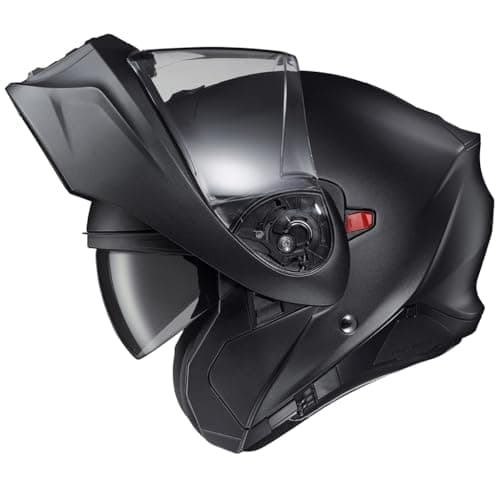
The EXO-GT930 does something genuinely different: the chin bar comes off entirely, so the helmet converts between a full-face and a proper open-face rather than just lifting out of the way. DOT plus ECE 22.05 with P/J homologation, polycarbonate shell at a published ~1,890 g (XL), and a drop-down sun visor. For a city rider who wants a chin bar in winter and an open face in August, this is the cleanest solution in our catalog. Who it is for: a commuter who genuinely rides in both configurations and wants one helmet for both seasons.
Detail in the Scorpion EXO-GT930 review, and it leads our open-face roundup on exactly this basis.
The honest cons. It is ECE 22.05, not 22.06 - the older revision, without the oblique rotational test, and that is the reason it ranks below the two helmets above rather than its features. It is the heaviest published weight in our modular catalog at ~1,890 g in XL. Never SHARP-tested. And the convertible design means more seams and more wind noise than a fixed shell.
Who should skip it: anyone who will never actually remove the chin bar. You are carrying the weight and the seams for a capability you are not using - buy the LS2.
4. HJC i91 - the budget pick, and the most comfortable of the four
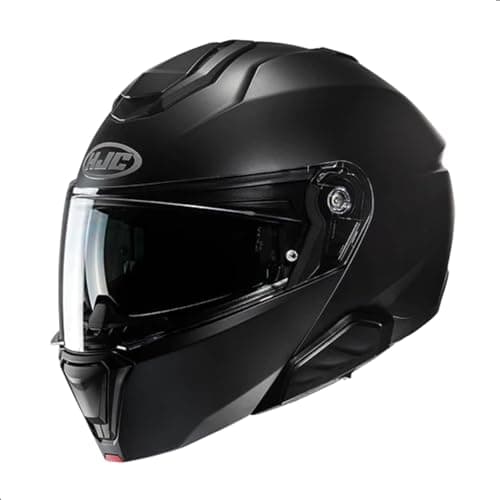
This is the budget pick: the cheapest modular we can document, at half the price of the winner, and the one riders most often describe as simply comfortable. Polycarbonate composite shell at a published ~1,720 g (M), with DOT homologation on the US listing, a drop-down sun visor and a Pinlock-ready HJ-33 shield. The interior is roomier than the rest of this page, which is why it leads our big-heads roundup and appears in our helmets for glasses list. Who it is for: a commuter on a real budget, a rider with a wide or large head, or anyone who wears glasses under a helmet.
More in the HJC i91 review and the step-up question in i91 vs RPHA 91.
The honest cons. Our card records ECE as unverified on the US listing and no P/J dual homologation - so on the one claim this page is actually about, it is the weakest of the four, and we are not going to dress that up. Never SHARP-tested. It is heavy for the money, the shell is polycarbonate, and the latch is the least satisfying of the four to operate in gloves.
Who should skip it: anyone buying a modular specifically because they intend to ride with the chin bar up. Without a documented P/J approval, that is a configuration nobody has tested - buy the LS2 or the Scorpions.
What the flip-front mechanism costs you
Worth stating plainly, because it is the trade every modular buyer makes without being told. Across our catalog, flip-fronts run between about 1,550 and 1,890 grams while comparable full-faces run between about 1,255 and 1,600. You are paying 150 to 300 grams for the hinge, the lock, the second seal and the sun visor, and you are adding seams that leak wind noise. That is the price of being able to drink a coffee, talk to a gas-station attendant or cool off at a light without taking the helmet off, and for a commuter it is routinely worth it.
What it does not cost you, if you buy a P/J helmet, is certification. That is the whole point of the label - and it is why the two cheapest helmets on this page are ranked the way they are. The format comparison in full is modular vs full-face helmets.
The verdict
Buy the LS2 Advant X. Forged carbon at ~1,550 g with DOT, ECE 22.06 and P/J is the best flip-front certification-and-weight combination at any price under $500, and it beats helmets at twice the money on paperwork.
Buy the Scorpion EXO-AT960 if you want one helmet for road and dirt. Buy the Scorpion EXO-GT930 if you genuinely want a full-face that becomes an open-face. Buy the HJC i91 if the budget is fixed, your head is wide, or you wear glasses - just understand you are buying DOT and a sun visor rather than a tested open-position approval.
And if the ceiling can move: the HJC RPHA 91 is the only modular we rate with an independent SHARP rating (4 out of 5) on top of ECE 22.06 P/J, and it sits just above this bracket. It is the first thing worth saving for.